Cedar Ridge, Nevada County

What is the area called Cedar Ridge? Good question and kind of funny. The official zip code for Cedar Ridge is 95924. The post office (see picture) is the only piece of property in Cedar Ridge that has that zip code. All of the immediate area around the post office is listed as Grass Valley, 95945. My office is across the street and I can’t get mail delivery because they don’t deliver mail out of the post office! They do give me a free PO Box though.
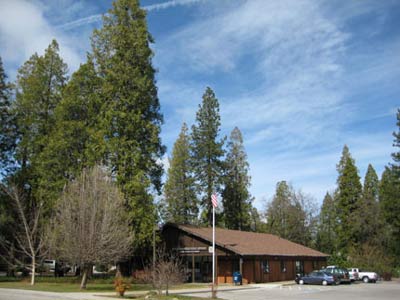
Cedar Ridge Post Office

The Cedar Ridge Post Office, the only area with the 95924 zip code. The area around the post office is Grass Valley, 95945

The best information that I can find is that way back in the 1870’s a man by the name of George Kress bought two hundred acres which became known as Kress Ridge. Kress Ridge was a stop for the now demised Nevada County Narrow Gauge railroad. They had a post office then as now. The name changed in time to Cress Ridge, Cedar Cress and is now our present Cedar Ridge
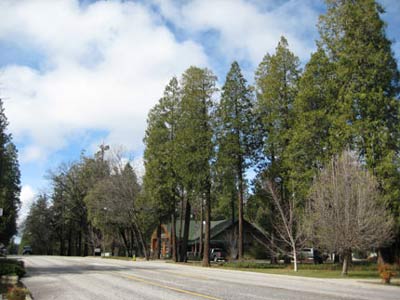
Cedar Ridge Fire Station

The Cedar Ridge Fire Station. With a modern fire station, fire engines and paid fire fighters.

It’s a beautiful area, with many cedars (of course) and pines at an elevation of around 3,000 feet. There is a post office, a fire station, a service station, a grocery store, a beauty shop and of course my office. Located on State Highway 174, between Brunswick Road and Grass Valley in Nevada County, be sure not to blink as you drive by, you might miss us
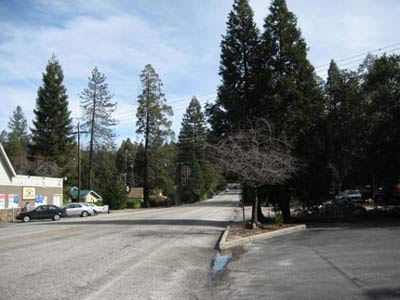
Hwy 174 Cedar Ridge
Hwy 174 Cedar Ridge

Looking at Highway 174 in the direction of Brunswick Road.

Now don’t get me wrong, just because we really don’t know where Cedar Ridge ends or begins, there are many fine homes in the area around the post office. There is a wonderful subdivision called The Cedars, with many fine homes ranging into the million dollars plus category just a very short distance away. There are also many homes near by with beautiful forest settings. It is a very desirable area to live in and commends a higher price for homes then some other areas of Nevada County.

If you have information on Cedar Ridge, please e-mail me.
Last Day In Buenos Aires

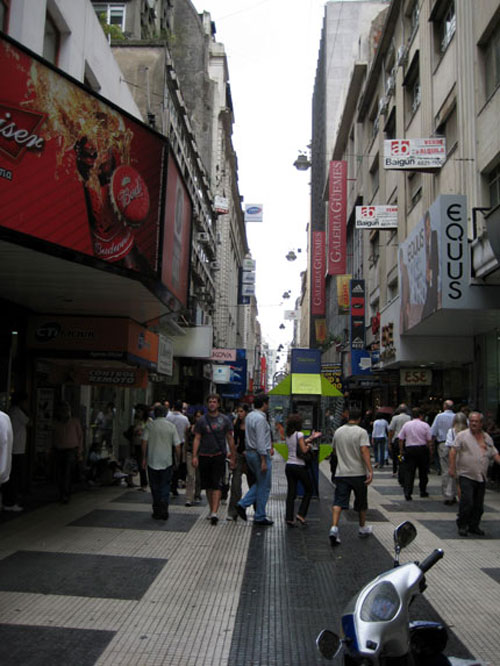
Our last day in Buenos Aires was Saturday February 9. My observation of the City this time from the sights of my trip here two years ago is that there are profound changes happening. Some of the changes are good, such as the majority of the stores are not locked now. When we were here two years ago, almost all restaurants and small shops were locked and you had to ring a bell to get in. There are still guards or security in a majority of the stores, but they’re not locked. You have to realize that starting in 1980 until 2001 there was huge unemployment and a large majority of people could just barely survive and as in all countries when times get bad, the crime rate goes up.

Florida Street, an upscale shopping area
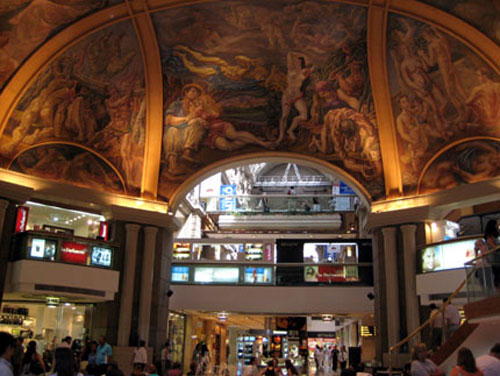
Inside shopping mall

Inside Galerias Pacifico located on Calle Florida, one of the most famous shopping malls in Buenos Aires, designed to recall the Galeria Vittorio Emanuele II in Milan, Italy, with it’s long halls, glass cupola and several tiers of shops. The frescoes were painted by local artists.

Another change is that a lot of the stores and restaurants and shops prohibit smoking, although a large majority of people seem to smoke. Now a lot more stores are taking credit cards and there are constant ads trying to get you to get cards. Two years ago, it was hard to find a store that would take a card. People here like to deal in cash, since a national sport is to avoid taxes, which is currently on twenty one percent value added tax basis.


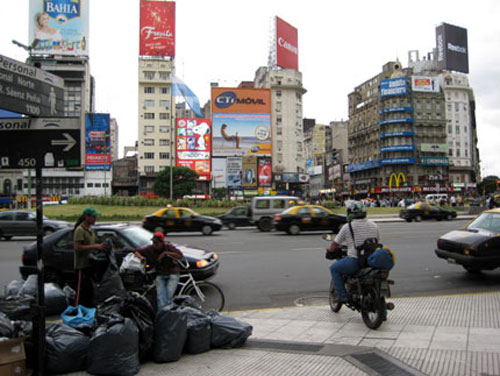
The bad is that there are a lot of fast food junk shops such as McDonald’s and Burger King. I counted two McDonald’s within one block and a Burger King thrown in the middle. In addition, it seems like a large majority of the people drink Coca Cola with their meals. I don’t recall seeing many overweight people last time, but now, according to the local news, sixty percent of the people are overweight and you can see it. It seems like the junk food boys are carpet bombing the world with their garbage.

The curse McDonalds & Burger King junk food

You can see a large McDonalds sign on the right, then one on the far left with a Burger King in the middle. The men in the forground is an outgrowth of the unemployment, they started making a living by collecting paper from garbage thrown away and continue to this day.

There is even a McDonalds in the Jewish District which serves kosher food, the only one in the world outside of Israel. However, if you want a big mac with cheese, which is a no-no in kosher food, all you have to do is turn around and there is another McDonalds and another one downstairs serving the super size me meals. (If you haven’t seen the movie, Super Size Me, about McDonalds, you have missed a great movie about fast foods.)

Also last time almost every woman wore high-healed shoes (despite the horrible sidewalk conditions.) In the intervening time there has been an invasion of flip-flops and now they are everywhere, women wear them with nice dresses now. Also I think it is much more informal in dress now, we saw many more shorts on women, however the tops continue to be let us say “revealing” of womanly charms, which I appreciate. And the pants are painted on in some cases.

It has been a great trip, the people are friendly and it’s easy to find a good cafe or restaurant with great food no matter where you go in the City. We stayed in the Microcentro area, which is a nice part of the City but very busy and lots of traffic. But next time we will go back to the Belgrano area where we stayed last time, a more friendly, residential neighborhood. It has a lot of clothing and other shops that have great prices because they cater to the locals, rather then the tourists.

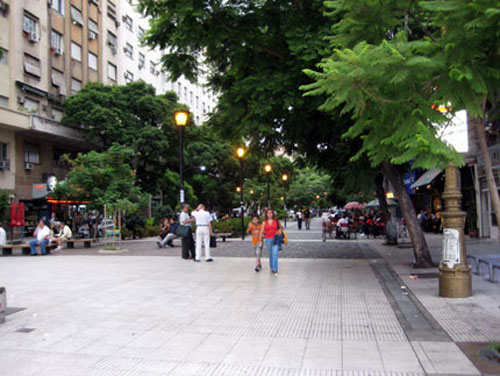
One of the many beautiful streets in Buenos Aires

A nice area to sit, notice all of the cafes with outside sitting

La Boca Area Buenos Aires

La Boca, meaning in Spanish, the mouth, is the area of Buenos Aires that Italians migrating to Buenos Aires in the 19th and 20th century settled into. The area was named La Boca because of the natural shape of the harbor formed by the River Rio Riachuelo bending and flowing into the Rio de la Plata creating what appears to be a mouth.

The area is difficult to get to using the Subte, so John and I bought a guide to the collective; the huge city bus system that criss-crosses the city. (Getting there was easy, getting back a little more difficult as we were standing on the wrong street for the return buses to our area. But here are almost no bus signs (let alone street signs), you just have to go stand where other people are standing; if they look like they are waiting for a bus!!)

Street Scene
Street Scene

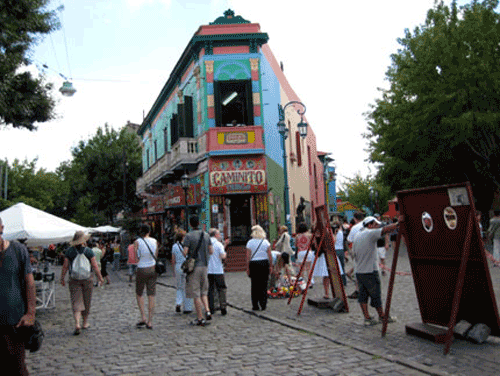
The vendors have painted the area to recreate the early days of the area.

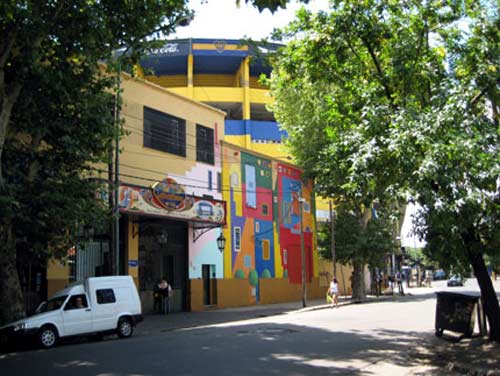
The first thing you see is the huge stadium for the Boca Juniors. And the people in the area have a fervent; most would say fanatical; identification with the team. Soccer memorabilia and T-shirts are everywhere.

Soccer stadium in background

Anyway, the first Italian and French immigrants built boarding houses haphazardly with metal sheeting called “conventillos”. These were decorated with whatever paint was left over on the docks, creating a mish-mash of colors on each building. The colors can be inviting, but the poorly insulated buildings can be unbearably hot in the summer and frigid in the winter. It was fine the day we were there, even though it is summer here, maybe mid-80’s.

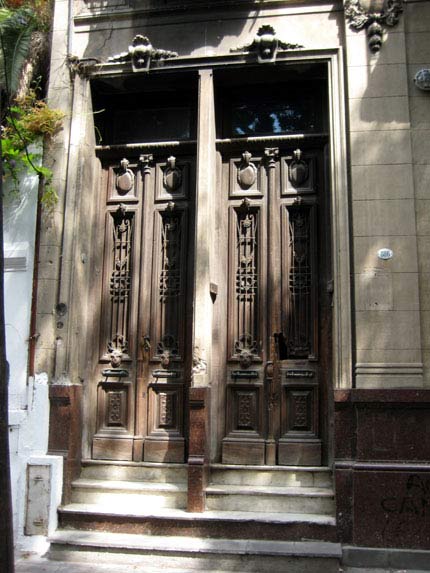
On of many beautiful doors in Buenos Aires

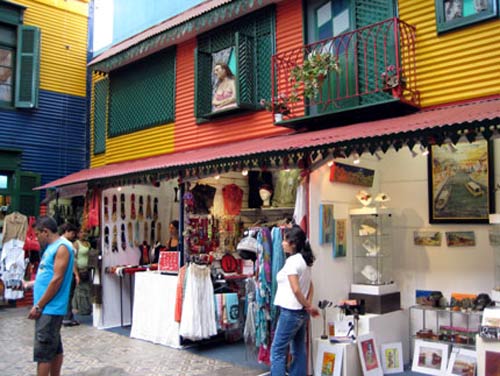
On a Saturday (when we went) it is very busy and touristy. We saw a lot of interesting things, and spent a couple of hours in an on street cafe, enjoying the dancing and singing of a local tango troupe. Lots of little stores, artists, and street vendors we did a good bit of shopping there.

Colorful shopping area

Colorful vendor area

Tigre Area Buenos Aires

A train ride to the outer reaches of Buenos Aires (made a little longer than necessary because John and I didn’t know we had to switch trains in the middle until we had reached some other end destination). Then a switch to the new, obviously touristy “Tren de La Costa” Stopping at 7 or 8 little beach towns along the edge of the delta, north of Buenos Aires. Very nice real estate.

Tigre is one of the most popular weekend destinations from BA, on the banks of the lush jungly banks of the Delta of a lot of different rivers. Arriving, and avoiding the El Parque del la Costa (sort of an Argentine Disneyland/county fair combo) and the big Casino at the end of the line we walked in a discovered a very cute little town. We located a B & B to stay at (an OLD family home where the Grandmother rents 4 rooms a night to tourists) for 150 pesos (less than $50 US)

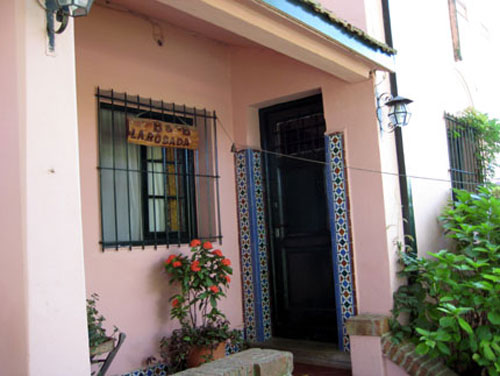
Bed and breakfest Inn Tigre

Typical treatment of many houses in area, with ornate treatment of front entries.

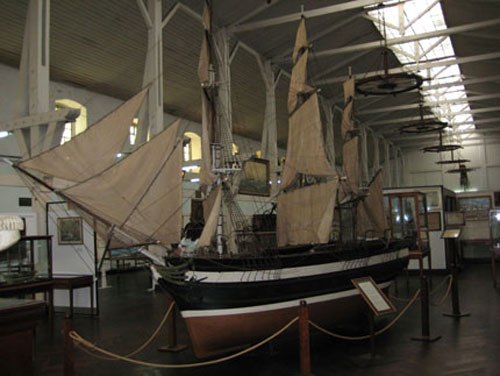
Walking, seeing the sites, visiting cafes and of course eating the great food. The next day we did some museum visits (the fantastically detailed Museo Naval, covering the origins of boat, Argentine navy merchant museum, lots of model ships, and relics from many old ships The outside display included relics of the Falklands Islands (Here called Malvinas Island) conflict with the British.

Model ship in Museo Naval

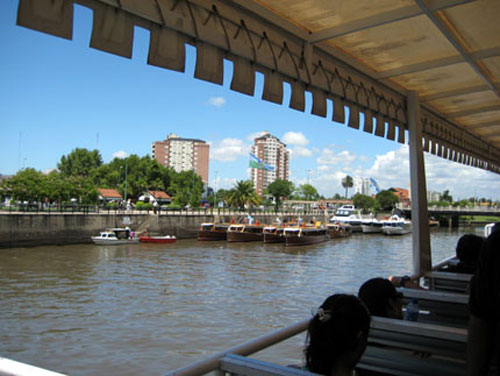
Then we were of on a 2 hour luxury cruse of a small portion of the huge delta, thousands of islands, waterways, summer homes, resorts, camping, restaurants and natural reserves. Really fantastic and relaxing. Next trip we are spending at least a week in one of these isolated resorts (I have the map, web sites and the phone numbers now!)

View delta Tigre
View delta Tigre

Looking out from the dining section of the catamaran. Great food by the way!

We passed (rapidly) through the smoky Casino and had a nice visit to the HUGE artisan and. fresh fruit fair, Puerto de Frutas. Handcraft wicker furniture and basketry (with river reeds and trees) are the specialty, and unique to the area.

Subways of Buenos Aires

A great way to get around Buenos Aires is on the subway or as they call it here the Subte. There are five lines A, B, C, D and E. You can get a map of the lines at the airport showing the routes. It’s cheap, thirty two cents per ticket when you buy ten at a time.

They were built at different times, by different regimes, and each has its own personality. Even the tiles in the halls and stairwells on the way down show the differences.

The Linea A is the oldest, and least decorated, although the wooden carts are works of art in their own right.

Linea B is the newest and most comfortable cars; it is also short on decoration.

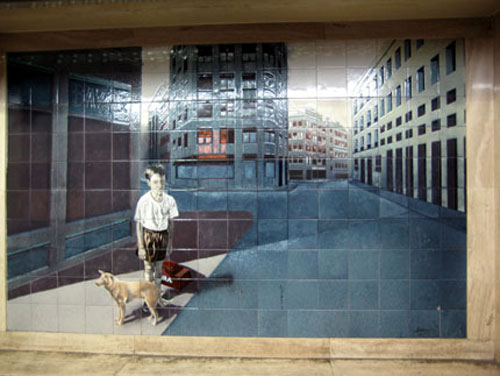
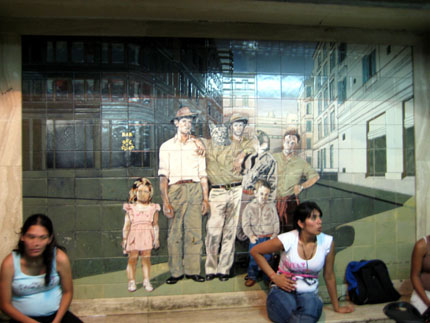
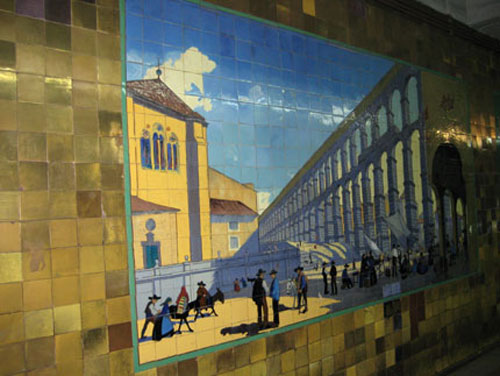
Linea C is the Linea de los Espanola, with ceramic depictions of landscapes from Spain. In the Retiro station there are three murals by Fernando Allievi: Saturday Story, the outing of a family, First Light, a bedraggeled shoeshine boy, and La Mascara (the Masks), unfortunately, the picture I took of Saturday Story came out blurred. One problem with the Cannon SD750 camera that I use, there is no anti-shake control.

The Sunshine Boy
The Sunshine Boy
La Mascara (The Masks) Notice the faces in the pictures

Linea D has more nationalistic depictions, the line opened in 1937, there are more depictions of the Spanish civil war and the Military regime then ruling Argentina.

Linea E opened in 1944, the time of the rise of Juan and Eva Peron, even more nationalistic times. Estacion San Jose has depictions of national treasures like Iguazu Falls.

Spanish Village Segovia

A depiction of life in a small Spanish Village Segovia, with Roman influence (Line C)