Journey to Purmamarca

The next day we started on an trip to Purmamarca, pretty much due north of Salta. But we went the long way around first , to the north west of Salta. We started by following the famous narrow gauge railway called Tren a las Nubes (the train to the clouds).
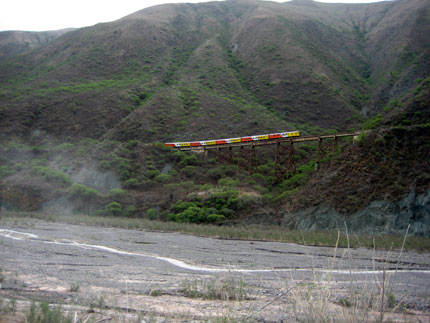
Train to the Clouds

If you do want to take the train, it is a full fifteen hour trip from Salta and back again. But we were in a van and only followed the train for a few hours. Along the way, we watched the train when it came to an area that the train had to come to complete stop, back up to another track going up hill, raising as it backed up, then going forward to a higher track. This was the only way it could climb the mountain. The construction of this railroad is an engineering feat and took twenty years to build, constructed by men with only basic tools through almost impossible conditions, detonating rocks and cutting away steep mountain sides through howling winds and snow.
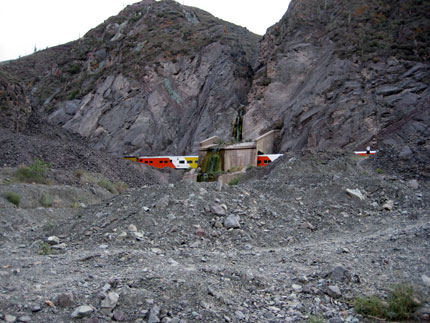
Train going through small tunnel built to have water diverted over tracks

This small tunnel was constructed to have the water from the mountains go over the track, otherwise washing out the rails.

We arrived at San Antonio de los Cobres where the land changes dramatically to the high desert puma (a lot like Nevada). This was a simple former mining town of low adobe buildings in very poor condition in the middle of a dry dirt valley.
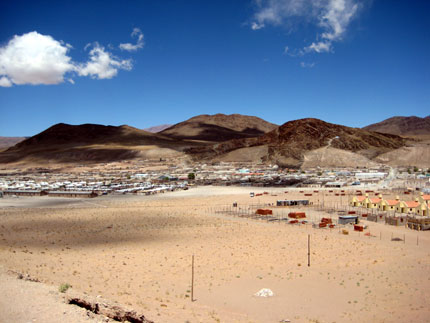
Town of San Antonio de los Cobres

We left that town after a quick tour with no stops(!) and went to a settlement truly in the middle of nowhere, which was founded by a man who had a vision to be self-sustaining and to have a place for tourists to stop and have lunch. He had many children and has since, with them, built many buildings all of them of adobe. He has even constructed a church and museum. He has goats, chickens, llamas, a hot house for fruits and a garden to grow their own vegetables.. There was a solar oven, one small solar panel for electricity, a homemade cell phone antenna… and basically has done quite well if you like to be with your family 24/7 and work seven days a week from sun up to sun down.
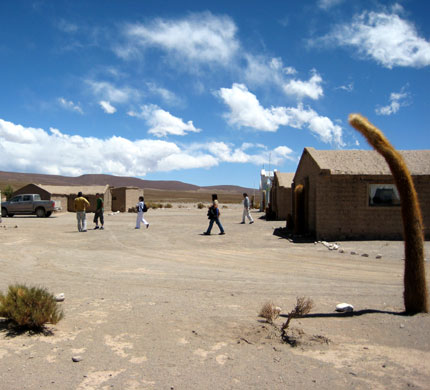
Small Town near Salinas Grande

We had a very nice lunch there, family style, with a stew (of an unknown type of meat), vegetable soup and fruit desert. The restaurant held maybe 40 people, and was really quite nice. The tables we ate at were made of SALT (more on this later).

After lunch we proceeded down Highway 40 to Salinas Grandes (Great Salt Lake). This is an area that was once the Pacific Ocean, but due to past uplifting of the earth and volcanic eruption, it left a large area of the ocean to slowly The ocean evaporated leaving a large salt and mineral deposit. the thickness of the salt and mineral deposits range to from 1 to 3 meters. There are artisans carving figures and even huge sculptures (and large rectangles for shelves and tables) out of the salt.
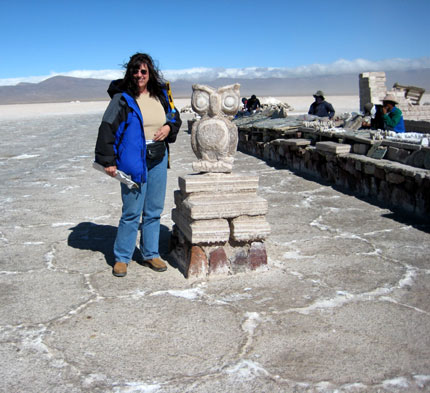
Salinas Grande

Water is still found when a hole is cut on the surface to about 8-10 inches below the surface. When this is done, the hole is left open for the winds to blow minerals into the pool, which then forms new crystals, and then is mined and sold. But for every 1000 Kilograms (or 2200 pounds) of salt the natives only get 18 pesos, or about $6.00 US from the Government. By the way, the winds blow constantly. And we were there on a good day which was blowing really hard.
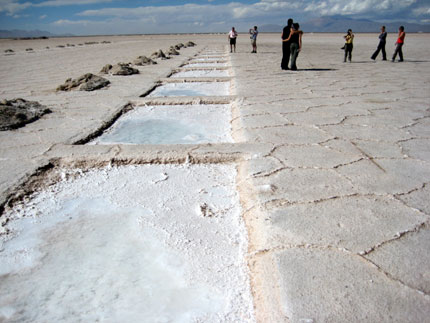
Salinas Grande Pits

From there we went over some mountains, and down into a valley which held one of the cutest towns we had seen so far, Purmamarca. There we spent the night in the motel La Conarca in a suite/rooms that looked like it could belong to Worldmark or RCI travel corporations, really nice, and brand new. We bought a lot of gifts in the local market around the square, the best deals we had found.

Purmamarca is surrounded by mountains of seven different colors as you can see from this photo:
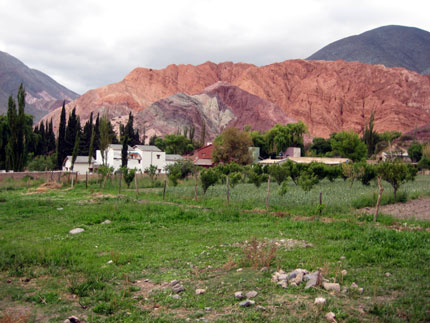
Mountains of Seven Colors

John O’Dell is a licensed civil engineer, general contractor and real estate broker. Judy Pinegar is Wavier Officer for the Department of Education. Your comments are welcomed
Journey to Cachi

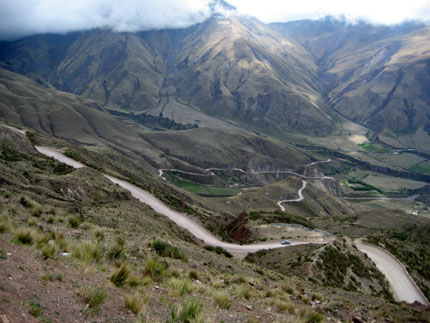
On Tuesday the 18th, we took a tour to Cachi, southwest of Salta. The drive is through a valley and raises to about 5,000 meters (Salta is at 1200 meters). The drive is one of the most unforgettable drives in Argentina. I know that Judy and I will not forget it, with a gravel, narrow, twisting road with many switch backs. The altitude raises quite rapidly and the vegetation changed as we got into the high desert.

Road to Cachi
Road to Cachi

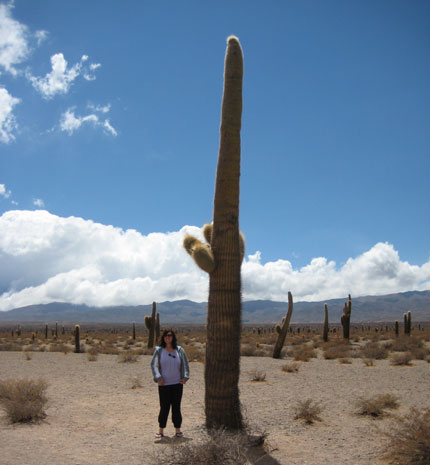
As the journey continued, we went through Parque Nacional Los Cardones which has huge candelabra cacti. According to our tour guide they only grow less then one centimeter per year and since they grow to about 6 meters that would make some of them about 600 years old.

Cacuti
Cacuti

Judy standing by the side of one of the many cacti in the area

We arrived at the town of Cachi, located in a wide green valley. Cachi was founded in 1694 by the conquering Spanish. Prior to that time, it had been an Indian settlement long before the conquering Incas arrived in 1450, and the irrigation channels constructed by the Incas are still in use today. They grow a lot of red peppers and after the summer they are spread on the ground in huge patches to dry. But it was only spring time now, and the wet season has not started.

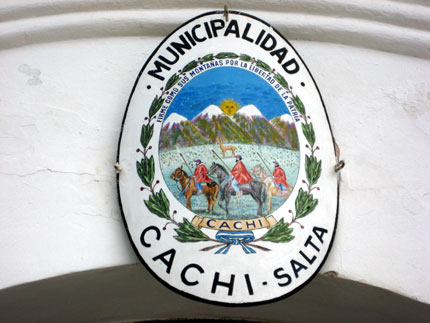
Cachi-Salta City Hall

It is nice place to stay for a few days, as it is very quiet, not too touristy, and very inexpensive. There is no wi-fi, not sure that there is television available, but other than that, it has all modern conveniences.

Street scene
Street scene

Street scene in Cachi

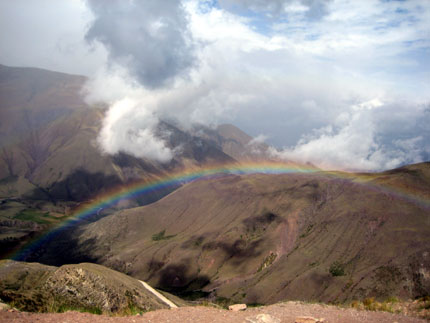
Our trip back down the mountain was a little hair raising and the tour group cheered the driver when we got down to the flat lands again in one piece. Luck was with us in the form of a rainbow!

Rainbow
Rainbow

John O’Dell is a licensed civil engineer, general contractor and real estate broker. Your comments are welcomed

Back To Argentina

I’m starting in the middle of our journey to Argentina this time, about a new area we visited. I wrote quite a bit of about the City of Buenos Aires on our last trip to Argentina in January, February, 2008.

We arrived in Buenos Aires on November 8,2008 and our trip out of town was on November 15 to the northwest of Argentina, bordered by Bolivia to the north and Chile to the west. We arrived in the city of Salta by overnight bus. The bus we took was luxurious with seats that flatten into a bed with blankets and pillows. Provided on these buses are a snack, dinner with wine, an after dinner drink, and breakfast in the morning.

Salta is both a province and a city. The providence of Salta has an extraordinary range of landscape from puma (high desert) populated only by llamas and a few other creatures, to the cloud forest and from hill sides of pink rock where cactus thrive, to valleys irrigated by the Incas of the past to produce scarlet fields of red peppers. The irrigation system developed by the Incas are still in use.

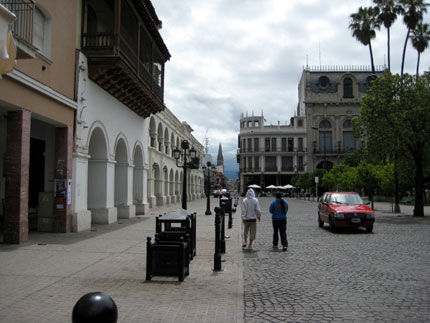
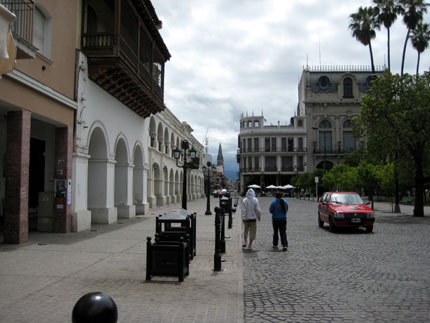
Street scene City of Salta

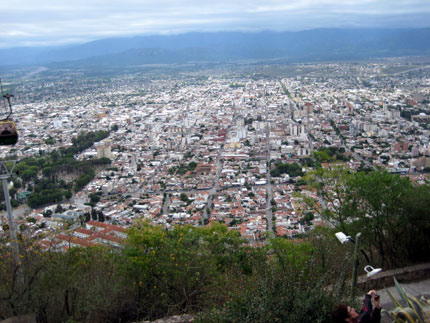
The City of Salta is at the heart of this province in the broad Lerma Valley with a background of dark green hills. Salta was founded in 1582 and became a strong hold for the Spanish which conquered the native and Inca population.

Over looking City of Salta

There is an active night life and the architectural is from the colonial period. Things are much cheaper here than Buenos Aires. We spent the first few days walking to the multiple museums which contain much of the history of the area. We took a tour of the city but learned much more of the city by just going out on our own, which seems to be the case in most city bus tours that we have taken.

One of the things that we liked the most was a gondola ride to a top of a mountain to a place called Cerro San Bernardino from which you can see most of the city. The cost was ten pesos (about $3 US) and is well worth the ride. One of the nicest museums was the Museo Antropologico which contains relics from the pre-hispanic cultures of the area. It was at one time considered by the natives that to have a flatten head front and back was a sign of higher intelligence. So in order to achieve that, they tied boards to the front and back of their heads to flatten the the skull as the children grew. Several of those skulls are on display along with a well preserved mummy.

By the way, people drive here like there is no tomorrow. Cars come to intersections and it seems like whoever gets there first wins. As in most parts of Argentina, stop signs are suggestions to slow down, double yellow lines means you can pass anytime you want or to drive in either lane. Pedestrians are someone to avoid hitting but not stopping for.

John O’Dell