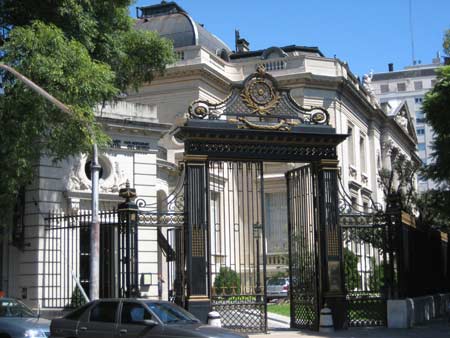
Friday I went to the Museo Nacional De Arte Decorativo or National Museum of Decorative Art. First an update of what’s happening here. The peso was propped up Thursday by the Central Bank and state run banks as they heavily intervened in the market to stop the peso from further weakening. The US gained two cents on the peso Friday, its highest value since 2002. When the banks offered $100 million dollars of its reserves, the peso settled at 3.622 pesos to one dollar. It’s the pesos lowest level since November of last year.
If you think that your credit card interest rate is high, how about the interest rate for commercial construction in Argentina?Argentine President Christina Ferandez complained about “the usurious interest rates” banks are charging private companies for infrastructure works. “Local banks have offered rates of up to 40 or 41 percent” she blasted.Of course Argentina is presently having a 20 percent inflationrate andreal estate in Argentina is bought for cash, no low down payment and 30 year mortgage.
Back to the museum, the original structure was built by Mr. Matias Erazyriz and his wife Mrs. Josefina De Alvear. They resided in this huge palace with their two children.The palace was the hub of many major social events until Mrs. Alvear passed away in 1935.The remaining family sold the palace along with the art collection to the Argentine Government shortly thereafter.
The museum is huge, with four floors and a basement that was used for servants, boilers and garage. The museum holds over 4,000 exhibits, some dating back to the 15th century.It is well worth going to this museum if you happen to be in Buenos Aires. Just the workmanship of the building itself is worth the trip. The museum is located at Av. Del Libertador 1902 in Buenos Aires. Their website is Nacional De Arte Decorativo
So I called the bank again, after paying to rent a computer to get all the information the previous agent wanted. I gave a new agent my card number, social security number and said, now do you want my mother’s name, my address and she cut me off and said “Oh, no you’ve given me enough information.” (Grrr!) She got off the phone for a few minutes, came back and said they were upgrading my card, which was the problem, they were taking care of the problem now and I should be able to use my card in a few hours.So today, I was able to use my card, its fun dealing with a bank, NOT!
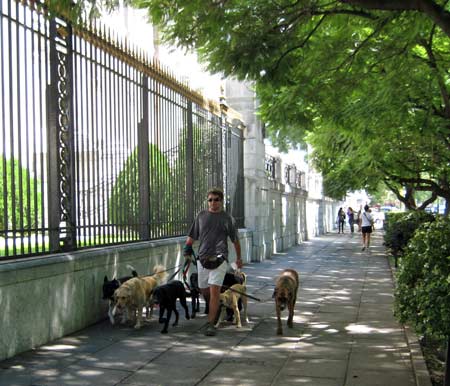
Professional Dog Walkers, There are many of Them in Buenos Aires
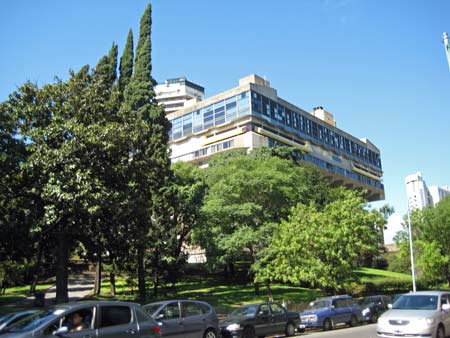
National Library
Prior to traveling abroad, I advised my bank that I was traveling to Buenos Aires. What a surprise when I went to draw out some money and my card was rejected!Calling the international toll free number listed on the back of my card, (which does not work here in Buenos Aires),I was asked for my card number,my social security number, my address, my mother’s name, and then what was the last deposit or what was the last expenditure or my account number.After 10 minutes, having none of that information, I gave up, went on line and got all the information that the agent for the bank requested.
There was a very interesting article in the Buenos Aires Herald today by James Neilson. The Herald is a news publication printed in English and you can usually get one at the numerous newspaper stands on the streets of Buenos Aires.
Mr. Neilson points out that we are in a better position to pull out of this recession quicker and healthier then Europe, Japan, China or Africa. If you notice, our dollar continues to gain strength against the Euro, the Yen and almost all other currencies of the world.
In his article, Mr. Neilson states in part:
“But bad as the situation in the US undoubtedly is, elsewhere it is even worse. That is one reason why in these troubled times jittery investors want to get their hands on dollars. Another is that, no matter what happens in the next year or so, the medium-term prospects facing the US are far more promising than those of Europe, China or Japan, to name just three possible alternatives. This being the case, it is somewhat premature to speak of the imminent end of US economic hegemony and its replacement by a more equitable arrangement involving at least half a dozen other countries. “
Mr. Neilson goes on to explain the problems that Europe, Japan, Russia, China, Africa and South America are facing. Problems that is severe with no easy or probable solutions for them.
For example, Mr. Neilson says about China and summary:
“China’s outlook is only marginally less alarming than that of Europe and Japan. Thanks to the one-child policy, before too long there will be a huge number of single men who will be expected to support their aging parents. Many will not take kindly to the idea. Though China is bursting with talented people who, unlike so many of their North American and European contemporaries, are willing to study and work as diligently as any Victorian, before that immense human capital can be properly tapped China’s rulers must find a way of maintaining social discipline during slumps like the current one. That will not be easy. Before everything went haywire, Chinese officials insisted that their country’s economy would have to grow by at least 8 percent a year simply to provide enough work to satisfy the millions who were leaving the poverty-stricken countryside. China’s GNP may still be increasing, but at an annual rate that by all accounts is far lower than 8 percent.
As a result, if the recession, or depression, lasts as long as pessimists fear, the US will in all probability emerge in far better shape than any of its hypothetical rivals. With this in mind, it is quite natural for Asian, European and Latin American investors to put their money on the US dollar rather than on the Euro — which may not survive the mayhem — the battered pound sterling, the Swiss franc, the yen, the yuan or even the peso. The US may be groggy and could soon hit the canvas, but it would be less likely to remain there for longer than the other big countries that would go down with it.”
First a little update as to what’s happening in Argentina.It’s raining here now which is a relief because just like us in California they are having a drought. My understanding is that it has been so dry that they have lost over 800,000 head of cattle. The government, along with the drought is putting Argentina once the third leading exporter of beef in the world to seventh in the world.(BBC News) Since Judy and I were down here in November of 2008, the peso has depreciated from 3.40 pesos to 1 dollar, to the present time of 3.70 pesos to the dollar.
Everyone I talked to down here blame the recession on America’s and Europe’s ability to borrow money to buy houses with a low down payment and to have a thirty year mortgage. They say that cannot happen in Argentina because there, everyone pays cash for their homes. Paying cash for their homes assures them that they will not lose their homes to foreclosure.They said if we had paid cash for our homes, we would not be in this real estate melt down.
In Argentina there is only one way to buy a residence and that is strictly cash. You offer fifty percent down and on closing you put up the other fifty percent.There are no title companies there; you rely on a notary to assure you that you are getting a clear title to the property that you are buying.He or she is insured and they charge two percent of the purchase price for their service.
For them, it limits their market tremendously, only those that can afford to raise cash in the amount of $90,000 to $500,000 can afford to buy a home. (About the going rate in Buenos Aires for apartment condominiums)
It is hard for the Argentineans to see the advantages of being able to borrow money to buy real estate, since all they read about and see is the news about foreclosures, here in the United States and abroad. They are not aware of the greed of the banks and their CEO’s that led to this present crisis. Their qualifications for a loan were simple, they put a mirror in front of a person’s nose and if they detected that the person was breathing, the loan was approved.
Of course paying cash also limits your market, since so few here in Argentina (And the United States) can afford to raise that kind of cash. Even now, in the United States, our ablity to borrow money is what will pull us out of the housing crisis. First time home buyers, real estate investors, almost all of them rely on borrowed money.So we still have in my opinion, the best system in the world. Borrowed money has made a lot of people wealthy and provided homes for the majority of people in the United States. In contrast, the real estate market is flat in Argentina, since no one is spending money and the majority of the people do not have the resources’ to buy a home.
Containing on from my last post, I boarded an American Airline 777 for a nine hour and forty four minute flight to Buenos Aires. I asked my agent who booked my flight to get me a seat next to the emergency exit as you have more room to stretch your legs. Instead, she booked me a seat ahead of the exit and in the middle row!
Now you may not know this, but when manufactures’ design airplanes, they spend thousands of hours designing the seats, using live people for testing, computers and engineers with PHD’s. When they find just the right amount of leg room so that people can barely get into their seats and when they find just the right angle for the seat to tilt back so there is no way you can fall asleep, they go, that’s it, put it into production!
I arrived in Buenos Aires at 9:30 in the morning. My friends were to pick me up and of course they went to the terminal for American Airlines. This being Argentina, our plane landed in the terminal for the Argentina airlines NOT American Airlines. After much searching for me and an hour later, they did finally find me.
Now you may not know that for the last three times I was in Buenos Aires, in addition to vacationing, I was also trying to get my DNI, fighting an endless amount of red tape.DNI stands for Documento Nacional De Identidad or National Identification Number.(Think of something similar to a social security card) Since I was born in Buenos Aires and left for California when I was seven years old, I have dual nationalities. Thanks to my girlfriend’s help with Spanish translation and Buenos Aires maps every time we went there, it was now finally ready to be picked up on my forth trip.
My friends that picked me up were helping me in my final leg of getting my DNI . You have to know in Argentina that is easier said than done. The first office that they drove me to said we had to go to another office. We went to the other office and they said to go upstairs. We went upstairs and they told us to go downstairs. We went downstairs and the clerk said they did not have my DNI. We said “Yes you do.” He asked where did you apply for this. We said here. He said “Oh”, and then he looked for my DNI and found it!So, I finally have it and everyone says what are you are going to do with it. I don’t know, when I figure it out, I’ll let you know. Chow.
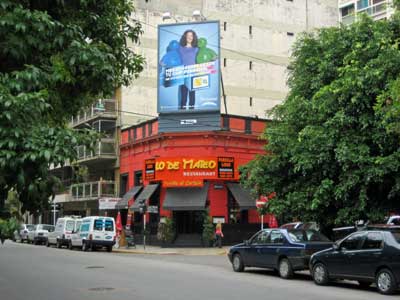
Oh, by the way, I’m having breakfast, lunch at Lo De Mateo at austria y juan maria gutierrez
I’m sitting here at the Sacramento International Airport waiting for my flight to take off at 1:20 pm. I’m flying American Airlines this time instead of Delta. Going through security I thought I was going to have to take off all my clothes before the darn alarm would stop going off. Every time I walked through the metal detector monster that everyone has to walk through it would just keep buzzing. Finally, down to my shorts, I got to go through. (just kidding)
You know the gig, take your shoes off, then your belt, your keys, your cell phone, you cell phone case, pull the laptop out of the case, remove the steel plate out of your head, (no, they haven’t gone that far yet).
Once I get to Texas there is a two hour delay for the flight to Buenos Aires. Good thing to do when you get on the long flight to Buenos Aires is take a sleeping pill, forget about whatever they bring you that they call food and wake up to summer in South America.