Reed Diehl Sentenced to 57 Months in Federal Prison

Reed Diehl
Reed Diehl

Reed Diehl, a former University of California lineman has been sentenced to 57 months in federal prison for his role in a $5 million Ponzi scheme. What’s with all these people getting away with Ponzi schemes?  Anyhow, 57 months in prison, $5 million take, equals a wage of $87,720 a month. Seems like a light sentence for stealing that much money.

According to an FBI press release in July of this year:

SANTA ANA, CA—A former player with the Tennessee Titans pleaded guilty this afternoon to federal fraud charges related to a $5 million Ponzi scheme in which he collected funds with promises of high rates of returns on investments in loan programs, including multimillion dollar condominium projects in Mexico.

Reed Kyle Diehl, 30, of Coto de Caza, pleaded guilty this afternoon in United States District Court to three counts of wire fraud and one count of money laundering.

According to a plea agreement in the case, Diehl falsely represented himself to potential clients as a banker who made “hard money loans” to businesses or individuals. Diehl also admitted that he fraudulently collected deposits for lines of credit for people who desired financing for construction and development projects in Mexico.

In relation to the “hard money loans,” Diehl told investors that he would pool their funds and make secured loans to individuals or businesses that had shortterm cash needs. Instead of using investor funds to make loans, he used investors’ money to repay earlier investors and to fund his lifestyle.

In relation to the second part of his scheme, Diehl told victims involved in construction projects in Mexico that he could secure multimillion dollar lines of credit. Diehl told one victim that it would cost $1.175 million to secure a $24 million loan and that the deposit would be used as collateral for the line of credit. The victim eventually paid Diehl $2.5 million, money that Diehl used to pay, among others things, other people who had made investments with Diehl. None of the victims ever obtained a line of credit through Diehl.

In his plea agreement, Diehl admitted that he caused losses of just over $5 million.

Diehl pleaded guilty before United States District Judge David O. Carter, who is scheduled to sentence the defendant on September 28. At sentencing, Diehl faces a statutory maximum sentence of 20 years in federal prison for each of the three counts of wire fraud and 10 years in prison for the money laundering count.

Diehl was initially charged and arrested in this case in March 2008. After being freed on bond, Diehl’s bond was revoked in January after he attempted to enter into a real estate transaction for a $3.5 million house using a false name and someone else’s social security number.

The investigation into Diehl was conducted by the Federal Bureau of Investigation.

Remember, if you are promised high returns on your money that seems too good to be true, yep, run for the hills.
Amphitheatre Design by Elizabeth Dunn, Landscape Architect

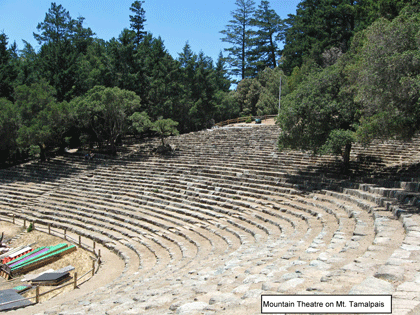
Mountain Theatre at Mt. Tamalpais

One of the current projects in the office requires an amphitheater.  In Roman times, an amphitheater was considered two theaters facing each other with a stage in the middle.  The Roman Coliseum is a good example of this.  Today it simply means an outdoor theater with a stage and places to sit and a place for vendors to provide food and drink.  With this initial knowledge, I went looking for design elements of amphitheaters.

I searched the web and found some great photos.  One of the best was the Scott Outdoor Amphitheater at Swarthmore College in Pennsylvania.  It was designed by Thomas W. Sears, a landscape architect, and built in 1942.  Then, I went to the library and found the 4th edition of ‘The Oxford Companion to the Theatre.’ This book lists several definitions about the theater.  Under the acoustics heading, several physical elements that enhance sound distribution were explained.  This reading brought me back to the internet where I found an article about the outdoor theater in Epidaurus, Greece.  Live Science.   Finally, I reviewed the outdoor venues I have visited and what made them enjoyable.

The most fascinating item I found was that the outdoor theater in Epidaurus, Greece, which was built about 4 B.C., is one of the best theatres for sound distribution.  Recently they have determined that it is not just because of the semicircular seating or the incline angle of the seats, it also has to do with the material of the seats.  They were built with limestone.  Turns out the limestone absorbs low frequencies like the whispers of the crowd and reflects the higher frequencies of the performers’ voices. If the performers have some low frequencies here and there in their speech, ‘The Oxford Companion’ explains the human mind has the ability to fill in these lower sounds and understand the dialogue.

A few other physical elements to enhance sound include a backdrop, a ceiling and a lowered front floor.  The backdrop stops the sound from leaving out the back of the stage.  The ceiling over the stage keeps the sound from going up into the sky.  A solid floor in front of and a bit below the stage bounces the falling sound back into the audience.  In an indoor theater, it is known that a smooth wall will bounce around sound from the performers and the audience members over and over.  This will amplify and echo the sounds and disrupt the listener’s experience.  These indoor walls need an absorptive quality.  Many times you will see tapestries or ornate wood carvings on the walls and ceilings.  These elements capture the sound and keep them from becoming an echo.  If the elements are too absorptive, the sound will be muffled to the extreme and again lessen the listener’s experience.  

Today there are speakers to help with the sound distribution.  They come in all sizes and range of frequencies.  Depending on the size of the audience, an experienced sound engineer / sound technician will set up a speaker or multitude of them.   They will be set right at the stage and/or spread throughout the audience.  Either way, the sound engineer has the ability to test the set up and adjust them for any echo or feedback that screeches through.

A good example of the use of speakers is in the lawn seats at Ravinia.  This outdoor venue just outside Chicago, IL is a popular spot.  The Chicago Symphony and other performers play through out the summer.  There is permanent seating around the stage that is arranged in an arc and built with a slight incline.  This is the pavilion and it has a roof, but the sides are open.  The sound is distributed throughout the seating area and into the surrounding lawn area with the use of speakers.  The lawn area allows for less expensive seating.  However, several of the people with pavilion tickets come early, sit in the lawn with their picnic and then enter the pavilion at their leisure.  The ticket holders for the lawn come as soon as the gates are open, stake claim to their spot with blankets and tie balloons or banners so others in their party can find them.  After their meal, the audience in the lawn quiets, stretches out on their blanket and watches the stars brighten as the music lingers in the air. 

Here in Grass Valley, the Nevada County Fairgrounds has a large lawn area where the audience sets up their own chairs in front of the temporary stage.  I have not been there early enough to see this happen but they must have a chair alignment police to make such a nice arrangement.  I have been told that if the owners of the chairs are not watching the current performance, one can go sit in the chairs until the owner returns.  I have not tried this.  Nor do I think I would be comfortable trying it unless I knew the person who owned the chair.  I would also prefer to lie on a blanket and watch the tips of the trees sway in the summer breeze and find formations in the clouds as the music dances by my ears.

The design required for our project will be completed in phases, with a current budget allowing for a small stage and lawn seating. Future phases, and a generous donor, would allow the design elements of the great outdoor theatres to be incorporated into this space.  This would include designs for permanent seating, set on an incline and built with stone (with cushions for modern comfort).  In addition to the historic elements, an open area is a required design element.  This will allow the audience to spread out on a blanket, enjoy good company and relax while watching the sky and as the music floats by their ears. 

Elizabeth Dunn is a licensed Landscape Architect. She spends the majority of her work days in the studio of Rebecca Cofffman Landscape Architects in Nevada City, CA

Brewster World’s Tallest Puppy

Brewster-worlds-tallest-pup

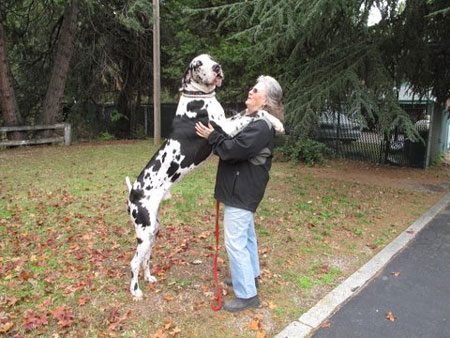
I happened to be walking directly across the highway from my office in Cedar Ridge to the dog groomers to see if I could get an appointment to have my dog Angel get her nails trimmed. Sandy Hall, famous for owning the tallest dog in the world happened to be there and I asked her if I could take a picture of her latest dog Brewster.

Sandy owned Gibson, who stood 42.6 inches tall, measured from the ground to the top of his shoulders and measured 7 feet 1 inch all stretched out and standing on his hind legs. He weighed 180 pounds. Gibson passed away on August 7 of this year due to bone cancer.

The dog in the picture is the latest dog that Sandy owns and is only 14 months old. Sandy says the dog will continue to grow until he is three years old. He weighs in at 140 pounds right now and as you can see in the picture, is pretty darn tall already.

Sandy is very determined to raise money to help fight canine bone cancer and is working with an organization called Morris Animal Foundation.
For more information about Gibson go to Gibsondog.com  and for PiMorris Animal Foundation go to  Morris Animal Foundation

Site was corrected November 23, 2009 Sorry about that Sandy!

Bits & Pieces Nevada County


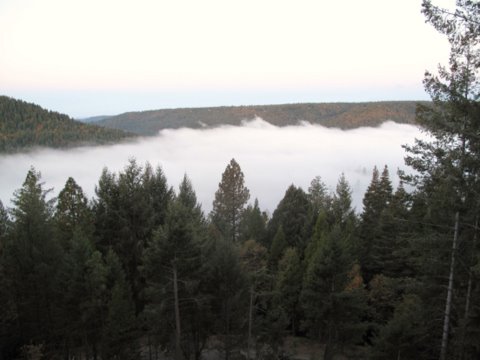
Fog over Scotts Flat Lake 1

November 15, 2009

I took this picture from my deck yesterday looking at Scotts Flat Lake. It has its own eco-system and generates a fog over itself. The nice thing is my house is at 3,700 elevation and the fog usually never gets all the way up here.  Wish I could say the same thing about snow sometimes.

A couple of weeks ago I saw a black bear scooting across the road at 8:30 at night. Fortunately, he just crossed the road and we missed each other. Not so fortunately for my son, he was traveling along the same road and hit a black bear a couple of days ago.  He doesn’t how badly hurt the bear was, but he has a large dent on the left side of his car. I’ve heard that there has been a high rate of deaths of deers and bears this year from car accidents, be careful, espcially at night.

If you have been reading my blogs, you know that I bought out my franchise and am no longer Realty World, The O’Dell Realty Group.  I’ve gone back to O’Dell Realty. It sounds simple, but I’ve had to order new signs, inform the Department of Real Estate, change checking accounts and it goes on. This coming week everything will be in order and I’m back to your local home town realty.

In other news, California Land Title Company, in business in Nevada County for thirty eight years closed its doors Friday.  The recession has affected all of the title companies, downsizing their offices and the number of employees.

Home Sales to Increase 15 Percent in 2010

home-prices-increasing
Home sales will increase 15 percent to about 5.7 million units and REALTOR® income will be up 20 percent in 2010, NAR Chief Economist Lawrence Yun told a packed room of REALTORS® today in a residential economic update at the 2009 NAR Conference & Expo.

Yun credited the home buyer tax credit with unleashing sales on the lower-end of the housing market this year, bringing up to 400,000 first-time buyers into the market who wouldn’t have bought otherwise. That influx tightened inventories of starter homes, shored up prices, and helped reduce households’ fear over continuing price drops.

This virtuous cycle will continue now that the federal government has extended the credit to mid-2010 and expanded it to make a smaller credit available to repeat buyers and to households with higher incomes. “The key is stabilizing prices and preserving household wealth,” he says.

Yun predicts the supply of homes to stabilize at the historic norm of six to seven months. Homes above $500,000 will remain elevated in the near-term, but that weakness will be offset by a hefty drop in starter-home inventories, which are running at about a five months supply.

The tightening inventory at all price points will help improve market performance by bringing supply into better balance with demand, but the added sales, particularly on the higher end, will also increase the number and quality of the market comparables used by appraisers to assign valuations. Once appraisals improve, foreclosures will ease, blunting their drag on the market and making it less likely that Fannie Mae, Freddie Mac, and even FHA will need help from the taxpayer.

“Then we’ll be set for a durable economic expansion,” he said.

New-home sales, which comprise about 10 percent of the market, will continue at suppressed levels–about 550,000 units, down from more than a million during the boom–mainly because builders have scaled projects way back, in part because financing isn’t available.

“Weakness in new-home sales shouldn’t be viewed as tepid demand,” he said.

Even under the most positive economic scenario, unemployment will remain elevated through 2010. Yun is predicting unemployment to stay near double-digits going into 2011, qualifying this recession, as some economists have, as the “Great Recession.”

Source: Robert Freedman REALTOR® Magazine

Joe Montana’s Vacation Home For Sale For $49 Million

Joe-Montana-Home

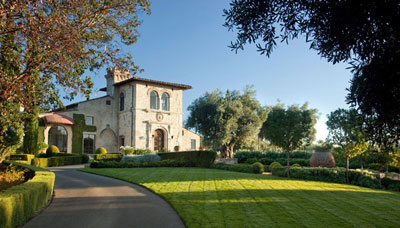
Remember when  Joe Montana, former San Francisco quarterback and Hall of Fame quarterback had the art of winning the football game in the last 10 seconds of play? Surprising as he was then, it’s even more surprising that he has a home in Calistoga that he put on the  market for a cool $49 million. Not only that, this home is just a vacation home, not his main residence.

The setting: More than 500 acres in Calistoga, at the north end of the Napa wine country, spilling over into Sonoma County. The “ultra-private property” includes a 9,700-square-foot Tuscan-inspired main residence, “professional-grade” equestrian center, two creeks, a pond, full-sized basketball court, skeet shooting range, caretaker’s residence, guesthouse, pool and spa, gym, Bocce ball court, and a producing olive farm.

The main residence features three bedrooms, 3 1/2 baths, a sitting room/upstairs tower, great room and dining room, loggia, kitchen, breakfast room, media room, office, climate-controlled wine cellar and tasting room, outdoor viewing tower, and two laundry rooms.

“Villa Montana was designed to feel as if it was handed down through the generations,” Jennifer Montana said in a Nov. 9 statement.

The property consists of multiple parcels, which were assembled starting in 1995, said spokeswoman Alyson Pitarre. Joe and Jennifer Montana don’t want to disclose how much they paid for the various parcels, she said. They live in Thousands Oaks, Calif., and have been using the Calistoga estate as a vacation house.

Local real estate agents say if Montana gets even close to his asking price, it will be a record sale for Sonoma County.

Cat stuck in a tree: if they could come down, they would

cat-in-tree

“Ever see a cat skeleton in a tree?”

This sarcastic question is usually intended to “prove” that cats never get stuck in trees. When they feel like coming down, they will, goes this misguided thinking. The premise of the lame joke, however, is utter nonsense. Cats do get stuck in trees. They do die. Here’s why, and what to do if your cat (or a cat you know) ever gets stuck in a tree.

A cat usually climbs a tree for one of two or three reasons: she’s chasing something (like a squirrel), she’s running away from something (like a dog), or perhaps she just wants to see what’s up there. Okay, so Kitty is way-high-up in a tree, the danger (or the fun or the mystery) is gone, and it’s time to come down. Why doesn’t she come down on her own?

A cat’s claws are designed for climbing up. A cat is not a squirrel; squirrels can climb up, down, and sideways, always headfirst, no problem. But a cat must climb with her head up to avoid falling, and once she’s up, the only way down is to back down. (The margay, or tree ocelot, a rare cat found in the rain forests  of Mexico, Central America, and South America, is the only cat that can climb down a tree headfirst.)

Once she’s close enough to the ground, she’ll turn around and jump down; the biggest challenge is a tree that has no low branches, like a pine tree. By the time the immediate danger or curiosity has passed, Kitty has used her burst of adrenaline and does not have enough energy left for the time-consuming, frightening task of descent. This is especially true of an indoor cat with little or no climbing experience.

The good news is, cats have been known to survive over a week in a tree and have sustained falls of over a hundred feet without serious injury. The bad news is, a panicked cat will continue to go…up. Worse, a cat may eventually become too weak to climb down, and after a point, even if rescued, may die later of starvation, dehydration, or exposure.

We don’t see cat skeletons in trees because of a well-known law of nature called gravity: Kitty becomes too weak to hold on, lets go, and falls.

What do you do?

If the cat is not too high—a distance you feel confident climbing yourself—wear gloves, long sleeves, and long pants. Take a pillowcase and rope with you. Make the first grab count; if you only succeed in scaring Kitty, she may go higher. Grab her by the scruff of the neck and stuff her into the pillowcase; secure it with the rope and lower it carefully to someone on the ground. Take the bagged kitty indoors before opening the pillowcase.

If you can’t manage the rescue yourself, wait no more than a couple days. That’s about the longest it will take Kitty to decide to come down if she can. Call your cat. If it doesn’t encourage her to come down, it will at least let her know she’s not forgotten. Keep dogs and other unnecessary commotion away. Try tempting her with food.

If your cat does not meow, it means one of two things: she’s too weak to do so (bad) or she doesn’t feel she is in trouble (good). Unfortunately, you can’t tell which it is.

Get help sooner rather than later if:

  • It’s a kitten. Kittens do not have the weight or strength to hang on.
  • It’s an indoor cat. She’s not used to being exposed, and she has no climbing skills.
  • She’s declawed. A declawed cat has virtually no chance of climbing down without help.
  • The cat has been up there for more than two days. After this, her chance of getting down on her own declines sharply, especially considering she’s becoming weaker as time passes.
  • Wet, cold, or windy weather is forecast.
  • An electrical storm is forecast. If you do decide to call someone, he may decline to come, out of concern for his own safety.
  • She’s injured or literally stuck—wedged or (worse) impaled.
  • The stranded kitty’s plight is causing stress to you or another family member.
  • There’s a reasonable fear of attack by wild animals.
  • Her meowing is bothering someone. You don’t want a grouchy, cat-hating neighbor to shoot your cat down.

Who’re you gonna call?

Continue reading Cat stuck in a tree: if they could come down, they would

Nevada County Fair – Create a Gingerbread House & Win!

gingerbread-house

Now is the time for holiday bakers to think about the creation of a magical Gingerbread House to enter into the 7th annual Gingerbread House Competition at the Country Christmas Faire, held November 27 – 29 at the Nevada County Fairgrounds. Entry forms must be submitted by Friday, November 20.

Houses, bungalows, cottages, and castles fashioned from spicy gingerbread will be displayed for holiday shoppers to enjoy at the Nevada County Fairgrounds in Grass Valley during the Thanksgiving weekend festivities.

Competitors may enter any of the 12 categories, including children, teens, adults, families, groups and businesses. New this year is a category for children under 8 years of age who want to enter a house made by a kit.

Prizes and ribbons abound for all. First through third place winners will receive award money with the Best of Show winning $100. A special gift basket from Tess’ Kitchen Store will be awarded to the Best of Show winner and the People’s Choice Award.

Entry forms must be received at the Fairgrounds by Friday, November 20; the actual gingerbread house entry must be delivered to the Fairgrounds on Tuesday, November 24.  All Gingerbread House exhibitors will receive two free passes to the Country Christmas Faire.

Entry forms and a complete list of rules can be picked up at the Fairgrounds office on McCourtney Road, or downloaded from the Fair’s website at Nevada County Fair.

The 25th annual Country Christmas Faire begins Friday, November 27, and runs through Sunday, November 29.  The hours are 10 am – 5 pm on Friday and Saturday; and 10 am – 4 pm on Sunday. Admissions is $4 for adults, and children 12 and under are free. Parking is also free.

Artisans from across the country fill the Fairgrounds exhibit buildings with quality hand-made crafts and unique gifts. Visitors to the Faire will enjoy strolling live entertainment, festival foods, wagon rides, and a community bon-fire. Santa Claus and Mrs. Claus will be on hand to greet children and a photographer will be available to capture the special moment with Santa.

The Northern Mines Girl Scouts will offer free babysitting so parents can drop off their children while they enjoy holiday shopping. Errand elves will also be available to assist you throughout the event.

The Nevada County Fairgrounds is located at 11228 McCourtney Road in Grass Valley. For more information, visit Nevada County Fair or call (530) 273-6217.

Source: Wendy Oaks, Publicist Nevada County Fair

Amateur Astronomy in Nevada County

universe

An important point of astronomical activity in the county is the science museum, with education and sky shows.  Regarding education, this is the International Year of Astronomy (IYA) 2009, and the Imaginarium Science Museum is celebrating the event this fall with astronomy exhibits and activities for local school children during the week throughout the fall into December.  For November, two public events are:

Nov. 13th Imaginarium Open to the Public

Time: Noon to 5 pm

Astronomy exhibits and activities supplement other science exhibits
COST: $4 Student $6 Adults
Nov. 20th, Astronomy Event – Movie Night:  The Universe in Powers of Ten
Time:

5:00 – 6:00 Museum Open
6:30 – 7:00 Films:  Powers of 10 and Zoom, 12 and 8 minutes, respectively
7:00 – 7:30 Film:  Cosmic Voyage, 35 minutes
7:30 – 8:00 Discussion and talk featuring Wayne Watson,
                   the Astro Guy on the Size and Shape of the Universe
COST:  $4Student $6 Adult

The three spectacular movies (Zoom, Powers of 10, Cosmic Voyage) present a common theme of exploring the universe that is visually developed further with each successive film under newer technology. They will be followed by a 20-30 minute discussion and talk on the size and shape of the Universe. You’ll learn about some the very unusual, fun, mind warping features of the universe that weren’t featured in the films.  The first two movies are appropriate for children 6 and older, child care will be provided from 7:00 – 8:00 p.m. For more information check the museum’s information line at 478-6415.  For sky show schedules see local media, radio, newspapers, as below for other sky shows.

The museum’s monthly sky shows from April to November have supported the IYA with views of the sky, and short talks on various subjects from April to November. The next sky show is at Tobaissen Park 300’ up the hill from the Madelyn Helling County Library parking lot on Friday, November 13, from 7 to 9:30 p.m.

Another important group is the Nevada County Astronomers club, NCA, which meets at the Madelyn Helling Library County Library Community Room  near Nevada City  the first Tuesday of each month at 7 p.m., except during the summer months.  They feature discussions and talks by astronomy enthusiasts.  Their web link is Nevada County Astronomers

Additionally, popular and informative sky shows are provided by Alan Stahler of KVMR-FM who hosts sky watches throughout the year near Grass Valley and Nevada City, and famed comet hunter, Donald Macholz, who hosts sky shows throughout the year in Auburn.  Auburn is just out of our county, but close to much of our population.  For schedules on Alan’s shows see KVMR-FM, KNCO-AM announcements, and The Union’s Thursday Prospector. For Don’s shows see similar radio and newspaper outlets in the Auburn area.

If you want to enjoy our good skies for astronomical viewing, then latch onto the activities above. You’ll find plenty of knowledgeable amateur astronomers and resources at the museum to help you.

Source: Wayne Watson, Imaginarium Science Museum Sky Show Host

Wayne Watson’s Website

Feds Clean Up Closing Costs For Borrowers

piggy bank

It seems that times are getting harder for mortgage brokers. First, they can’t in most cases use their appraiser of choice and now, they have to give you a close estimate of closing costs when you purchase a home.  No longer will you be given an approximate closing cost.  Than find the final closing costs on your mortgage to be $2000 to $3,000 higher than what you were told you would have to pay.

Worse yet, you had to come up with the extra cash to handle the surprise costs or the home purchase or refinancing could not proceed.  A lot of mortgage companies low ball the estimated closing costs just to rope you into doing business with them, than surprise you with extra costs when you are ready to sign the final closing papers.
Here’s what’s about to happen: Starting Jan. 1, loan charges and settlement fees will be spelled out on a revised, more consumer-friendly version of the good-faith estimates (GFE) form that borrowers are supposed to receive within three days of their mortgage applications. Charges will fall into three broad categories on the form:

• Fees that cannot increase from upfront estimates to final closing.

• Fee estimates that come with wiggle room and can increase by as much as 10 percent.

• Fees that can increase without limit, mainly because the lender has no control over them or because the amount is difficult to predict.

Charges in the zero-increase category include the lender’s or broker’s mortgage origination, processing and underwriting charges, where junk fees sometimes sprout — or increase significantly at closing. Also in this category are the lender’s or broker’s loan discount charge, or “points,” based on the interest rate quoted, and local transfer taxes.

Charges subject to a 10 percent aggregate increase include services required by the lender but where the lender chooses the providers, such as appraisals; expenses such as lender’s title insurance and settlement services, where the borrower chooses a firm on a list approved by the lender; owner’s title insurance, when the borrower chooses a company on the lender’s approved list; and recording charges by local governments.

Though any one of these items can increase more than 10 percent from the upfront estimate to closing, the combined total of all the fees in this category cannot jump by more than 10 percent. This is crucial, especially in title insurance and settlement charges, where some of the biggest surprises pop up at closing.

Charges that can increase without limit include lender-required services where the borrowers choose a title insurance, escrow or other settlement company that is not on the lender’s list; the cost of homeowners’ hazard insurance; daily interest charges on the loan; and the amount of the initial deposit by the borrower into an escrow account.

Besides getting rid of closing-cost surprises, the new good-faith estimate encourages loan applicants to shop around before committing. The form has space for comparing up to four competing lenders’ GFEs on interest rates, rate locks, prepayment penalties or balloon payments, among other factors. The cost estimates from each competitor are required to remain available for 10 business days. Interest rates can change unless locked in.

Paired with the new GFE rules will be a new standard closing-cost statement, the “HUD-1,” which allows consumers to directly compare what they were told upfront with what they’re being asked to pay at closing.

Also, for the first time ever, the new HUD-1requires disclosure of the widely misunderstood fee splits of title insurance premiums between the insurance underwriter — the company actually insuring the title — and the title agent, who is often the settlement agent. Consumers may be stunned to learn that in some markets, 80 percent to 90 percent or more of the premium they pay at closing actually goes to the agent, not to pay for the insurance itself.