The Friuli-Venezia Giulia region is an overlooked region in the Italian tourism scene, but it produces some exceptional wines. The origins of these wines date back to the middle ages (1066 to 1485), when the area was important in the Mediterranean spice route from the Byzantine Empire to the trading center of Venice. Travelers through the area brought grape vines from Macedonia and Anatolia. Under the Hapsburg reign, the German and French grape varieties were brought in. Even today, the Friuli-Venezia Giulia wine region is an area close to Austria and Slovenia. Due to this positioning, the region has a unique blend of Italian, Slavic and Austrian cultures and foods. But the wine, especially the white wine is special.
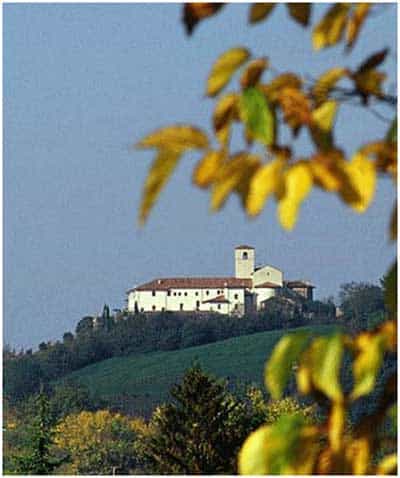
The Abbey of Rosazzo is located in the Coli Orientali (eastern hills) of Friuli in an isolated area to the northeast of Manzano (famous for the production of chairs), around twenty kilometres from Udine and ten kilometres from the Slovenian border. The origins of the over one thousand year old abbey are still not fully known. Proof to the early origins of winemaking as well as the importance of the craft to the society comes from a document in the abbey dated January 20, 1341 that reads: “The Patriarch Bertrando has threatened the excommunication of several people, who after having occupied a wood belonging to the Abbey of Rosazzo did not want to plant vines”. Shocking!
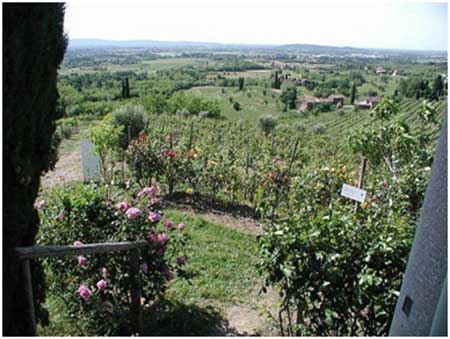
Looking out from the Abbey Both photos and quote courtesy of The Abbey of Rosazzo http://www.abbaziadirosazzo.it
In the pictures of the Abbey note the proximity of the vines and roses. Even today in California on a wine tour you often see a single rose planted at the end of each row, traditionally the roses are the grape growers early warning system. Powdery mildew is a fungus affects both plants, but roses are much more sensitive to the disease. So if the roses are infected, it is time to spray the grapes with sulfur or other fungicides that are used today. Roses also warn of other diseases, and harbor beneficial insects that help kill other insects in the grapes. And they are beautiful! The Abbey can be visited, with some limited rooms, but visit the cellar as it is one of the oldest in Friuli, dating back to the end of the thirteenth century with the Benedictine monks.
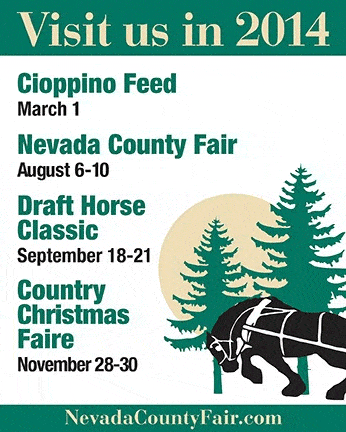
Join the Nevada County Fairgrounds Foundation at its fourth annual All-You-Can-Eat Cioppino Feed on Saturday, March 1 at Ponderosa Hall at the Nevada County Fairgrounds. Doors open at 5 pm, and dinner service begins at 6 pm.
For the event, the chefs will create and serve Arnie Romanello’s special 100-year-old recipe for all to enjoy. Dinner includes antipasto, all-you-can-eat Cioppino, salad and garlic bread. This year, a pasta dish will be available to those who do not prefer Cioppino, but want to attend the event. A no-host bar will also be available, and there will be a silent dessert auction and a live auction.
Tickets are $35 per person. If you’d like to purchase a table for 8, it is $350 and includes two bottles of wine.
Tickets are available by visiting the Nevada County Fairgrounds, calling the Fair Office at (530) 273-6217, or downloading an order form at www.NevadaCountyFair.com/foundation.
Proceeds from the event will benefit the Nevada County Fairgrounds Foundation and its mission of supporting and improving the community’s Fairgrounds.
For more information, visit www.NevadaCountyFair.com or call the (530) 273-6217.
Please help to keep this blog going
Let us Sell or help you buy your new home or land
John J. O’Dell Realtor® GRI
O’Dell Realty
(530) 263-1091 Email John
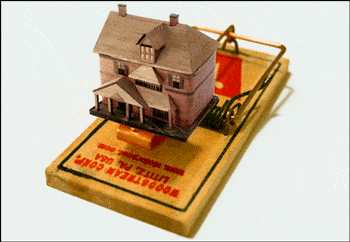
Don’t be duped by mortgage fraud. Here are a few common scams and the red flags you should look for in a transaction.
Mortgage fraud is pervasive: An estimated $4 billion to $6 billion in annual losses result from mortgage fraud, according to FBI reports. “An entire community can be damaged by mortgage fraud,” says Rachel Dollar, a lawyer from Santa Rosa, Calif., and editor of the Mortgage Fraud Blog. Mortgage fraud can lead to a spike in foreclosures, home values plummeting, and lenders raising their rates and fees to recover losses.
The crimes are often complex, involving several parties and occurring over multiple transactions. To protect you and your clients, educate yourself about mortgage fraud and be on guard for any warning signs in a transaction. You can start by reviewing these five scams, and then test your knowledge by taking our Mortgage Fraud Quiz.
The Scam: “Rescuers” promise cash-strapped home owners that they can save their home from foreclosure. The rescue, which involves paying upfront fees, can take multiple forms, such as the perpetrator obtaining a new loan on behalf of the owner or by having the owner sign over the home’s deed and then rent the home until they can repurchase it. Eventually, the home owner loses the home, either to foreclosure or the fictitious rescue company.
Red Flags: With foreclosure rescue programs, borrowers are often advised to sign over the title of their house to a third party, become renters of their home, not contact their lender, or send mortgage payments to a third party, according to Fannie Mae, which provides fact sheets on mortgage fraud.
2. Loan Documentation Fraud
The Scam: This fraud involves numerous schemes in which a borrower provides inaccurate financial information — such as about their income, assets, and liabilities — or employment status in order to qualify for a loan with lower rates and more favorable terms. Occupancy fraud is one growing area: Borrowers say they plan to live in the property when they actually intend to rent it.
Red Flags: Documentation may raise suspicion if the employer’s address is shown as a post office box, accumulation of assets compared to the person’s income appears too high or low, the new house is too small to accommodate occupants, the person has no credit history, or the application is unsigned or undated, according to Fannie Mae.
3. Appraisal Fraud
The Scam: A faulty appraisal — saying a property is worth more than what it really is — is connected to many types of mortgage fraud. It entails manipulating or overstating comparables, market values, or property characteristics in order to obtain a higher appraisal. The higher property appraisal, which generates false equity, is done by falsifying an appraisal document or using an appraiser accomplice to obtain the higher value.
Red Flags: Be skeptical of appraisals that are dated prior to the sales contract, list comparable sales that do not contain similarities to the property or are outside the neighborhood, the owner is not the seller listed on the contract or the title, or a third party participating in the transaction orders the appraisal, Freddie Mac warns.
The Scam: This entails purchasing properties and reselling them at inflated prices. These scams usually involve faulty appraisals and inaccurate loan documents. The property is then refinanced or resold immediately after purchase for an inflated value. The home is purchased at a higher price, often by straw buyers working with the “flipper,” and eventually falls into foreclosure.
Red Flags: Some key things to look for are rapid refinancing of a property; the seller recently having acquired the title or acquiring the title concurrent with the transaction; an appraisal that comes in too high; a property that was recently in foreclosure being purchased at a much lower price than its sales price; or the owner listed on the appraisal and title not matching the seller on the sales contract, according to Fannie Mae.
The Scam: Borrowers owe more than the current value of their home so they fake financial hardship and no longer make their mortgage payments. An accomplice of the borrower then submits a low offer to purchase the property in a short sale agreement. The lender agrees to the short sale, unaware that it was premeditated. The property, after being purchased at the reduced price, is then often resold at the home’s actual value for profit.
Red Flags: The borrower suddenly defaults on the mortgage with no workout discussions with the lender, an immediate offer is made to a lender at a short sale price, the short sale offer is less than current market value, or a cash back is offered at closing to the delinquent borrower (disguised as “repairs” or other payouts, for example) and is not disclosed to the lender, according to Fannie Mae.
You can report instances of suspected mortgage fraud to Stopfraud.gov.
Recent cases are challenging the rights of online reviewers to remain anonymous against the right of businesses to pursue defamation claims. In one of the latest cases, Yelp filed an appeal all the way to the Virginia Supreme Court that challenges a court’s order to release the identity of allegedly defamatory reviewer.
In the case, Yelp Inc. vs. Hadeed Carpet, the company Hadeed challenges whether a set of negative reviews posted on Yelp were really authored by real customers. Hadeed had filed a complaint and asked Yelp to supply documents containing the full name, gender, birth date, IP address, and e-mail address of the authors. The company used a Virigina statute that says anonymous communications must be revealed that “may be tortious or illegal.”
Yelp refused to supply the information and the incident first went to circuit court, then the court of appeals, and now the Virginia Supreme Court is being asked to weigh in.
Yelp argues that if “a company is able to identify its critics by doing no more than representing that it believes that its critics are not customers, consumers and others who have valuable contributions to make to public debate, but who worry about retaliation, will be chilled into silence.”
But businesses say it’s unfair to provide them with no recourse when they’re targeted by an anonymous review that they know to be false.
The topic is raising First Amendment issues. “Under our Constitution, anonymous pamphleteering is not a pernicious, fraudulent practice, but an honorable tradition of advocacy and of dissent,” wrote the U.S. Supreme Court in 1995. “Anonymity is a shield from the tyranny of the majority.” However, speech that is deemed defamatory can fall outside First Amendment protection.