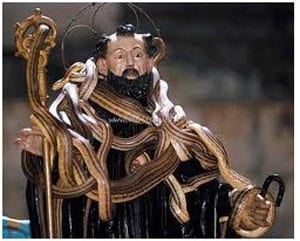
But along came the Roman Catholic Church, who could not approve of such paganism, so we now have the Festival of Saint Dominic (who is the patron saint of the town of Cocullo). Saint Dominic is of course known for many other things, the greatest of which was founding the Dominican order within the Catholic Church. However this legend has the village fields overrun with snakes, and when Saint Dominic cleared the fields of snakes the villagers of Cocullo came up with a lasting show of gratitude, where the effigy of Saint Domenic is draped in snakes and paraded around in May of each year, also known as the Feast of the Serpari. The snakes are primarily of the local variety, four-lined aesculapian, grass and green whip snakes, and are released into the fields at the end of the day. (Humm, I guess we need Saint Dominic to come back and clear the fields again!)
But on feast day the statue is draped in snakes and carried around the town, while many people also allow themselves to be draped with snakes as well. Of course the snakes are all non-poisonous, or have had their fangs removed, but this is not a festival for the faint of heart or anyone with a snake phobia! The festival is held to seek the Saint’s protection from snake bite.
It is believed that the snakes, once on the statue can predict the future. The people in attendance watch the snake behavior carefully. According to custom, if the snakes wind around the head of the statue it is a good sign. But if they go in the direction of the arms or body something bad is ahead.
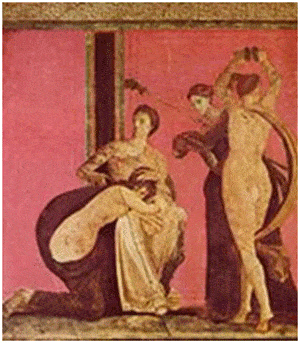
Women celebrating Bona Dea from: abitabout.com/Bona+Dea
By Judy Pinegar
Meanwhile, the Romans who always had to re-name the Greek gods and goddesses to fit their “new” civilization seem to have adapted Angitia into Bona Dea, an ancient and holy Roman goddess of women and healing. Women also referred to her as Fauna, but men were not allowed to use that name, or attend her secret ceremonies and festivals. Bona Dea, “the Good Goddess” protects women through their changes, and is believed to watch over virgins and matrons especially. She was skilled in healing and herb lore, and snakes and wine were sacred to her. As a healing goddess, the sick were tended in her temple garden with medicinal herbs. Bona Dea was portrayed sitting on a throne, holding a cornucopia. The snake is her attribute, a symbol of healing, and consecrated snakes were kept in her temple at Rome, tended by her priestesses.
Under the laws of the Roman republic, patrician women were not supposed to drink wine, and could be punished, if caught. But by calling it “milk” the ancient and sacred practices could be reconciled with the rules of Roman Society. Bona Dea’s secret festival for women was held at night during the First of May, in the house of the chief elected official ( although he was not allowed to attend), the Vestal Virgins officiated, and a great jar of wine was in the room, although it was called “milk” and the jar was called a “mellarium” or honey jar. After making libations to the Goddess Bona Dea, the women drank and danced to music. It is said that later in the history of the empire this festival “degenerated” into wild and extravagant affairs, such as the Greeks had with Dionysus, the God of Wine.
Judy Pinegar is a writer. Part of this three part series appeared in the Corriere della Valle Magazine
Thinking of buying or selling?
For all your real estate needs
Email or call:
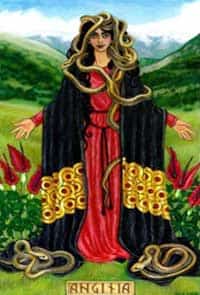
Angitia, Snake Goddess of the Marsi from www.thaliatook.com/OGOD/angitia
By Judy Pinegar
While the region of Puglia is the “heel”, and the Gargano Pennisula is the “spur”, the mountainous regions of Abruzzo and Molise (united until 1963) are the “ankle” of the “boot” that is Italy. The area was settled by Apennine tribes in the Middle Bronze age (2000 to 1700 BC), was later taken over by the Romans, by the Normans in the 12th century, then by a succession of rulers out of Naples. In spite of all this, the Abruzzo region, dominated by the Apennines Mountains, to this day is a brooding, introspective land, with precipitous drops from mountain sides, endless tracks of forests, small towns clinging to mountainsides, a semi abandoned, poor area, one of the last wildernesses of Italy.
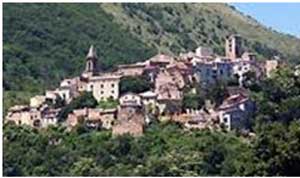
Yet the first Thursday of every May, ophidiophiliacs (snake-lovers, often accompanied by their own snakes) come from all over the world come to the town of Cocullo (with a population of 316 persons) for a festival, the Feast of the Serpari (Snake Festival) that has been re-created possibly three different times over the eons of time to become one of the most multicultural, ancient and historic festivals in all of Italy.
Town of Cocullo (Google pictures)
In pagan times, the tribe of the Marsi ruled this area east of Rome. A tough warlike, mountainous tribe, they were ruled from about 800 to 580 BC (before Christ) by the Eutruscans, and then until 325 BC under the Samnites. The chief divinity in their society was the ancient snake goddess, Angitia. She was an early goddess of witchcraft and healing, associated with verbal and herbal charms, especially against snake bite. Her name referred to killing snakes through enchantment, possibly with just a word from her deific lips. The Greek myths say Angitia was one of the three daughters of Aeetes along with Medea and Circe, two of the most famed sorceresses of Greek mythology. Angitia lived in the area around the Lake Fucinus (later drained) and specialized in curing snake bites.
In north eastern Italy, on the flat landscape of the Venito region, with the spectacular Dolomite mountains in the distance, sits the city on Vicenza. It is home to one of the premier art showcases around the world, called Abilmente, with a spring showing on March 3-6, 2011, and a fall showing on October 20 to October 23, 2011 at the Fiera di Vicenza (Fair of Vicenza) located at Via dell Oreficeria 16, Vicenza, Venito, Italy.
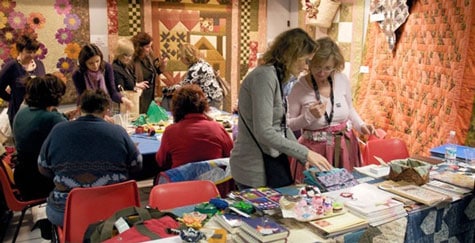
A feature of Abilmente are the “Workshops”(or Ateliers), spaces where the practical aspects and exhibitions combine. The settings will highlight the work of leading artists in each sector, providing plenty of ideas to others. There are chances to participate in several courses held by the leading associations and artists in each sector. The planned workshops are: “A Voyage into the World of Color”, “Patchwork” “Natural Dye” “DIY Fashion: Bijoux and Accessories” and “Creating with Paper”:
This year in honor of the 150th Anniversary of the Union of Italy, there was a special Creative Workshop, on October 20-23, 2011 presented a workshop called Patchwork Atelier. Here the Associazione Nazionale Quilt Italia, the star of this workshop, presented the Italian cultures, images and landscapes of the regions that have united to make Italy a truly great nation. The show displayed, through original pieces of patchwork quilt, the distinctive features that characterize each individual region.
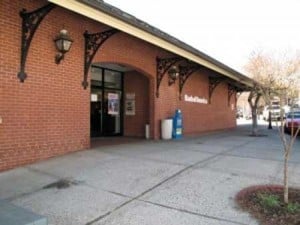
Bank of America Nevada City Closing in 2012 Photo by John J. O'Dell
Faced with finicky lenders, would-be home buyers are increasingly turning to family members, friends, and even strangers they meet online. While this is understandable, given the abundant bargains on the market, they also present significant risks.
So-called peer-to-peer lending sites, such as Prosper and Lending Club, say demand for home-related financing is on the rise. In September, Weemba, a social-networking site, launched a platform to connect lenders directly with prospective home buyers and other borrowers.
Despite historically low mortgage rates, traditional lenders remain reluctant to provide mortgages to anyone with less than stellar credit. And, in certain markets, lenders are requiring down payments of more than 20 percent of the home’s purchase price.
Borrowers taking loans from family members – so-called intrafamily loans – save on interest since family members are likely to charge less than the banks. Additionally, parent lenders can earn a higher return from their child’s interest payments than they would on a certificate of deposit or money-market fund. Under federal law, on a loan of more than nine years, parents must charge at least roughly 2.8 percent, in most cases.
Consumers who prefer to look for loans beyond the family can apply at peer-to-peer lending sites. If approved for a loan after a screening by the companies, applicants may then receive money from investors.
However, these alternative routes to financing can be expensive for borrowers. Rates at Lending Club run from around 7 percent to 28 percent. At Prosper, rates run roughly 7 percent to 35 percent. The companies say these rates, which are fixed, are higher than traditional mortgage rates in part because their loans are unsecured.