Well I was down with a head cold and John thought that he was right behind… but Ted came up with some medicine to be used pre-cold and we took it. Seems quite nice so far!! Wonderful, totally NEW breakfast again! So after a bit of a sleep-in for me and Breakfast for John and Ted, we agreed to split for the day. Ted needed to go see his attorney, and we were going exploring in San Jose, Costa Rica.
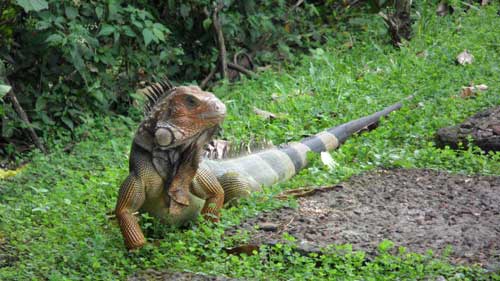
Our first stop was INBio Park, a natural history museum, a living monument to the biological diversity that has made Costa Rica famous. Paved trails lead through re-creations of several distinct ecosystems in Costa Rica. We saw several Iguanas (see picture) and other creatures.
After that we went to the Jade Museum. Jade was the most valuable commodity among the pre- Colombian cultures of Central America, worth even more than gold. The museum holds a huge collection dating from 500 BC to 800 AD. Most are large pendants, primarily of human or animal depictions that were part of presumably massive necklaces.
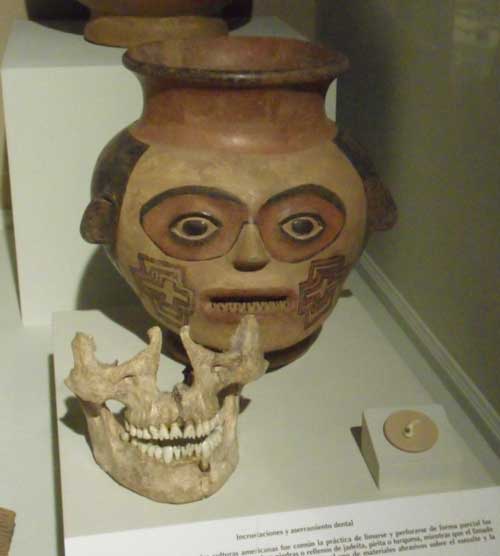
The museum also had a large collection of pre-Colombian terra-cotta vases, bowls, and figurines. Some of these pieces are surprising in their modern design and advanced techniques. Particularly fascinating are a vase that incorporates real human teeth and a display that shows how jade was imbedded into human teeth for decoration!!
Judy Pinegar is a writer and her articles have appeared in numerous publications
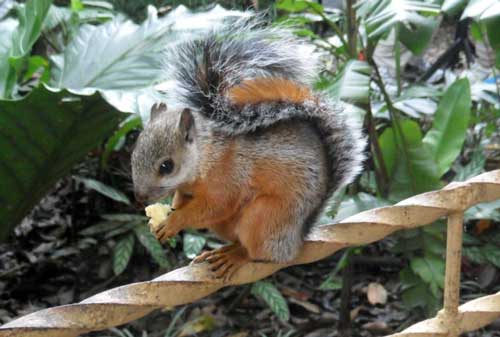
The day began with another full breakfast at Hotel Aranjuez in San Jose, and except for the made to order omelet and the typical rice and beans, every dish was a new item! Wonder how many days they can keep this up?? Today our table was visited by a local squirrel, exciting all us tourists, so of course we took a picture too.
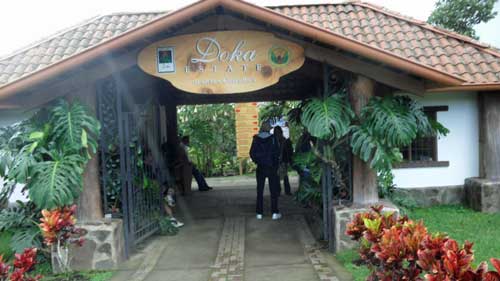
We decided to visit a coffee plantation in the nearby hills of Jan Jose, over 3000 ft altitude. We picked the Doka Estate, out of Alajuela as they offered tours even if it rained. The drive was supposed to be 45 minutes to an hour, but after about an hour we found our taxi driver had never been there either. Luckily I had the phone number and our taxi driver had a cell phone, so we got there 5 minutes after our reservation, and the tour hadn’t left yet. True to the ad, it was a “seed to cup” tour. We learned it takes a full year to grow the seeds into a plant, ready to be transplanted to a bigger container, and another year to grow the plant to be ready to plant in the field.
The plant is more of a shrub than a tree, the top of each one can be reached by the arms of the picker (migrant workers from Nicaragua or Panama), who picks each berry individually, only when they are red, so a plant has to be picked many times, from October until February of each year. They fill a basket, tied around their waist, which when full weighs 25 pounds. A very good picker can pick 30 baskets a day, and gets paid $1.00 per basket!!
After that the berries are taken to a wash bath where they are re-measured, then dumped into a water bath. The good quality beans sink, and are exported, the bad ones float and are sold in Costa Rica!! They are then again processed so the outer red shell comes off leaving from 1 to 3 seeds and again are sorted by size into three categories (biggest is best). After that they are “fermented” for 3 days in a large open vat with some water. It is a natural fermentation, the guide didn’t know what caused it, but I assume it was natural (or wild) yeast, as she said nothing was added. The alcohol and some water is then siphoned off and shipped to another company that makes coffee liquor.
The remaining beans are then dried for 3 days on a concrete pad in the sun and are raked to turn over, every 30 minutes 24/7! After that they spend another day in a gas fired dryer, rotated constantly. They are then stored in bags for 3 months (the berry is still “green”). Then most of the beans are exported in that condition as the gourmet coffee companies (Starbucks gets 60 % of this plantation’s crop), like to do their own secret roasting and blending.
entrance-doka-plantation
Image 1 of 5
Entrance to the Doka Plantation
Then we saw a roasting room where three levels (light, medium and dark) or roasting is done. This is a very small plant as the only coffee they roast is that sold in their own tourist shop, and are the very highest quality of beans. The low quality beans are sent to another Costa Rican company to roast for the locals and all export beans are sold green.
Tastes of their 7 blends were then offered (John and Ted imbibed; I just toured the gift shop). An interesting fact was that to make decaffeinated coffee the beans are shipped to Germany, where they were decaffeinated through a water process at NO cost, because the German company sells the Caffeine all over the world for other purposes. Doka Estate only pays to ship them over and back to Costa Rica. But again this is a very small % of the crop. All in all it was a very interesting tour taking about 2 hours whicha I would recommend to any visitor.
Well, really day two, but getting in last night an hour before midnight doesn’t count!! The trip didn’t start too well as they held us for an hour in Sacramento while they fixed some computer problem. This caused us to miss our connection in Denver to go to Houston. When we got there we were told we had been rescheduled on Continental, but arriving at that gate we found it was NOT reserved. We were then put on “standby” but luckily got on anyway. Then somebody had a medical emergency (heart) on our plane, but (also luckily) there were 3 Doctors on board.
The Hotel Aranjuez in San Jose is very nice and inexpensive too. Wonderful FULL breakfast included with a double room (actually two beds and a bath) for US$ 48.00. It is within walking distance of the main downtown, which is what we did today. …oh and RAIN…did I mention it was raining… (pouring) most of the morning? John and I were prepared, but several hours into it Ted realized his windbreaker was not waterproof (duh)…but tiendas (shops) abound so we found a nice waterproof Adidas jacket with hood.
museum-rafael-angel-calderd
Image 1 of 9
Rafael Angel Calderón Museum
Our walking tour started with the Rafael Angel Calderón Museum, Costa Rica’s (CR) President from 1940-44, and the social reforms he helped to create in that time period. Educated in Costa Rica and Belgium as a medical doctor, Calderón soon turned his back on the conservative coffee elite to address widespread poverty and poor health conditions among the working poor. He became the first Central American president to primarily focus his attention on poverty and deteriorating social conditions.
How’s Nevada County’s residential sales going? Let’s take look at the years 2010 and 2011 from January to October of each year and compare the two.
The Year 2010 from January to the end of October. There were a total of 1,619 listings. Total sales in that period were 750. Average list price of unsold properties was $453,771 and the average price of the properties that sold was $310,793. Average days on the market of sold properties were 97 days.
For the year 2011 from January to the end of October. There were a total of 1,446 listings. Total sales in that period were 859 which is an increase in sales of 14.5%. Average list price of unsold properties was $395,080. The average price of properties that sold was $260,463 a decrease in sales price of 34.1% Average days on the market were 144 about 48% longer to sell a listing.
So how does future look? Foreclosures were up 7% in October but down 31% for the same period last year. Until the foreclosures are cleared by the mess Wall Street and the banks created by their greed, I think we will see a further decrease in sales price going well into the end of next year.
Thinking of buying or selling?
For all your real estate needs
Email or call:
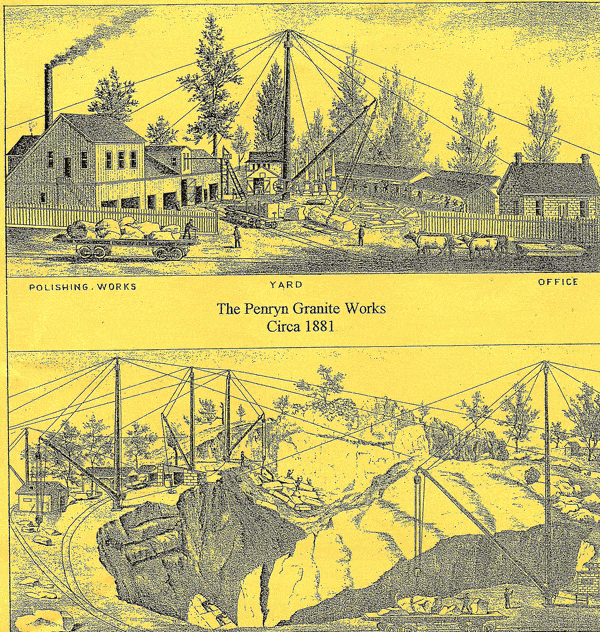
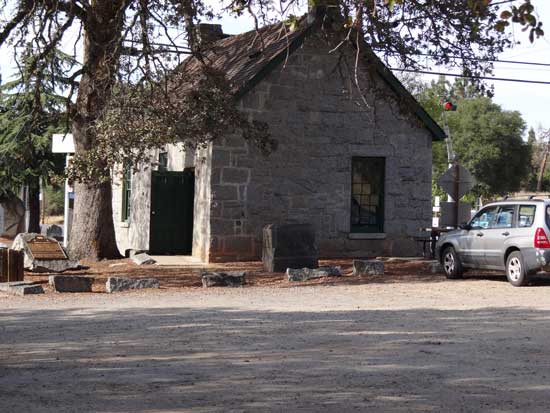
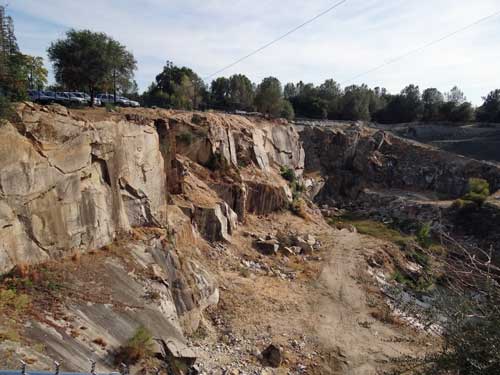
John and I wanted some exercise so we went to Griffith Quarry Park and Museum in Penryn, CA. This site is listed on both the National Register of Historic Places and the California Landmark Program. The surrounding 23-acre park contains ruins of the first polishing mill built in California and some of the quarry holes from which the unique Penryn granite was taken. It is a wooded area with trails both close to and wider around two large former quarries. The walk starts at the parking lot, where the museum is the same building that used to house the Quarry Office, and the parking lot itself used to be the main Yard and polishing buildings.
Here is a picture of what it looked like circa 1881.
Click on picture to enlarge
As we walked John took pictures of several areas of interest in the park.
museum
Image 1 of 6
Office and museum
Click on picture to enlarge. Click on picture to return to page.
The Penryn stone is dark gray biotite granite, uniform in color, and there was also “black granite,” a very dark granite one mile east of Penryn. This stone is used mainly for cemetery monuments and buildings.
Then we went to the Museum, and learned more about the quarry, established as Penryn Granite Works, by Welsh immigrant Griffith Griffith in 1864. Mr. Griffith formerly worked in the famous slate quarries in Penrhyn, Wales. He quarried granite at Folsom, but in 1864 he came to Penryn, which he named after his Welsh home. Here he remained, and he and his descendants quarried granite from that time until about 1906. The museum contains some of the original office furniture of the Penryn Granite Works and information on the Griffith family, the granite industry, and the history of the Penryn-Loomis Basin area. While there, talking to the volunteer we heard about the Rocklin History Museum, which had some old mining tools in the basement.
Since that is just a few miles down Taylor Road, we went there next, where they display Rocklin’s history of “Rock, Rails and Ranches”. They have a timeline of the small settlement of the 1850’s to the thriving community of today. There also was a lot of information about when the Central Pacific Rocklin Roundhouse provided engines to power the Transcontinental Railroad over the high Sierra. When they grew out of space in Rocklin, they moved the whole roundhouse to Roseville along with some of the houses!
Rocklin was the “Granite Capitol of the West” over 40 quarries were in operation at one time. The Rocklin granite quarries were first opened about 1861. The Big Gun granite quarry is located behind the Rocklin City Hall building, and John and I walked across the street to see it. Rocklin stone is biotite granite, lighter in color than the Penryn granite.
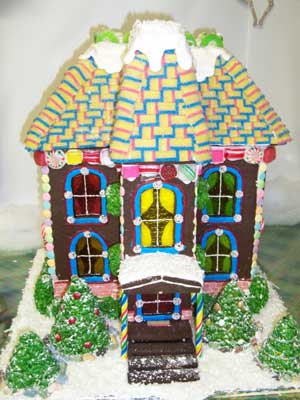
Now is the time for holiday bakers to think about the creation of a magical Gingerbread House to enter into the 9th annual Gingerbread House Competition at the Country Christmas Faire, held November 25 – 27 at the Nevada County Fairgrounds.
Houses, bungalows, cottages, and castles fashioned from spicy gingerbread will be displayed for holiday shoppers to enjoy at the Nevada County Fairgrounds in Grass Valley during the Thanksgiving weekend festivities.
Competitors may enter any of the 11 categories, including children, teens, adults, special needs, families, groups and businesses. There’s even a category for children under 8 years of age who want to enter a house made by a kit.
Prizes and ribbons abound for all. First through third place winners will receive award money, and the Best of Show will win $100. A special gift basket from Tess’ Kitchen Store will be awarded to the Best of Show winner and the People’s Choice Award.
Entry forms must be received at the Fairgrounds by Friday, November 18; the actual gingerbread house entry must be delivered to the Fairgrounds on Tuesday, November 22. The cost is $2 to enter, and all Gingerbread House exhibitors will receive two free passes to the Country Christmas Faire.
Entry forms and a complete list of rules can be picked up at the Fairgrounds office on McCourtney Road, or downloaded from the Fair’s website at www.NevadaCountyFair.com.
The 27th annual Country Christmas Faire begins Friday, November 25, and runs through Sunday, November 27. The hours are 10 am – 5 pm on Friday and Saturday; and 10 am – 4 pm on Sunday. Admission is $4 for adults, and children 12 and under are free. Parking is $5; however, Faire-goers will receive one free admission for each paid parking pass.
Talented artisans fill the Fairgrounds exhibit buildings with quality hand-made crafts and unique gifts, so you can get all your holiday shopping done in one location. Visitors to the Faire will enjoy strolling live entertainment, festival foods, wagon rides, and a community bon-fire. Santa Claus and Mrs. Claus will be on hand to greet children and a photographer will be available to capture the special moment with Santa.
Free babysitting will be offered so parents can drop off their children while they enjoy holiday shopping, and errand elves will be available to assist shoppers throughout the event.
The Nevada County Fairgrounds is located at 11228 McCourtney Road in Grass Valley. For more information, visit www.NevadaCountyFair.com or call (530) 273-6217.
Click on picture to enlarge, click on picture to return to normal view.
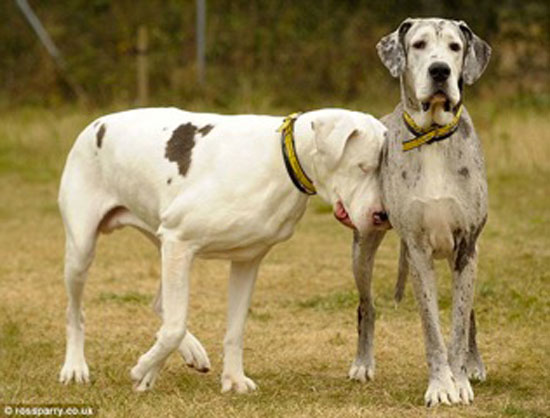
A friend of mine sent these pictures. It’s so touching, I had to put it on this blog.
Lily is a Great Dane that has been blind since a bizarre medical condition required that she have both eyes removed. For the last 5 years, Maddison, another Great Dane, has been her sight.
New York Times
Closing costs can increase the price of a home by as much as $10,000, sometimes more. Borrowers who are “cash-poor” can ask for assistance, or talk to their lender about a lender credit toward closing costs.
Some lenders advertise that if borrowers agree to accept a mortgage interest rate from a quarter to a full percentage point higher than they would ordinarily qualify for, they can receive credit toward their closing costs.
These mortgages are sometimes called no-closing-cost loans, though the term is misleading. The credit usually covers only fees charged by the mortgage broker or bank, like the loan origination fee, the underwriting expense, and the appraisal. That generally leaves title insurance, mortgage-recording taxes, insurance, and escrowed taxes to cover.The amount of credit depends on total closing costs and other loan details. Generally, for every one-eighth of a point increase in interest rate, borrowers receive a credit worth half a percentage point of the principal amount.
While these mortgages can be helpful to some, borrowers should carefully review all the details. There are pluses and minuses to these loan types. A downside is the higher rate and monthly payment remain in place through the life of the loan.
Doing a side-by-side comparison of loans with and without the credit can be helpful.
Loans in foreclosure have been delinquent an average of 624 days — a record high, according to Lender Processing Services’ September report.
The time loans spend in foreclosure continues to increase. For example, 40 percent of home owners with loans in foreclosure have failed to make a payment within two years, and 72 percent of home owners have failed to make a payment in a year or more.
The time from the last payment to foreclosure sale has been found to be even longer in judicial states, in which foreclosures must be approved by the courts. The time span in judicial states is averaging 761 days, six months longer than non-judicial states, LPS reports.
While loans are spending longer in foreclosure, the number of foreclosure starts is decreasing. Foreclosure starts decreased 11.2 percent in September compared to August, and foreclosure starts are 15 percent below a year earlier, LPS notes in its recent report.
The states with the highest percentage of loans in delinquency or foreclosure are:
Florida
Mississippi
Nevada
New Jersey
Illinois
The states with the lowest: North Dakota, South Dakota, Wyoming, Alaska, and Montana.
Watch how future technology will help people make better use of their time, focus their attention, and strengthen relationships while getting things done at work, home, and on the go. (Release: 2011)
Thinking of buying or selling?
For all your real estate needs
Email or call:
John J. O’Dell Realtor® GRI
(530) 263-1091
Email jodell@nevadacounty.com