I’m wishing all of you a very happy Fourth of July, 2010!
httpv://www.youtube.com/watch?v=MeFi3SDi_n8
John J. O’Dell
Real Estate Broker
General Contractor
Civil Engineer
Contact 530-263-1091

I’m wishing all of you a very happy Fourth of July, 2010!
httpv://www.youtube.com/watch?v=MeFi3SDi_n8
John J. O’Dell
Real Estate Broker
General Contractor
Civil Engineer
Contact 530-263-1091

As the housing downturn has shown, homeownership is about more than buying a home – you have to make sure you can keep the home over the long term. If you’re thinking about buying a home, these five steps can help ensure you get the right house for you and the affordable financing that helps make homeownership a long-term success:
1. Get Educated. A little mortgage know-how goes a long way toward ensuring you get an affordable mortgage
Before you hire an agent or find a lender, get educated on the loan process and key factors that make a loan affordable. You’ll want to know about loan types – fixed-rate mortgages, adjustable-rate mortgages, FHA and VA loans – and the full range of line items that contribute to the total cost of securing the loan, including discount points, appraisals, and real estate agent commissions.
If you would like more in-depth information, the Department of Housing and Urban Development (HUD) can put you in touch with the nearest housing counseling professional in your area. Visit www.HUD.gov for more information. You can also check with local government, neighborhood associations and neighborhood bank branch offices for information sessions on home buying as well as homebuyer-education programs.
Continue reading Five Steps to Take Before Buying a Home
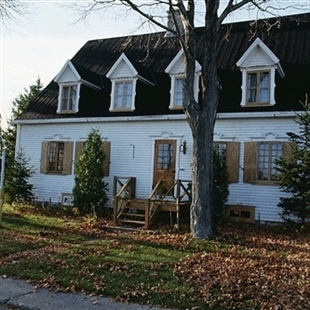
A new report estimates that nearly one in five mortgage defaults through the first half of 2009 were “strategic,” where borrowers who appeared to have the capacity to pay their mortgages stopped doing so.
The research follows on an earlier report by Experian and Oliver Wyman that first aimed to quantify the share of mortgage defaults that are “strategic.” Strategic defaulters are defined as those who miss six straight mortgage payments without missing multiple payments on auto loans and other consumer debts for the six months after they first fell behind on mortgage payments.
The report finds that the share of borrowers who strategically defaulted through the first half of 2009 is unchanged from the end of 2008. Still, the absolute number of strategic defaults in the first half of 2009 increased 53% from the year ago period.
Government-sponsored mortgage purchaser Fannie Mae is trying to encourage distressed homeowners to find alternatives to foreclosure by banning those who walk away from getting new loans for seven years.
Troubled borrowers who do not try in good faith to work out a deal, but have the capacity to pay, are targeted by the policy announced June 23, 2010.
“Walking away from a mortgage is bad for borrowers and bad for communities and our approach is meant to deter the disturbing trend toward strategic defaulting,” said Terence Edwards, executive vice president for credit portfolio management.
A strategic default occurs when a homeowner stops making payments on a mortgage despite being able to do so. It has become increasingly common in communities where housing values fell sharply and homeowners are “underwater,” or owe more than their houses are worth.
Fannie Mae said that in locations where the law allows, it also plans to take legal action to recoup outstanding mortgage debt from borrowers who strategically default. The company plans to instruct its servicers to monitor delinquent loans facing foreclosure and recommend cases to pursue for such judgments.
httpv://www.youtube.com/watch?v=P4HrgcbUIUc
By Jeff Toff
This is Logan who was born on St. Patrick’s day! 5 years ago. He was a champion show dog, winning every show he entered except one. He retired from the ring and became my hiking buddy. Logan is the gentlest giant around. When other dogs–big or small–growl at Logan, he just wags his tail and gets excited. When another dog tries to bite Logan, he merely jumps out of the way and comes back for more. Despite the fact that Logan is still “intact,” has never growled or shown any male dominance or aggressive behavior. As a matter of fact, he ran at full speed away from two “attack” cats and one kitten. He chases anything that runs, but then again, doesn’t know what to do when he catches up with his prey. When another dog comes into Logan’s dog room, Logan watches patiently as the other dog eats all of Logan’s food.
Logan sleeps on a full size mattress. To create a dogie door, we had to remove the entire bottom of the door, up to the door knob. Even though he is unfenced at home in the woods, he never leaves the house unless I am there to take him for a walk. On hikes in the high country, he runs around and explores the sites and sounds but never ventures too far from me.
He is quite shy with strangers. When riding in the car down to San Diego, an 11 hour trip, Logan never makes a sound or becomes anxious. He watches the view from the back of the van, drools on my shoulder when it gets too warm and generally relaxes during the trip. He loves to hike as long as there is a lake or stream in which he can cool down. He prefers water not more than 2½ feet deep so that he can lie down and keep his head out of the water.
When playing with other dogs or people, he lopes like a big lion. However, at times, when he decides to chase something, he gallops on those long legs like a gazelle. It has been reported that Irish Wolfhounds, part of the greyhound family, can run up to 30 MPH–when they want to. When he goes to a dog park in San Diego, he gets intimidated because immediately, almost every other dog in the park run over to Logan and begin sniffing and nuzzling him like he is royalty.
He eats about 6 cups of dry food per day but drinks gallons of water. Many times he won’t eat his food or dog bones unless someone is next to him while he eats. A string or ribbon tied across the hall keeps him from exploring the rest of the house. When it snows, you would think he was just served ice cream. He runs and jumps and rolls in the snow. Many times he would prefer to lie in the snow rather than come into the house. He almost never barks. He thinks he is a small, lap dog. He is the perfect companion.
Jeff Toff
Jeff is a local attorney in Grass Valley, CA

by Lisa J. Lehr
It’s been a long, cool spring, but it’s bound to get hot one of these days. And when it does, human bodies will be heading for water bodies in droves.
There’s no question that swimming cools you off, provided the water temperature is lower than your body temperature—which it is, unless we’re talking about a hot tub or a hot spring. But is swimming the equivalent of a glass of lemonade: cools you off, but has no real health benefits? Or is it really good for you?
Well…it depends.
First, the pluses of swimming as exercise:
1. It uses all your major muscle groups.
2. It can provide a good workout for your heart and lungs.
3. It’s easy on your joints.
4. The buoyancy factor (you weigh about one-tenth as much in water as you do on land) makes it a good exercise for people who are pregnant, have injuries, or need to avoid high-impact types of exercise.
5. It’s appropriate for people of all ages and ability levels.
Now the minuses:
1. In order to count swimming as exercise, you’ll need to swim a good number of brisk laps (floating and splashing won’t do it), and some people find that monotonous.
2. Swimming puts no stress on your bones, and weight-bearing exercise is essential for maintaining bone mass and strength.
3. Swimming makes you hungry, so the calories you consume after a swim may exceed those you burned during the swim.
4. Unlike with other types of exercise, your body does not continue burning calories at an increased rate after your workout. This is because you don’t heat up as much exercising in water as on land; you lose body heat faster to water than to air because water is denser, so your body doesn’t have to work to cool you down post-workout.
5. Finally, if swimming is to be your workout of choice, you need convenient access to a pool. The “inconvenience factor” may become a convenient excuse not to exercise.
So if you like swimming, find that it meets your exercise needs, and is convenient and not too boring, go for it. But if you’ve been swimming for a while and wondering why you’re not seeing the results you expected, now you know why! You may want to explore some other type of exercise.
And if you’re heading for a natural water body, especially the fast-moving, snowmelt-fed rivers of Nevada County, remember that humans (and other land creatures) and cold, white water are a dangerous and often deadly combination. Especially when alcohol is involved.
Lisa J. Lehr is a writer, copywriter, and fitness enthusiast living in Grass Valley. She can help you promote your business with a full range of online and offline marketing pieces. A member of Empire Toastmasters, she’s available to speak to your business or professional group. Visit her website www.justrightcopy.com for more information, opt in for a message series, and receive a free Marketing Guide.
—
Lisa J. Lehr
I write words that make you money–just ask me how.
www.justrightcopy.com
Visit my website and sign up for my fr~ee marketing tips.
New! No~cost Marketing Guide now available at my website.
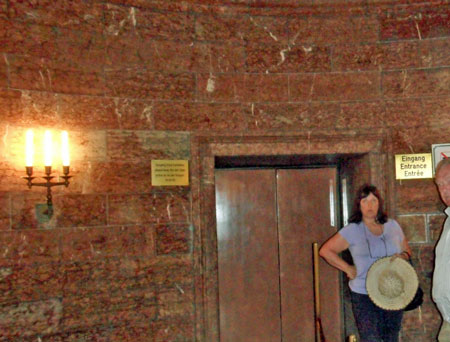
A place of great beauty, in which a residence was built for the devil reincarnated, Adolf Hitler. Situated upon a mountain top in the Alps, at an elevation of 6,017 feet above sea level, it has breath taking views of the mountains and valleys below. Since then, the idyllic setting and remarkable architecture of the Eagle’s Nest on the Kehlstein have been overshadowed by its close connection with the Third Reich. Although Hitler rarely stayed in the building himself, his wicked tyrannical image still hangs over it today.
httpv://www.youtube.com/watch?v=nrHYUlWNm1k
Given this background, it is not surprising that a plan to demolish the Eagle’s Nest was very nearly approved in the 1960s. Just as Hitler’s command centre on the Obersalzberg had been destroyed by the bombs of the liberating Allied forces, so, it was hoped, would the Eagle’s Nest be wiped forever off the face of the beautiful Bavarian landscape. As it turned out, however, history took a different course, and the building has been administered by the Berchtesgaden Regional Tourist Office since 1960. Today, the Eagle’s Nest is leased out to private operators who run it as an alpine restaurant. The engineering feats and mighty architecture of the building leave many visitors speechless. Even the approach from the carpark is imposing: a tunnel of 124 metres in length, lined with panels of natural rock, runs through the mountain massif. At the end of the tunnel there is a grandiosely designed brass-plated lift. The lift ascends to the interior of the Eagle’s Nest in just forty-one seconds. Inside, visitors are surrounded by metre-thick walls and mighty bulwarks. At 1,834 metres above sea level, the Eagle’s Nest commands a breathtaking panoramic view.
The Kehlsteinhaus was commissioned by Martin Bormann, with construction proceeding over a 13-month period. It was completed in the summer of 1938, prior to its formal presentation to Hitler on his 50th birthday on April 20, 1939. It is situated on a ridge at the top of the Kehlstein Mountain 1,834 m (6,017 ft), reached by a 6.5 km (4.0 mi) long and 4 m (13 ft) wide road that cost 30 million RMs to build (about 150 million euros in 2007, adjusted in line with inflation). It includes five tunnels but only one hairpin turn and climbs 800 m (2,600 ft).
The last 124 m (407 ft) up to the Kehlsteinhaus are reached by an elevator bored straight down through the mountain and linked via a tunnel through the granite below that is 124 m (407 ft) long. The inside of the large elevator car is surfaced with polished brass, Venetian mirrors and green leather (the elevator is still used daily). Construction of the mountain elevator system cost the lives of 12 construction workers.The main reception room is dominated by a fireplace of red Italian marble, presented by Mussolini. Much of the furniture was designed by Paul László.
The Eagle´s Nest itself and the unique Kehlstein road were constructed in an extremely short period of time despite the difficulties of wartime: the fortress-like residence took one year to build, the Kehlstein road thirteen months. The unique design of the road has no counterpart anywhere in the world. It makes no more than a single bend in its ascent of the towering 700 metres between the Obersalzberg and the Kehlstein carpark, traversing the steep north-west face of the Kehlstein twice as it does so. The road is now closed to normal traffic; it can only be accessed by a bus service.
Arriving by airplane form Catania, Sicily about 9:00 AM, our first hint that this was a different sort of town was when we took a waterbus from the airport instead of a bus or a taxi. There is actually a “water road” marked by large piers on either side, to guide the boats through the water, each boat keeping to its right, just as in a car driving situation. On the way we passed the Island of Murano, famous for its glass blowing companies, and Museum.
Then, we were in the Gran Canal, surrounded on both sides by beautiful palaces, boats, people and lots of things to look at. Our hotel was very near the Rialto Bridge, one of the most famous sites in the city. Many of the Gran Canal pictures were taken from that bridge.
httpv://www.youtube.com/watch?v=HnsOKNiFUrs
One of the most wonderful things about Venice (besides all the canals and boats), is the absolute lack of any motorized vehicles, cars as well as the ever present motor scooters in the rest of Italy. It was total pedestrian bliss; even the crowds of tourists were not too bad.
In the afternoon, we walked to Saint Mark’s Square, although somehow we ended up at Accademia, we soon corrected ourselves and came to the famous plaza. Aside from the famous church (which was undergoing some reconstruction or cleaning work, was and partially covered), the first thing you noticed was all the crazy tame pigeons… all over people if they held still, or had some grain to feed.
Although the church and Doge’s Palace were closed, we rode the elevator to the top of the Campanile bell tower, and got some fantastic shots of the view of Venice in all directions.
Early the next morning we again arrived in the area, and this time took the tours of both Saint Mark’s Basilica (beautiful and technically free, but every time you turned the corner they wanted several Euros to go further, we were quite disappointed) as well as the Doge’s Palace (quite worth the cost), including the trip over the covered “Bridge of Sighs” into a medieval prison that must have been quite ghastly when in use… we could just imagine the smells and the sounds. We also toured the Correr Museum, and returned via the crazy twisted streets, bridges, and covered walkways, finishing with a fantastic dinner on a piazza under the lights.
Two days is certainly not enough for Venice, so we are scheduling this one for a return visit.
by Lisa J. Lehr
In an earlier post, I talked about the importance of autoresponders: those little automated messages that your website visitors get when they opt in to (i.e., put their name and e-mail address in the boxes) your website. In doing some outreach to local businesses recently, however, I discovered that not only does the average local business not have an autoresponder series…they don’t even have a website!
Grass Valley-area businesses, the 21st century is calling: you need a website.
These days, getting a website up and running is not a major project that you need to budget thousands of dollars for. You have many options with a range of prices and skill requirements. Check out XSitePro, FrontPage, Dreamweaver, and Godaddy’s Website Tonight. You can even set up your website as a blog using WordPress and choosing from their many free themes; you also have the choice of installing the blog directly on the domain name and forgoing the “/wordpress” extension. If you can’t (or don’t have time to) do this yourself, hire a teenager or someone from Elance.com.
Once you decide which way to go, the important thing is not flashy graphics or the latest technological bells and whistles, but good content. You’ll need plenty of informative material that establishes you as an expert in your niche. Besides making you look like a genius, free content has the desirable effect of making people feel indebted to you. End result: when they need your product or service, they come to you, not your competition.
Articles, downloadable free reports…free content takes many forms. And don’t forget the opt-in—that’s how you stay in touch with your prospective customers and maintain that top-of-mind awareness. Skyrocket Your Sales
Now, how many Grass Valley-area business owners reading this will decide that this is the final piece of convincing evidence they needed to put up a website? And how many of them are your competition?
Lisa J. Lehr is a writer and copywriter living in Grass Valley. She can help you promote your business with a full range of online and offline marketing pieces. A member of Empire Toastmasters, she’s available to speak to your business or professional group. Visit her website www.justrightcopy.com for more information, opt in for the message series, and receive a free Marketing Guide.
—
Lisa J. Lehr
I write words that make you money–just ask me how.
www.justrightcopy.com Visit my website and sign up for my free marketing tips.
New! No cost Marketing Guide now available at my website.
One of the days we took a beautiful cruise to Panarea and Stromboli, with the purpose “to see Stromboli at night.” Stromboli is an active volcano for the last two millennia, spewing sparks and red hot rocks into the air. In the daylight, you can only see puffs of steam but at night it is fantastic, about every 10-15 minutes there is an explosion as you can see several in the video.
httpv://www.youtube.com/watch?v=sE12zeX8mVw
First we stopped at Lipari the biggest island, and the administrative head of the whole group of about 7 livable islands, and some rocky crags, as you will see. That was just to take on passengers, so we only got shots from the Boat. Lipari is a white island, rich in pumice. The Aeolian Islands’ culture extends back 6000 years and there is evidence of trade with virtually every Mediterranean culture from the Etruscans to the Greeks
Then we were off to Panarea, where we were able to get off for an hour, and have some gelato! Panarea is the smallest island and the most exclusive (according to the tour book), it is known for its coves (you will see a neat one), rocky islets, clear water for diving, and nightlife.
After that stop we went to Stromboli, had several hours wandering the island and having a nice dinner at reasonable rates. We also saw a (clearly) state sponsored film about the lava flow and emergency services protections in place on the islands. Ha! With the volcano erupting every 15 minutes and recent lava flow in 2001 that covered some houses, they can use all the protection they can get, but we can’t say it made us feel any safer! Then out trip at night, around the back for the show, and back to Vulcano.
A bit about Vulcano, it is technically a “spent Volcano” but it still has a constant sulphur emissions seeping out of the ground all over… and I mean all over, sometimes in the ocean, causing little warm pockets of water, sometimes just out of the side of the mountain and a lot from the crater itself, as well as the famous fanghi mud baths (too stinky for Judy). It turns the rocks yellow and red, and on one side there is a beautiful black sands beach we walked. As you drive around you frequently smell the rotten eggs result of the emissions, thankfully not where we stayed though!
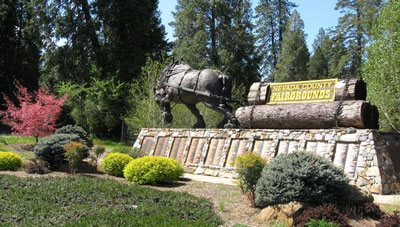
The Nevada County Fairgrounds was recently recognized by the California Heritage Council (CHC) with an Award of Achievement and Recognition for historic preservation.
The Fairgrounds, established in 1938, was recognized for its natural beauty, expansive green lawns, hundreds of tall pine trees, and for the many community events that attract people from all over the country to historic Nevada County. Community events cited in the nomination letter include the Nevada County Fair, the Draft Horse Classic, Music in the Mountains, the Blue Grass Festival, and the Celtic Festival.
“The values represented by these events, presented in this extraordinary setting, are among the best heritage assets in Northern California,” said John Hodges, Board Chair of the California Heritage Council.
The Fairgrounds was nominated for the award by Dr. Susan Walima, a resident of Grass Valley and a Board member of the California Heritage Council. Walima has been active in the CHC for almost two decades.
“I nominated the Nevada County Fairgrounds because of its foothills beauty, the magnificent trees, the small town sense of historic community, and for all the incredible events that take place at the Fairgrounds,” said Walima. “I’ve successfully nominated three prior award sites and buildings, and I wanted this year to honor the Nevada County Fairgrounds.”
Sandy Woods, Fairgrounds CEO, and Ed Scofield, Nevada County Supervisor and Fairgrounds Foundation President, will accept the award on behalf of the Fairgrounds at the Council’s Annual Award Ceremony on June 30 at the Saint Francis Yacht Club in San Francisco.
The California Heritage Council, the oldest historic preservation organization in California, is dedicated to preserving and honoring those places and buildings that have given quality and distinction to the cultural life of California.
The Nevada County Fairgrounds is located in Grass Valley, 50 miles northeast of Sacramento, off Highway 49. For directions, event details or general information, visit www.NevadaCountyFair.com or call (530) 273-6217