This is a great video, it has a thirty second commercial at the start, but it is really worth watching.
In Bozeman, Mont., Anders Lewendal is hard at work building a home he hopes will be a blueprint for creating jobs in America.
Lewendal, an economist turned builder, is constructing a house made entirely from U.S.-made products. Everything from the nails, screws and bolts, to the steel, staples and bathtub is made in the United States.
“Every piece here is made in America,” he said.
Lewendal is convinced that if every builder bought just 5 percent more U.S.-made materials, they would create 220,000 jobs. The Boston Consulting Group agrees, confirming that Lewendal’s numbers add up.
Just as in 2011, in 2012 many will be trying to figure out where housing is headed. While the housing market didn’t worsen in 2011, it also didn’t stabilize either. This year, the story will be about local markets. While many housing markets rose and fell together, they’re recovering at difference paces so talking about housing on a national level is not beneficia
Confidence and jobs: Housing is more affordable than it has been in decades, but many would-be buyers are worried about buying today if prices are going to be lower tomorrow. Still, others don’t want to buy a house until they have more evidence that they’re not going to get laid off or see their hours cut back.
Foreclosures: Banks and other mortgage investors own around 440,000 foreclosed properties, but there’s another 3.4 million loans in foreclosure or serious delinquency, according to estimates by Barclays Capital. Because banks are faster to cut prices to unload inventory than are traditional sellers, home values can fall further as the share of distressed sales rises.
Rents: If low mortgage rates aren’t enough to give urgency to would-be buyers, rent hikes could accelerate buyers’ decisions to take the plunge.
Mortgage credit and rates: It’s still hard for many buyers to get approved for a mortgage because banks are demanding lots of documentation of borrowers’ incomes.
Regulation: Many analysts don’t expect Congress to make major changes to Fannie Mae and Freddie Mac during the election year, but several major regulatory changes could significantly reshape the future of the lending landscape in 2012.
Meanwhile, the regulator that oversees Fannie and Freddie is revamping the way that mortgage companies are paid for collecting loan payments. This could lead to a broader shakeup in the mortgage industry that ultimately influences how much borrowers are charged for mortgages and how banks handle loans that fall into delinquency.
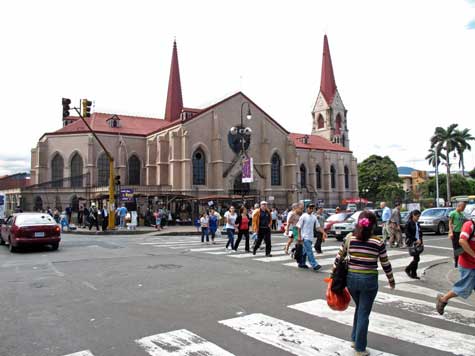
Church Merced San Jose Notice the high fence surrounding the church Photo Courtesy of Artist Hubert Steed http://www.pbase.com/hjsteed/profile
How about going to a country that is absolutely beautiful, but the inhabitants live behind fences, windows with bars and razor wire on top of the fences? Welcome to Costa Rica.
Judy and I went to Costa Rica recently, along with a friend that owns property there. In San Jose, capitol of Costa Rica, we were informed at the car rental agency not to leave our SUV unguarded. If we get a flat tire, keep going, thieves there slash your tires, than come by on the pretense of helping you, but instead proceed to rob you. That’s right get a flat, ruin the rim, but keep going until you get to a service station.
Judy and I were eating at a restaurant in San Jose and I said, look at the front door. She said what? I said, there are two men there with steel pipes in their hands. They are guarding the entrance to prevent being robbed here. Walking back to our hotel, a taxi cab driver went by and stopped to tell us, watch out for thieves, be careful. Nice.
Going to a local bank, there were two guards at the entrance, both with guns behind locked bullet proof glass. They would let one person in at a time, lock the door, search the person, than let repeat the process after a few minutes wait, so there were not too many people in the foyer.
Leaving San Jose, we found much the same thing throughout Costa Rica. Private homes with eight foot fences with razor wire on top, guards at restaurants, stores shuttered at night, windows with steel bars.
Arriving in Nicoya, we broke the rule that the rental agency gave us, leaving our SUV unattended. I parked the car downtown and looked at the street. I saw a lot of school children going home and thought, well, our vehicle should be save.
Wrong, came back thirty minutes later and all our luggage was gone. We called the police and after much jabbering, we were told to drive to the local police station. When we got there, there was an identical vehicle to ours. Robbers had taken a screw driver to the back door lock and stole all the luggage out of this guy’s SUV.
Gone was all of our suitcases, everybody’s medicines my new Sony camera, laptop, I-pad, Bose earphones, Judy’s Kindle and new binoculars, as well as a few gifts we had purchased.
So Judy lost all her luggage which her home insurance policy will not pay because she has a $2,000 deductible. I have AAA and my home policy will pay for most of my loss.
After that, we drove straight to San Jose, got a room for the night and flew back to California. Along the way, we talked to at least three people who knew of similar robberies during their vacation in Costa Rica.
One incident, as told to us, involved a case where armed robbers went into a hotel room and stole everything the tourist had, including the wife’s wedding ring.
Than after we got home, I talked to one of my former clients who had a friend that went to Costa Rica last year and was robbed at gun point while a policeman across the street completely ignored the situation. Then, to top it off, another friend of my told me his cousin went down there with his grandmother and was killed when he resisted the robbers. He was 27 years old
If you are going to Costa Rica, just be careful.
For further information please go to the following sites if you are considering a trip to the land of crime, Costa Rica.
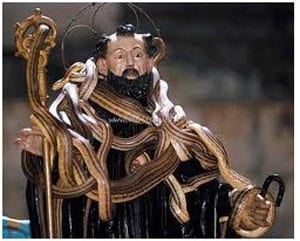
But along came the Roman Catholic Church, who could not approve of such paganism, so we now have the Festival of Saint Dominic (who is the patron saint of the town of Cocullo). Saint Dominic is of course known for many other things, the greatest of which was founding the Dominican order within the Catholic Church. However this legend has the village fields overrun with snakes, and when Saint Dominic cleared the fields of snakes the villagers of Cocullo came up with a lasting show of gratitude, where the effigy of Saint Domenic is draped in snakes and paraded around in May of each year, also known as the Feast of the Serpari. The snakes are primarily of the local variety, four-lined aesculapian, grass and green whip snakes, and are released into the fields at the end of the day. (Humm, I guess we need Saint Dominic to come back and clear the fields again!)
But on feast day the statue is draped in snakes and carried around the town, while many people also allow themselves to be draped with snakes as well. Of course the snakes are all non-poisonous, or have had their fangs removed, but this is not a festival for the faint of heart or anyone with a snake phobia! The festival is held to seek the Saint’s protection from snake bite.
It is believed that the snakes, once on the statue can predict the future. The people in attendance watch the snake behavior carefully. According to custom, if the snakes wind around the head of the statue it is a good sign. But if they go in the direction of the arms or body something bad is ahead.
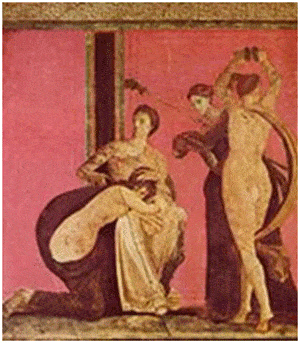
Women celebrating Bona Dea from: abitabout.com/Bona+Dea
By Judy Pinegar
Meanwhile, the Romans who always had to re-name the Greek gods and goddesses to fit their “new” civilization seem to have adapted Angitia into Bona Dea, an ancient and holy Roman goddess of women and healing. Women also referred to her as Fauna, but men were not allowed to use that name, or attend her secret ceremonies and festivals. Bona Dea, “the Good Goddess” protects women through their changes, and is believed to watch over virgins and matrons especially. She was skilled in healing and herb lore, and snakes and wine were sacred to her. As a healing goddess, the sick were tended in her temple garden with medicinal herbs. Bona Dea was portrayed sitting on a throne, holding a cornucopia. The snake is her attribute, a symbol of healing, and consecrated snakes were kept in her temple at Rome, tended by her priestesses.
Under the laws of the Roman republic, patrician women were not supposed to drink wine, and could be punished, if caught. But by calling it “milk” the ancient and sacred practices could be reconciled with the rules of Roman Society. Bona Dea’s secret festival for women was held at night during the First of May, in the house of the chief elected official ( although he was not allowed to attend), the Vestal Virgins officiated, and a great jar of wine was in the room, although it was called “milk” and the jar was called a “mellarium” or honey jar. After making libations to the Goddess Bona Dea, the women drank and danced to music. It is said that later in the history of the empire this festival “degenerated” into wild and extravagant affairs, such as the Greeks had with Dionysus, the God of Wine.
Judy Pinegar is a writer. Part of this three part series appeared in the Corriere della Valle Magazine
Thinking of buying or selling?
For all your real estate needs
Email or call:
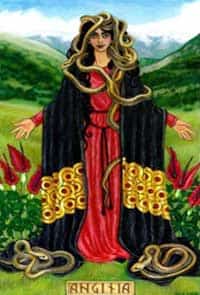
Angitia, Snake Goddess of the Marsi from www.thaliatook.com/OGOD/angitia
By Judy Pinegar
While the region of Puglia is the “heel”, and the Gargano Pennisula is the “spur”, the mountainous regions of Abruzzo and Molise (united until 1963) are the “ankle” of the “boot” that is Italy. The area was settled by Apennine tribes in the Middle Bronze age (2000 to 1700 BC), was later taken over by the Romans, by the Normans in the 12th century, then by a succession of rulers out of Naples. In spite of all this, the Abruzzo region, dominated by the Apennines Mountains, to this day is a brooding, introspective land, with precipitous drops from mountain sides, endless tracks of forests, small towns clinging to mountainsides, a semi abandoned, poor area, one of the last wildernesses of Italy.
Yet the first Thursday of every May, ophidiophiliacs (snake-lovers, often accompanied by their own snakes) come from all over the world come to the town of Cocullo (with a population of 316 persons) for a festival, the Feast of the Serpari (Snake Festival) that has been re-created possibly three different times over the eons of time to become one of the most multicultural, ancient and historic festivals in all of Italy.
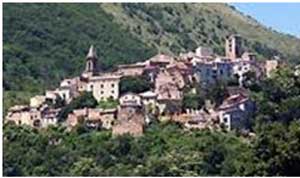
Town of Cocullo (Google pictures)
In pagan times, the tribe of the Marsi ruled this area east of Rome. A tough warlike, mountainous tribe, they were ruled from about 800 to 580 BC (before Christ) by the Eutruscans, and then until 325 BC under the Samnites. The chief divinity in their society was the ancient snake goddess, Angitia. She was an early goddess of witchcraft and healing, associated with verbal and herbal charms, especially against snake bite. Her name referred to killing snakes through enchantment, possibly with just a word from her deific lips. The Greek myths say Angitia was one of the three daughters of Aeetes along with Medea and Circe, two of the most famed sorceresses of Greek mythology. Angitia lived in the area around the Lake Fucinus (later drained) and specialized in curing snake bites.
In north eastern Italy, on the flat landscape of the Venito region, with the spectacular Dolomite mountains in the distance, sits the city on Vicenza. It is home to one of the premier art showcases around the world, called Abilmente, with a spring showing on March 3-6, 2011, and a fall showing on October 20 to October 23, 2011 at the Fiera di Vicenza (Fair of Vicenza) located at Via dell Oreficeria 16, Vicenza, Venito, Italy.
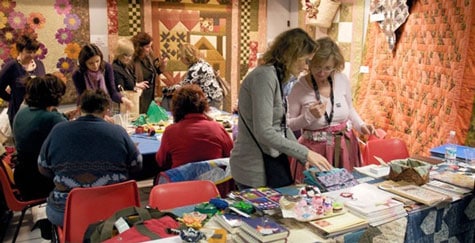
A feature of Abilmente are the “Workshops”(or Ateliers), spaces where the practical aspects and exhibitions combine. The settings will highlight the work of leading artists in each sector, providing plenty of ideas to others. There are chances to participate in several courses held by the leading associations and artists in each sector. The planned workshops are: “A Voyage into the World of Color”, “Patchwork” “Natural Dye” “DIY Fashion: Bijoux and Accessories” and “Creating with Paper”:
This year in honor of the 150th Anniversary of the Union of Italy, there was a special Creative Workshop, on October 20-23, 2011 presented a workshop called Patchwork Atelier. Here the Associazione Nazionale Quilt Italia, the star of this workshop, presented the Italian cultures, images and landscapes of the regions that have united to make Italy a truly great nation. The show displayed, through original pieces of patchwork quilt, the distinctive features that characterize each individual region.