By John J. O’Dell

For all your real estate needs call or email
John J. O’Dell
Real Estate Broker
O’Dell Realty
(530) 263-1091
Email jodell@nevadacounty.com
DRE# 00669941

By John J. O’Dell
For all your real estate needs call or email
John J. O’Dell
Real Estate Broker
O’Dell Realty
(530) 263-1091
Email jodell@nevadacounty.com
DRE# 00669941
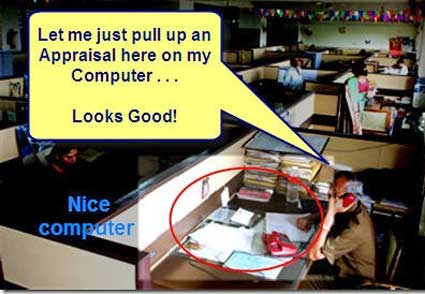
Photo courtesy of Red Clay Media
Despite Federal Reserve regulations that took effect April 1 requiring lenders to pay appraisers fair fees, many appraisers say they are still offered $200 to $250 by lenders for work billed to consumers at $450 or more.
For all your real estate needs call or email
John J. O’Dell
Real Estate Broker
O’Dell Realty
(530) 263-1091
Email jodell@nevadacounty.com
DRE# 00669941

By John J. O’Dell
I wonder why banks call short sales, short sales? Of course, what they mean by a short sale is that they are agreeing to sell a house for less than the mortgage they hold on the property. After that, short sale means you will complete a sale within a period of three months to one year, maybe.
I’ve had two short sales going since November 2010. Last week, one of them gave the go ahead to proceed. Now remember, my buyer has been waiting about five months. So they can wait as long as they want, but they want the buyer to close the deal within 30 days. Of course, they don’t sign the purchase contract, they just tell you go for it! They send you a one sided contract with their very own terms. You ever notice banks make their own rules?
My other “short sale”, started at the same time. Well, seems like the bank lost all the paper work. So they said they were not going to go ahead with the sale.
It’s a good thing my client has a very lady like scream. So the short sale is back on again.
The process is simple, (not) you submit tons of paper work. Then they assign a negotiator who emails you and tells you to upload all the documents you have already uploaded for the second time. (like I said, that’s the same documents that I uploaded in November and they lost)
So I don’t know how long I will have to wait for this second short sale, but I’ll let you know, in the meantime don’t hold your breath. I want you around to read my blogs.
John is a real estate broker
General Contractor and civil engineer
You may reach John at Email jodell@nevadacounty.com

Picture from Design Reviver, The Best and Worse Web Design
by Lisa J. Lehr
In an earlier post, I talked about the importance of auto responders: those little automated messages that your website visitors get when they opt in to (i.e., put their name and e-mail address in the boxes) your website. In doing some outreach to local businesses recently, however, I discovered that not only does the average local business not have an auto responder series…they don’t even have a website!
Grass Valley-area businesses, the 21st century is calling: you need a website.
These days, getting a website up and running is not a major project that you need to budget thousands of dollars for. You have many options with a range of prices and skill requirements. Check out XSitePro, FrontPage, Dreamweaver, and Godaddy’s Website Tonight. You can even set up your website as a blog using WordPress and choosing from their many free themes; you also have the choice of installing the blog directly on the domain name and forgoing the “Wordpress” extension. If you can’t (or don’t have time to) do this yourself, hire a teenager or someone from Elance.com.
Once you decide which way to go, the important thing is not flashy graphics or the latest technological bells and whistles, but good content. You’ll need plenty of informative material that establishes you as an expert in your niche. Besides making you look like a genius, free content has the desirable effect of making people feel indebted to you. End result: when they need your product or service, they come to you, not your competition.
Articles, down loadable free reports…free content takes many forms. And don’t forget the opt-in—that’s how you stay in touch with your prospective customers and maintain that top-of-mind awareness. [link back to article on ARs]
Now, how many Grass Valley-area business owners reading this will decide that this is the final piece of convincing evidence they needed to put up a website? And how many of them are your competition?
Lisa J. Lehr is a writer and copywriter living in Grass Valley. She can help you promote your business with a full range of online and offline marketing pieces. A member of Empire Toastmasters, she’s available to speak to your business or professional group. Visit her website www.justrightcopy.com for more information, opt in for the message series, and receive a free Marketing Guide.
—
Lisa J. Lehr
I write words that make you money–just ask me how.
www.justrightcopy.com
Visit my website and sign up for my fr~ee marketing tips.
New! No~cost Marketing Guide now available at my website.

Source: LA Times
Despite the decline in home prices, 81 percent of U.S. adults believe buying a home is the best long-term investment a person can make, according to a national survey by the Pew Research Center.
For all your real estate needs, call or email:
John J. O’Dell
Real Estate Broker
O’Dell Realty
(530) 263-1091
Email jodell@nevadacounty.com
I had heard about this “robo” signing. But here exposed by 60 Minutes is the story of how they did it. Its simply amazing that the banks and Wall Street created the recession that we are in, but they continue their shoddy practice without regulation even today! Banks can’t find their paper work, so why not fake it and sign anybodies name on the fake paper work. If you or I did that, we would be in jail in a heartbeat, but not the banks. The banks create whatever they need to suit their purpose.
How about punishment, do you think any of the CEO’s of any of these banks are going to jail? What do you think?
For all your real estate needs call or write:
John J. O’Dell
Real Estate Broker
O’Dell Realty
(530) 263-1091
Email John at jodell@nevadacounty.com
By Judy J. Pinegar
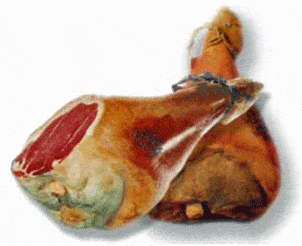
Parma ham is known the world over as Prosciutto de Parma and is made from a pig’s hind leg or thigh. The entire zone for producing this delicately-textured raw ham is within the Province of Parma, in the Emilia-Romagna region of Northern Italy. Its boundaries begin five kilometers south of the via Emilia, run to the shores of the Ena River in the east, and to the Stitrone River in the west. Parma Ham is also guaranteed by a consortium, Consorzio del Prosciutto di Parma, which protects and controls quality and production in the 164 producing companies, 5,000 pig farms with a total economic impact of 1.7 billion euros.
The legs are first cleaned, salted and left for up to two months. Two types of salt are used in the process – “wet” salt covers the exposed part of the meat to keep it moist and “dry” salt is used for the rest of the leg. The leg also needs to be at the right temperature: too cold and it will not absorb enough salt; too warm and it might start to spoil. The curing rooms are on upper floors of the curing house where the temperature and humidity are dictated by nature. The only control is the breeze passing through the many windows and occasionally a dehumidifier. Some medium size firms employ a person whose only job is to open and close the windows
Then the excess salt is removed, and a lighter coating of salt is added to continue the salting process. No other additives or preservatives are used, and it’s absolutely forbidden to freeze a leg that will become Prosciutto di Parma. During the salting process, the prosciutto are given “massages” to remove all of the blood still left in the meat.
After the salting process, the prosciutto are again washed , salted more lightly and hung to dry – usually in climate-controlled rooms so that the air temperature is the same, and most importantly, dry. If there is too much moisture in the air, the meat will spoil instead of curing. The air is also changed frequently. The air is important to the final quality of the ham, the best results are obtained in the cold climate of northern Italy. The amount of time this takes varies, depending on the local climate and size of the ham.
After it’s dried sufficiently, the prosciutto leg is spread with sugna . Sugna is rendered pork fat, which is spread over the exposed part of the prosciutto by hand. Usually the fat is mixed with spices like salt and pepper. The sugna helps protect the exposed part of the prosciutto and keep it from drying out excessively with respect to the interior part of the prosciutto, and therefore ensures you a slice of prosciutto that is tender and moist the entire way through.
At the seventh month, after the sunga is applied, they are moved to cellars for 10-12 months (based on weight) for the maturing period. After the maturing period, a horse bone “needle” is inserted in five points of the joint and the bone is then smelled by master tester for uniformity of aroma and maturation. The needle is inserted into the area covered by the sugna and then the tester will cover up the hole made with the needle with his hand. Only after all passing all these previous steps will finally be fire-branded “Prosciutto di Parma” with its distinct “corona a 5 punte” – a 5 pointed crown brand and the manufacturer’s identification. At this point in time the hams will have lost around 30% of their total weight and the entire process takes up to 18 months.
Sliced prosciutto crudo in Italian cuisine is often served as an antipasto, wrapped around grissini (breadsticks) or, especially in summer, cantaloupe or honeydew. It is eaten as accompaniment to cooked spring vegetables, such as asparagus or peas. It may be included a Tuscan dish of tagliatelle and vegetables, in a filled bread, or as a pizza topping. Saltimbocca is a famous Italian veal dish, where escallops of veal are topped with a sage leaf before being wrapped in prosciutto and then pan-fried. Prosciutto is often served in Panini and sandwiches, sometimes in a variation on the Caprese salad, with basil, tomato and fresh mozzarella. A basic sandwich served in many Italian cafes and bars consists of prosciutto in a croissant.
So picture yourself on a street-side cafe in the Emilia-Romagna region. Your first course is pink, transparent slices of Prosciutto di Parma, fanned out around shaved Parmigiano-Reggiano, soft, plump, green and purple quartered figs and thinly cut mint leaves on a simple white plate. Alongside it stands a glass of golden-tinged Malvasia wine. Sometimes the traditional ways really are the best!
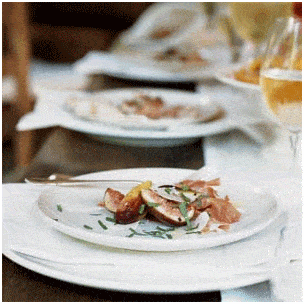
Figs and Prosciutto with Mint and Shaved Parmigiano-Reggiano
Ripe figs are the secret to this simple yet refined salad. It’s best made just before serving.
Ingredients
Preparation
Place figs in a bowl; drizzle with oil. Sprinkle figs with pepper; toss gently. Place fig mixture in the center of a platter; top with cheese and mint. Top with prosciutto.
Yield: 8 servings (serving size: 4 fig quarters, about 1/2 ounce prosciutto, and 1/8 ounce cheese)
Recipe Courtesy of Cooking Light
Source: Judy J. Pinegar
Writer and World Traveler
If you have writing needs you may contact Judy through me:
John J. O’Dell
Real Estate Broker
O’Dell Realty
(530) 263-1091
Email John at jodell@nevadacounty.com
DRE# 00669941
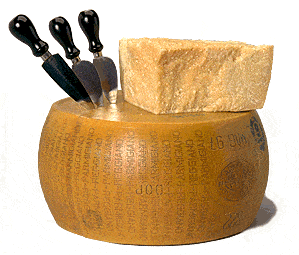
Photo courtesy of Gastronomical Products of Parma
By Judy J. Pinegar
No cheese is as famous and essential to Italian cuisine as Parmigiano, therefore, no visit to the Emilia-Romagna region of Northern Italy is complete without exploring the making of Parmigiano-Reggiano Cheese . Parmigiano is the Italian adjective for Parma, while Reggiano is the adjective for Reggio Emelia, both cities and providences of the same name in the Emilia-Romagna administrative region.
Parmigiano-Reggiano is made from raw cow’s milk, 16 liters (4.2 gallons) of milk per kilo (2.2 pounds) of cheese, and the cows must be fed only on grass or hay. Adding a partly skimmed milk to whole milk, and using copper lined vats for heating and cooling, with additions of natural whey culture (starter), and calf rennet (enzymes from the stomach), the milk coagulates. It then separates into solids (curds) and liquid (whey). The compacted curd is collected in muslin for cheese making, and the remaining whey is fed to the pigs from which Parma Ham will be produced! In many farms in Emilia-Romagna, the barns for the pigs are just yards from the cheese producing rooms.
The cheese is put into a stainless steel round form, pulled tight by a buckle so the cheese retains a wheel shape, and then imprinted several times with the words Parmigiano-Reggiano, the plant number, month and year of production. After brining in salt water the approximate salinity of the Mediterranean Sea, for 25 days, the wheels are then aged for at least 12 months. At this point each and every cheese is inspected and graded by the Consorzio (Consortium) Parmigiano-Reggiano. The cheese is tested by a master grader whose only tools are a hammer and his ear. By tapping the wheel at various points, he can identify undesirable voids and cracks within the wheel. Those that pass the test get the Consorzio’s logo branded on their rinds while cheeses that do not make the grade are stripped of all markings.
More aging follows and some people think Parmigiano-Reggiano is best at 24 to 30 months when it is still soft and crumby, with tiny crunchy areas from the salt, yet rich and complex. The cheese has a sharp, complex fruity/nutty taste and a slightly gritty texture. Inferior cheeses can impart a bitter taste. The name is trademarked, and in Italy there is legal exclusive control exercised over the production and sale of Parmigiano-Reggiano, under a governmental decree.
The average Parmigiano-Reggiano wheel is about 18–24 centimeters (7.1–9.4 in) high, 40–45 centimeters (16–18 in) in diameter, and weighs 38 kilograms (84 lb).
Uses for Parmigiano-Reggiano include being grated over pasta, stirred into soup and risotto, and eaten in chunks with balsamic vinegar. It is also a key ingredient in Alfredo sauce and pesto. In Emilia-Romagna it is often paired with pears and walnuts and enjoyed as a dessert at the end of a meal.
Outside Europe, most notably in the United States, commercially produced imitator cheeses may be legally sold under the generic name “Parmesan.” Parmesan is the French-language name and also is the informal term for the cheese in the English language. The name Parmesan is also used for cheeses which imitate Parmigiano-Reggiano, with statements such as “Italian hard cheese” to skirt legal constraints. In North America parmesan cheese is only aged for 20 months, and the milk used is pasteurized, Parmigiano-Reggiano on average contains two-thirds less salt than the average Parmesan so be sure you get the real thing if you are a true Italiano!
Written by Judy J. Pinegar
World Traveler & Writer
Need articles written? You may contact Judy through me
John J. O’Dell
Real Estate Broker
O’Dell Realty
(530) 263-1091
Email John jodell@nevadacounty.com
DRE #00669941
The blueberries found in blueberry bagels, cereals, breads and muffins are REAL blueberries right? Wrong! Award-winning investigative journalist Mike Adams, the Health Ranger, exposes the deceptive chemical ingredients and dishonest marketing of “blueberry” products from big-name food and cereal companies. The blueberries, it turns out, are made from artificial colors, hydrogenated oils and liquid sugars.
Source Food Investigations
See my blog on Captain Crunch Berries Not a Fruit
For all your real estate needs, call or email:
John J. O’Dell
Real Estate Broker
O’Dell Realty
(530) 263-1091
Email John jodell@nevadacounty.com
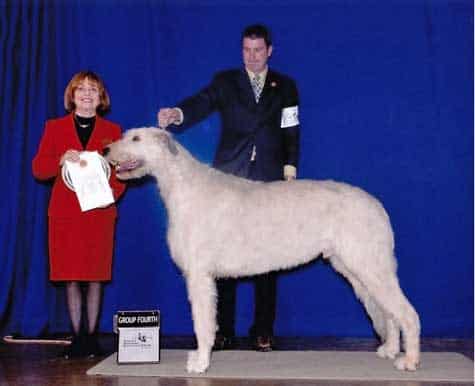
Gail Hawksworth with Cruiser
Earlier I had written about Logan, an Irish Wolfhound taller than his master. Now here’s Cruiser, Logan’s son and also first class of his breed. By the way, Cruiser is bigger than Logan!
Here’s Cruiser’s story as told by his owner Gail Hawksworth ,
“Cruiser is my best friend. He is much larger than his dad. He will be 5 this June. (Logan is 6 or 7 Yrs. old now) weights 184 lbs. and is 37 in. to his shoulders. Standing on his hind legs he is well over six and a half feet tall.
He is America’s number 1 Irish Wolfhound for 2010 in All Systems and the First Irish Wolfhound to received the title of Grand Champion in America. He also has other titles he has received === International / National Champion, T.D.I (therapy dog international) C.G.C (canine good citizen) and T.T. (temperament tested).
He is retired now and enjoys his therapy work which consist of giving sloppy licks to those who wants them and putting smiles on faces. He goes to hospitals, convalescent homes, schools and all different public events.
Has his dad they give some much love to all that comes in contact with them. They are truly ” Gentle Giants ” He is his father’s son —— : )
By the way, Cruiser’s full name is GCH.CH.MYSHAM OF REDWALL T.D.I, C.G.C, T.T ” CRUISER ”
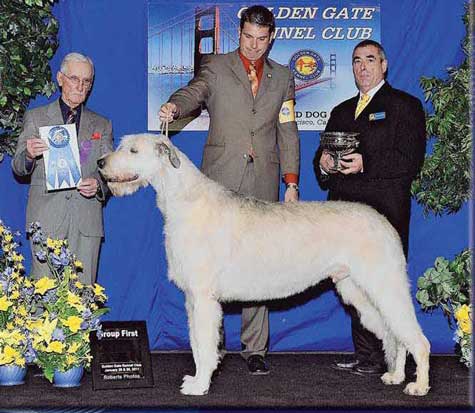
See also Irish Wolfhound, Logan, A Dog Taller Than Its Master
For all your real estate needs, call or email:
John O’Dell
Real Estate Broker
O’Dell Realty
(530) 263-1091
Email John jodell@nevadacounty.com