Merry Christmas To All
httpv://www.youtube.com/watch?v=nLazKA9KTYk
This is a wonderful video, with 1,750,000 views
Merry Christmas and may you have a wonderful New Year
John O’Dell
Broker
General Contractor
Civil Engineer

httpv://www.youtube.com/watch?v=nLazKA9KTYk
This is a wonderful video, with 1,750,000 views
John O’Dell
Broker
General Contractor
Civil Engineer
Frisco Christmas Lights – Wizards in Winter
httpv://www.youtube.com/watch?v=szLmAPW39uE
Happy Holidays
John O’Dell
Real Estate Broker
General Contractor
Christmas Lights, 1,400,0000 Dancing Lights 2008,Vancouver,BC Canada
httpv://www.youtube.com/watch?v=a_r51SHfD8E
12 Days of Christmas (This video had 4,500,000 hits)
httpv://www.youtube.com/watch?v=owK5tHjL0aE
Merry Christmas – Happy Holidays
John O’Dell
Real Estate Broker
General Contractor
Alvin and The Chipmunks: The Christmas Song
httpv://www.youtube.com/watch?v=2dnrosVyamY
Merry Christmas – Happy Holidays
John O’Dell
Real Estate Broker
General Contractor
Civil Engineer
This video had almost 6,000,000 views!
httpv://www.youtube.com/watch?v=rmgf60CI_ks
Happy Holidays
John O’Dell
Real Estate Broker
General Contractor
Civil Engineer
I hope your Christmas is much better than this!
httpv://www.youtube.com/watch?v=z4Yn-9u-r9E
Happy Holiday Season
John J. O’Dell
Real Estate Broker
General Contractor
Civil Engineer
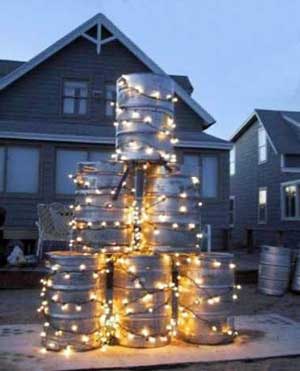
The holiday season is here…and with the holidays comes decorating! The following tips and suggestions will help ensure safety as you get in the holiday spirit.
Calculating Energy Costs For Your Christmas Lights.
It’s that time of year when houses shine a bit brighter. Ever wonder how much the decorative holiday lights add to a monthly electric bill? Here’s an easy way to help calculate energy costs this holiday season.
Source: RISMedia, publisher of Real Estate Magazine
Republished for educational purposes
John O’Dell
Real Estate Broker

Home building rose 8.9 percent in November to an annualized rate of 574,000, the U.S. Commerce Department announced Wednesday.
The rate was still 12.4 percent below what it was in November 2008, but the increases were nationwide, with the Northeast leading the trend with housing starts rising 16.4 percent. Housing starts rose 12.3 percent in the South, 3 percent in the Midwest and 1.9 percent in the West.
Analysts attributed the increase to the extension and expansion of the home buyer’s tax credit. David Crowe, chief economist at the National Association of Home Builders, is cautiously optimistic. “The new credit will have an impact as we move into 2010 and consumers plan for that credit availability, and builders begin to answer expected demand in the spring,” he says.
In another measurement of the industry’s strength, the National Association of Realtors said pending home sales, a forward-looking indicator based on contracts signed, have risen for nine consecutive months. Pending home sales were up 3.7% in October compared to September, and up 31.8% compared with October 2008.
Congress recently extended a tax credit for home buyers, giving first-time buyers until April to claim an $8,000 tax credit. Those who have owned a home for five consecutive years can claim a $6,500 credit for a new home purchase.
“The tax credit is helping unleash a pent-up demand from a large pool of financially qualified renters, much more than borrowing sales from the future,” said Lawrence Yun, the association’s chief economist.
The good and bad of foreclosures is a mixed bag. The bad is that banks which pushed these risky loans are going to take a bath. The bad is that people who are being foreclose on either because of being tricked into a bad loan or loss of income, are going to have bad credit ratings.
The good is that those people who have lost their homes will now have more money to spend.
According to the Wall Street Journal
“Analysts at Deutsche Bank Securities expect 21 million U.S. households to end up owing more on their mortgages than their homes are worth by the end of 2010. If one in five of those households defaults, the losses to banks and investors could exceed $400 billion. As a proportion of the economy, that’s roughly equivalent to the losses suffered in the savings-and-loan debacle of the late 1980s and early 1990s.
The flip side of those losses, though, is massive debt relief that can help offset the pain of rising unemployment and put cash in consumers’ pockets.
For the 4.8 million U.S. households that data provider LPS Applied Analytics estimates haven’t paid their mortgages in at least three months, the added cash flow could amount to about $5 billion a month — an injection that in the long term could be worth more than the tax breaks in the Obama administration’s economic-stimulus package.
“It’s a stealth stimulus,” says Christopher Thornberg of Beacon Economics, a consulting firm specializing in real estate and the California economy. “The quicker these people shed their debts, the faster the economy is going to heal and move forward again.”
So as everything in life, there is the good and the bad, what do you think?
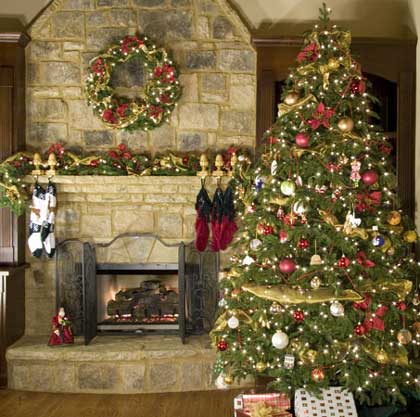
Photo Courtesy of Christmas Lights Etc.
By Elizabeth Dunn, Landscape Architect
It’s the holiday season, when the eggnog is back in the stores, the fruitcakes come out of the cupboard, and my hand is cramped from writing Christmas cards. It is also the time of year for magic and one of the best combinations of aromas. Hot chocolate with candy canes, cloves in oranges, and Christmas trees!
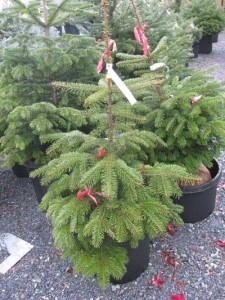
The Nevada County Farm Guide for 2009 lists several places to find Christmas Trees, and some of the local nurseries have live trees available. These trees can be planted in the yard after Christmas. They are not in pots or boxes but have their roots and attached soil wrapped in burlap. In the industry they are called balled and burlapped or B&B on the plant list. It allows for less waste when planting the tree because there are not wooden boards or plastic pots to send to a landfill or recycling center. The tree is planted with the burlap still in place. Before the hole is filled the burlap is pulled back from the top 1/3 of the rootball, the natural fiber rope is cut from the trunk and in a few other spots, and then the hole is filled with the appropriate mixture of planting soil.
I spend a couple Saturdays a month working at Peaceful Valley. They have live trees for sale. Having never worked on a Christmas tree farm, I enjoyed helping people pick out their tree. It was even more magical knowing that they will be able to enjoy the tree well into the future. It is recommended that they plant the tree in their fire safe zone, keep it irrigated for at least the first three years while it is becoming established, and eventually, after several years, remove the lower branches.
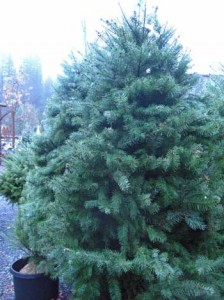
Douglas Fir is one of the favorites. It is listed as native to Nevada County in the Master Garden’s Western Nevada County Gardening Guide. It is not a True Fir tree as its botanical genus name, Pseudotsuga, shows. However, according to the National Forestry Association, it is one of the fastest growing conifers in the temperate forests and is the most important lumber species in the US.
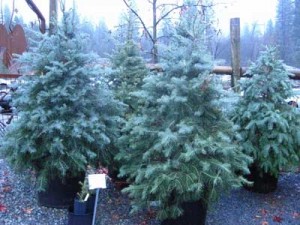
True Fir Trees have the botanical genus name of Abies. With my unscientific poll, this genus is best because of its scent. “It just smells like Christmas!” many friends say. There are several species of True Firs. The Nordman Fir is popular as an indoor potted plant. It has evenly spaced branches that easily showcase a range of ornaments. Sunset’s Western Garden Book notes that the Nordman is one of the best adapted Firs for California gardens.
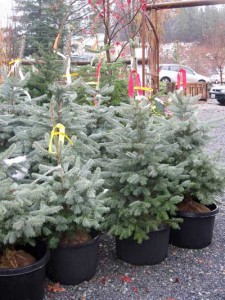
There are so many more evergreen trees out there. The Cedar, Cypress, Pine, Sequoia, and Spruce are all trees that are used for Christmas Trees and decoration. With proper care and the right location, any species of tree will provide years of wonder. Its ornaments next year can be popcorn and red berry chains. The magic will be heard when the winter birds are singing from its branches and it will be felt when standing close to the tree and listening to the silence of the snow as it falls all around.
Happy Holidays!
Elizabeth Dunn is a licensed Landscape Architect. She spends the majority of her work days in the studio of Rebecca Cofffman Landscape Architects in Nevada City, CA
Sources:
Peaceful Valley Farm and Garden Supply
Western Nevada County Gardening Guide
UCCE Nevada County Master Gardeners, c. 2006
Western Garden Book, Sunset Books, sixth printing, c. 1998
Manual of Woody Landscape Plants, Michael Dirr, c. 1998
