History of the Nevada County Narrow Gage Railroad


Nevada County Narrow Gage Museum, Grass Valley, CA

The need for rail service in the semi-mountainous and wooded area of Grass Valley and Nevada City was precipitated by mining operations subsequent to the California Gold Rush. In addition, timber operators wanted to make their land accessible to the Southern Pacific Company in Colfax. On March 20, 1874, the California legislature and Governor Newton Booth approved the right to build and operate a narrow gauge railroad from Colfax, through Grass Valley, to Nevada City. On June 20, an Act of Congress granted the railroad right of way through public lands.

J. H. Bates estimated that construction and equipment would total $411,132. Only one bid came in and it was for $500,000, signed by M. F. Beatty; he received a lump sum of $500,000. Construction began January 1875. Knox were subcontracted for earthwork. John Flint Kidder was the chief engineer. Within two months, 600 men were employed in the railroad’s construction.

Construction included two bridges, two tunnels, and five trestles. After leaving the Colfax depot, the road headed north, parallel with the Central Pacific Railroad, then crossed Bear River, and into Nevada County. One of the first stations was at the town of You Bet which serviced the Goodwin Drift Gravel Mine. The road proceeded into Chicago Park, a fruit and grape growers colony, and then continued into Grass Valley. All cars and locomotives had Westinghouse railway brakes, and cars used for passenger service had Miller Platform couplers. As the first contractor, Beatty, was unable to complete the project, a second, J. K. Bynre, was brought in; construction was completed in the spring of 1876. The inaugural train, from Colfax to Grass Valley, ran on April 11 and by May 20, the first train reached Nevada City.

The company’s first President was John C. Coleman, president of the North Star Mine. Kidder, the builder, decided to settle down in Grass Valley, becoming the General Superintendent, and in 1884, became the second president. Upon his death in 1901, Kidder’s widow, Sarah, took over, becoming the first female railroad president in the world.

In September 1907, a 3.56 mi (5.73 km) “cut-off”, at a cost of $132,285 was built, bettering the grade. The following year, construction was completed on the Bear River Bridge. By 1912, the NCNGRR was running three mixed trains daily, each way, between Nevada City and Colfax, while a fourth mixed train ran daily, each way, between Grass Valley and Colfax. Sarah Kidder sold her interests in 1913 and retired to San Francisco.

In 1926, Earl Taylor and his associates purchased the railroad for $1. With the outbreak of World War II, they sold it in 1942 for $251,000 to Dulian Steel Products Company and the last train to run over the line was on May 29.

Each combination coach had a small iron safe in the baggage compartment. Though $200,000,000 in gold was hauled out of Nevada County by the NCNGRR during its operation, there was never an attempted robbery.

Resources for further information:

Nevada County Narrow Gage Museum

Approximate location map of the museum on Kidder Court, map is a little off of exact location. But this will get you there.


View Larger Map

Enter Your Exhibits in Nevada County Harvest Fair at the Draft Horse Classic

It’s free and all exhibitors will receive free tickets to a Draft Horse Classic performance

Entries are now being accepted for the Harvest Fair, which takes place during the Draft Horse Classic, September 23 – 26, at the Nevada County Fairgrounds. The deadline for Nevada County residents to turn in entry forms to enter exhibits is 5 pm on Monday, September 20. It’s free to enter, and all exhibitors will receive complimentary tickets to the Thursday evening performance of the Draft Horse Classic.

Entry forms are now being accepted at the Fair Office and on-line at www.NevadaCountyFair.com.

There are more than 100 different categories to choose from, including fruits and vegetables, cobblers, harvest pies, scarecrows, dried flowers, jams, honey, cut flowers, produce characters, and birdhouses. There’s even a garden photo contest. So many fun categories to choose from!

There’s also a special division for youth and teens, which includes categories like apple face dolls, decoupage, Halloween masks, painted pumpkins, poetry, table settings, and wreaths.

Exhibitors must either submit paper entry forms at the Fair office or enter online at www.NevadaCountyFair.com.   There is no entry fee for those who enter an exhibit in the Harvest Fair.

Complete descriptions of all Harvest Fair divisions and categories are available online at www.NevadaCountyFair.com, at the Fair’s Office on McCourtney Road, or by calling the Fairgrounds Office at (530) 273-6217.

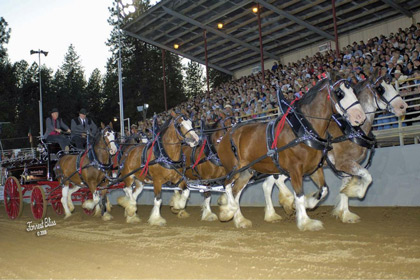
The Draft Horse Classic and Harvest Fair runs September 23 – 26 at the Nevada County Fairgrounds. There are six performances featuring the magnificent Draft Horses – Thursday and Friday at 6:30 pm, Saturday at 10 am and 6:30 pm, and Sunday at 10 am and 4 pm.

In addition to the Draft Horse performances, the Harvest Fair is bustling with activities during the four-day event. Live entertainment, Art at the Classic, Treat Street goodies, a Dutch oven cook-off, a clogging jamboree, a lumberjack show, a live shoeing competition, special exhibits, and visits to the barns and breed pavilion make for a family fun day at the Harvest Fair.

For Draft Horse performance tickets or information about entering a Harvest Fair exhibit, call the Fair Office at (530) 273-6217 or visit www.NevadaCountyFair.com.

By: Wendy Oaks
Publicist, Nevada County Fairgrounds
(530) 273-6217
wsoaks@gmail.com

Five Mistakes Home Buyers Make

Affordable home prices and historically low interest rates have created an ideal situation for many qualified first-time home buyers to purchase a house.  Despite this opportunity, some buyers may be overconfident and make mistakes during the home-buying process.

MAKING SENSE OF THE STORY FOR CONSUMERS

  • Some first-time buyers are unaware of the vast amount of paperwork and negotiations that go into purchasing a home.  As a result, buyers may think they can save money by forgoing the use of a REALTOR®.  However, managing the nuances of offers, inspections, financing, and other pivotal steps when buying a home often causes confusion and anxiety for buyers.  Working with a REALTOR®–who is obligated to put the buyer’s best interests first–will help to alleviate buyer concerns during this process.
  • Online mortgage calculators can help buyers estimate the amount of house they can afford, but calculators should not be the sole source for mortgage-approval information.  Buyers are advised to meet with a mortgage broker or banker prior to beginning the home search to help determine the loan amount for which they are most likely to be approved.
  • Although there is a large selection of homes available for sale, home buyers should not assume they can make low offers or unreasonable demands.  Even in hard-hit housing markets, homes in desirable neighborhoods are receiving multiple offers.

To read the full story, please click here.

John J. O’Del
Licensed Real Estate Broker
Call 530-263-1091

Profitable Coupon Strategies for Small Businesses

Lisa J. Lehr

by Lisa J. Lehr

Coupons are an especially effective strategy for brick-and-mortar, local-clientele businesses. They can work for online businesses as well, but too many potential buyers will decide not to print the coupon because it requires too much ink, because too many clicks are involved and they bail out along the way, or for any of a number of reasons associated with the short attention span Internet use is so famous for.

But coupons that are already printed and right in front of the customer’s face are tempting. So how do you leverage the power of coupons? Here are a few ideas.

Have a stack of them on your counter or in some high-traffic, prominent location at your business. You can mail them, but that can be costly, and without doing some market research, you’ll be mailing them to everyone rather than just your target market.

Swap coupons with another, complementary business. By complementary, we mean businesses that attract the same type of clientele. Pizza and ice cream go well together, as do pizza and video rentals; massage and fitness go together, as do massage and manicure; fitness and fast food aren’t as good a fit, and pairing pizza with manicure isn’t particularly obvious either. Choose your partner business carefully.

Here’s another strategy: a “50-50” coupon offering. Because of the time constraints of the deal, it works best if you have a website with an opt-in and a list of subscribers so you can send the offer to a large number of people at once. This is done as a broadcast, as explained in an earlier article: “Have you heard about the tool that can bring in 90% of your sales?”

So you send a limited offer to your list, say once a week or once a month. Depending on the size of your list, let’s say 100 coupons are available, and when they’re gone, they’re gone. People hurry to your website and those lucky 100 download the coupon. Yes, they will have to print it—but they will be motivated to do so.

The coupon is worth double its face value. For example, the coupon costs $25, and they can purchase $50 worth of goods or services with it. The catch is that they must pay for it immediately–they don’t simply print it and risk losing it or forgetting about it.

You get your $25 right away. The customer is motivated to make a purchase with you because he or she has essentially put down a $25 deposit. Depending on what your product or service is, the average customer may very well spend above and beyond the $50. If you’re a restaurant, for example, where a group of four will spend $100 on a nice dinner, they’re getting a bargain because they’ve saved $25. You’ve made a profit, and you’ve gained four loyal customers. Everybody wins!

The small business owner who capitalizes on simple strategies like these will be the one who survives in any economy.

Lisa J. Lehr is a writer and copywriter living in Grass Valley. She can help you promote your business with a full range of online and offline marketing pieces. A member of Empire Toastmasters, she’s available to speak to your business or professional group. Visit her website www.justrightcopy.com for more information, opt in for the message series, and receive a free Marketing Guide.

Frank Lloyd Wright House May Relocate to Japan

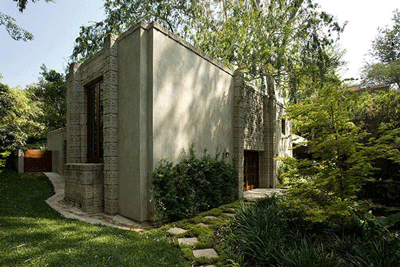
Frank Lloyd Wright house may relocate to Japan An experimental textile block house designed by architect Frank Lloyd Wright could be moved from California to Japan.

La Miniatura in Pasadena was built in the 1920s and is one of four similar houses in South California, reports the Los Angeles Times.

However, it has remained on the market unsold for two years and its asking price has now dropped from $7.7 million to less than $5 million.

Real estate agent Crosby Doe believes that he may now have found a potential buyer via an art dealer based in Japan.

“With my position in the preservation community, I will probably be crucified for saying this,” explained Mr Doe to the newspaper.

He added: “But we have to consider all options. We moved the London Bridge to the Colorado River. Why couldn’t we move this house to Japan?”

The Financial Times recently reported that there has been a surge in the number of Chinese investors purchasing property in Japan as real estate prices continue to fall across the country.

Written by Graham McPherson.