All posts by jd

Real estate broker, civil engineer and general contractor.

New Rules for FHA Loans Makes It Harder to Get a Loan


Due to its wreaking financial problems, the Federal Housing Administration is tightening its lending requirements.

  • The FHA is federally mandated to maintain reserve funds at 2 percent or greater.  As of November, the agency reported that its fund had declined to .53 percent.  The funding is used to cover losses on mortgages insured by the FHA that go into default.
  • Loans insured by the FHA generally are less expensive to borrowers because of the lower down payment requirements.  However, these loans also have fees, such as up-front mortgage insurance.  To help the agency raise its cash reserves, the FHA is increasing the up-front mortgage insurance premium from its current 1.75 percent to 2.25 percent.  HUD released a Mortgagee Letter today making the premium increase effective in the spring.
  • The agency also is raising the minimum credit score requirements.  Currently, borrowers with FICO scores as low as 500 have been approved for FHA-insured loans.  Under the policy changes, new borrowers will be required to have a minimum FICO score of 580 to qualify for the FHA’s 3.5 percent down payment program.  New borrowers with less than a 580 FICO score will be required to put down at least 10 percent.  FHA expects this to take effect in early summer once it passes the normal regulatory process.
  • The new policy also will reduce the amount of money sellers can provide to home buyers at closing to 3 percent, down from its current 6 percent, of the home’s price.  The change brings the agency in line with industry standards and removes the incentive to inflate appraisals.  The FHA expects this to take effect in early summer after it passes the normal regulatory process.

Source: CNN Money

Snow Pictures From My Deck

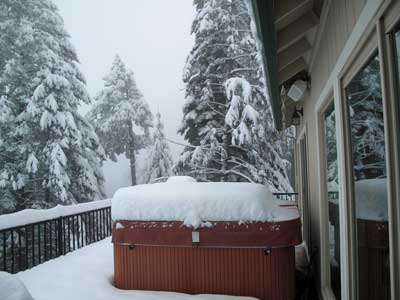
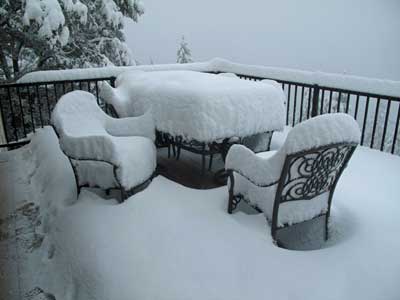
My house is located in Cascade Shores, outside of Nevada City.  I’ve used a GPS and the elevation of the house is 3,700 feet.  On a clear day, you can see Scotts Flat Lake.  On a very clear day, you can see the Coast Range Mountains, but there aren’t too many days when that happens. I took these shots at around 8 am this morning.  There’s 12 to 14 inches of snow, depending upon where I measured on the deck.

Looks like a nice Christmas Tree

The top outside edge of the hot tub has 14 inches of snow.

There's 12 inches of snow on top of the table
Looking downward from deck

Quickest, Easiest Way to Make More Sales: Re-activate Past Customers

Lisa J. Lehr

by Lisa J. Lehr   (Lisa is a regular contributor to this site)

If you’ve been in business for any length of time, you know that getting new customers is a lot more work—and a lot less profitable—than selling more to your existing customers. Needless to say, people who’ve bought from you in the past already have a relationship with you, so they don’t need to be sold; they only need to be reminded to come back for more.

People have short memories and fickle habits. If your competitor has offered your past customers some sweet deal, “your” customers may well stray from you to cash in the coupon (or whatever it is), receive good service, and switch loyalties, never to be seen again. The good news about that is…you can do the same thing, and get them back. And not only that: you can keep them coming back.

First step: get in touch with those past customers. If you already have their e-mail addresses, great; if not, you’ll need to use postal mail. An inexpensive, simple way to do this is with a postcard, which will need to do the following:

·         Tell your readers what to do: visit your store (for example, bring in the postcard for a special offer) or your website (to opt in to your list).

·         Follow the usual rules of good sales writing. Words sell!

·         Be attractive: following the rules of good design, yet not devoting so much space to graphics that you run out of space for words.

·         Entice your readers with what they’ll get when they take the next step. (Coming into your store gets them a discount or a freebie; opting in to your list gives them a heads-up on all specials, sales, and new offerings.)

·         Use both sides of the postcard. An often-overlooked strategy: put a map to your place of business. You’d be surprised—even customers who know where you’re located are more likely to visit if you show them how to get there!

·         Be prepared with the second step, i.e., whatever you’re going to give them when they visit your website or your store.

Now, once you’ve reestablished your relationship with your past customers, keep them! This is where your e-mail list is so important. You’ll stay top-of-mind, and when they need something, they’ll come to you—not your competitor. An essential part of the process is a website. The e-mails they get from you will be completely automated and anti-spam-compliant.

If you don’t have one yet, we seriously need to talk!

Lisa J. Lehr is a writer and copywriter living in Grass Valley. She can help you promote your business with a full range of online and offline marketing pieces. A member of Empire Toastmasters, she’s available to speak to your business or professional group. Visit her website www.justrightcopy.com for more information, opt in for a message series, and receive a free Marketing Guide.

Your Mortgage Closing Costs Forced to be More Transparent

Big changes have finally arrived in making good faith estimates when getting a home loan. The following  are required on good faith estimates as of January 1st of this year:

Consistency.

Lenders are now required to use a uniform three-page document when they give prospective borrowers a good faith estimate, says Vicki Bott, deputy assistant secretary for single-family housing at HUD.

Lenders also are required to provide the document within 72 hours after prospective borrowers apply for a loan.

This will allow consumers to figure out a loan’s total cost, including fees, and compare loan offers on an apples-to-apples basis, Bott says. “We encourage consumers to shop for the best rates and fees, and not just the best rate,” she says.

Transparency.

Many borrowers who bought homes during the housing boom later discovered that their loans contained hidden bombs that made their mortgages unaffordable. The new good faith estimate requires lenders to disclose features that could drive up costs. For example, the document requires lenders to disclose whether your interest rate will rise — as would be the case with an adjustable-rate mortgage — and if so, by how much. Lenders will also be asked whether the loan includes balloon payments or imposes penalties for paying the loan off early.

“All of these are really important questions,” says Helene Raynaud, vice president of housing for the National Foundation for Credit Counseling. “It will be able to raise red flags for consumers.”

Trade-offs.

Some lenders offer borrowers a lower interest rate in exchange for higher upfront costs — or vice versa. A new table in the good faith estimate (see box) helps borrowers compare how different interest rates and settlement charges will affect monthly payments.

Reliability.

Lenders are required by law to give mortgage applicants a copy of their settlement costs, known as a HUD-1, at least one day before closing. In the past, though, many borrowers discovered that the costs shown on the HUD-1 bore little connection to those provided in the good faith estimate.

The new rules will make it much more difficult for lenders to depart from their good faith estimates, Bott says. The new HUD-1 includes a line-by-line comparison to the good faith estimate, making it easy to identify any change in costs.

Lenders are prohibited from increasing costs they control, such as origination and processing fees. Fees for third-party services, such as appraisals and title insurance, can increase no more than 10% from those provided in the good faith estimate, as long as the borrowers use providers selected by the lender. The limit doesn’t apply if borrowers select their own third-party providers.

Other costs that aren’t subject to the 10% limit include the initial deposit for the borrower’s escrow account, daily interest charges and homeowner’s insurance (see box).

Source: USA Today

HUD has published a guide for home buyers, Shopping for Your Home Loan: HUD’s Settlement Cost Booklet. You can find it at HUD

Reprinted for educational purposes

Owner of Detroit Pistons Puts House on the Market for $47,000,000


View Larger Map

View as larger map and you can see the layout of the property.

For years, it was known as the Christiansen ranch, even though that family wasn’t its original owner. In subsequent years, the parcel that bears the name Glendale Stock Farm was owned by high-profile people including securities trader and philanthropist Boyd Jefferies and most recently, the Davidson family.

Now, according to the Wall Street Journal Ms. Davidson, owner of the Detroit Pistons, said it was time for a change.  “It’s got everything but a post office” she said of her 10 acre property, which includes the main house but also has two guest houses, a former stable and two barns. Ms. Davidson is the widow of Bill Davidson. Mr. Davidson passed away in March 2009 at the age of 86.

Ms. Davidson calls her estate a “landmark” property and says she believes the $47 million asking price is fair. One of the few residential properties in the county that’s allowed to have several structures, Stony Creek Ranch’s buildings offer 16,000 square feet of living space; its white-trimmed red barn is a familiar sight on a two-lane road connecting Aspen and Snowmass Village. Larry Jones and Katie Grange, both of BJ Adams and Company, have the listing.

Despite its square footage, most of the rooms in the main house are modestly sized. The decor is typical Rocky Mountain luxury—radiant stone floors, warm-toned wood—with an emphasis on animal-based accessories. Rooms are decorated with paintings of bison and cows, elk-antler chandeliers, mounted deer heads and upholstered cowhide chairs. The “bovine bathroom” has walls upholstered in black-and-white cowhide.

In 1996, Mr. Davidson (who was dating Ms. Davidson at the time) bought the property for $8.25 million from Wall Street trader Boyd Jefferies, now deceased, and his wife, Sharon. The Davidsons liked the property’s potential as a compound for their growing families.”

The listing information states the following:
2761 Owl Creek Road
Aspen, Co

Price: $47,000,000

Style: Single Family
Bedrooms: 13
Baths Full: 10
Baths Half: 3
Sq Ft: 16000.00
Year Built: 1999

County: Pitkin
Subdivision: Owl Creek
Lot Size: Refer to Acreage
Tax Fee: 29035.00

Another Funny Cat Video

Here’s another funny cat video. This one has been viewed over 3,500,000 times!

httpv://www.youtube.com/watch?v=IytNBm8WA1c

John O’Dell is a licensed real estate broker helping you to sell or buy real estate property. He is also a licensed general contractor and civil engineer.

Save Precious – American Staffordshire Terrier

Precious Needs a Good Home

“Source: Lori Perry

Precious is an American Staffordshire Terrier that was rescued from a high-kill shelter. Before that she was severely mistreated by her owner. She has suffered much, most recently bloat, diabetes and a thyroid condition.  She was literally starving to death. Thanks to a quick pull by one of our rescuers, the wonderful staff at Johnson Ranch Vet Clinic and Patty, her amazing foster Mom, Precious is on her way back to the healthy life that she deserves.

Precious has special needs. She needs someone who is willing to feed and medicate her properly on a regular basis. She gets along great with other dogs and likes people. She needs space to run and play because she was in a cage for far too long.

Her most important need is to find than one special home that is out there waiting for her. She needs love, affection and understanding. She needs a guiding hand to show her good manners and that there are kind hearted people in the world willing to share their life with her. Call Patty at 916-204-3407 or email SacCaninePlacementASsistance@gmail.com.”

Angel, my Assistant

This is very uncanny, Precious looks almost identical to my dog Angel. Please see if you can help Precious, after all she’s been through, she really needs a good home.

Click here to see more dogs ready for adoption Scooters Pals

John O’Dell
Real Estate Broker
General Contractor
Civil Engineer

California and 23 States Reach $22.5 Million Settlement Against Pharmaceutical Companies that Blocked Generic Drugs

I always wonder when I travel to another country why proscription drugs are so much cheaper than here in the States.  Here’s one of many reasons drug companies get by charging so much. They spend their money cooking ways to stifle competition, along with full page ads in magazines and TV ads.   Here’s the settlement details by the California  State Attorney’s General office for blocking of generic drugs.

“Oakland-Attorney General Edmund G. Brown Jr. and 23 other state attorneys general today announced a $22.5 million settlement with pharmaceutical giants Abbott and Fournier after the companies “illegally blocked” cheaper generic substitutes for the cholesterol-reducing drug Tricor.

The settlement is the result of one of the country’s first legal actions challenging pharmaceutical companies for “product hopping,” a strategy to block generic competition by making slight changes to the formulation of a drug.

“Abbott and Fournier devised a complex scheme that illegally blocked cheaper generic drugs from entering the market,” Brown said. “They used minor reformulations of the drug to delay competition and filed frivolous patent lawsuits. This scheme cost California and other states millions of dollars.”

Beginning in 1998, Abbott and Fournier, two of the nation’s largest pharmaceutical companies, partnered to manufacture and distribute Tricor, a cholesterol-reducing drug. Tricor’s annual sales were in excess of $750 million.

By 2002, as Tricor’s patents were set to expire, several drug companies sought approval from the Food and Drug Administration (FDA) to market a generic drug equivalent to Tricor. To be approved by the FDA, the generic-drug manufacturer must prove that its drug has the same active ingredients and the same labeling as the brand-name drug, in addition to being a therapeutic equivalent of the brand-name product.

Once a generic drug is approved for market, the market share for a brand-name drug like Tricor can decrease by up to 80 percent. Most states and group health plans require pharmacists to substitute the generic drug for a brand-name drug to get the cost benefit of the cheaper generic version.

Knowing generic manufacturers were attempting to enter the market, the lawsuit alleged that Abbott and Fournier devised a complex scheme to delay and prevent the approval and marketing of generic versions of Tricor. The companies made minor changes in the form and dosage strength of Tricor that did not provide any significant health benefits over previous Tricor formulations. These minor changes interfered with and delayed any FDA approval of the generics.

To further delay the process, Abbott and Fournier also filed more than a dozen lawsuits against generic drug manufacturers Teva Pharmaceuticals and Impax Laboratories because the law prohibits the FDA from approving a generic drug for 30 months after patent-infringement lawsuits have been filed. After the 30-month automatic stays expired, all of the suits were eventually dismissed.

As a result of the scheme, Abbott and Fournier recorded Tricor sales exceeding $1 billion at the expense of consumers and state governments.

Today’s settlement agreement requires the companies to cease illegal efforts to block generic competition to Tricor and to pay the states approximately $22.5 million dollars. In California, the Department of General Services, Medi-Cal and the Department of Corrections will be reimbursed for overcharges.

States joining California in today’s lawsuit include: Arizona, Arkansas, Connecticut, District of Columbia, Florida, Iowa, Kansas, Maine, Maryland, Minnesota, Missouri, Nevada, New York, Oregon, Pennsylvania, South Carolina, Washington, and West Virginia.”

Source Office of Attorney General