SEC Family Members Loses $2 Million to Bernard Madoff

Bernard-Madoff

Sept. 7 (Bloomberg) — Family members of a U.S. Securities and Exchange Commission enforcement official, whose unit got a tip in 2005 that Bernard Madoff may be running a Ponzi scheme, entrusted $2 million to the scam, the agency’s watchdog said.

real-estate-ad-1

 The anonymous e-mailed tip to the Office of Internet Enforcement was among at least six “substantive complaints” the SEC didn’t fully investigate during 16 years, Inspector General H. David Kotz said Sept. 4 in a report released before he testifies before the Senate. Investments by two of the official’s relatives were disclosed as a footnote in the 457- page report, which doesn’t identify him or specify losses. He wasn’t part of any Madoff probe, Kotz noted.

Kotz’s eight-month inquiry offers the most exhaustive look yet at how the agency missed chances since 1992 to detect a $65 billion fraud that burned thousands of investors. The inspector faulted the agency for inadequately pursuing tips, assigning inexperienced staff to conduct reviews and failing to seek trading records that would have revealed the scam.

“It is a failure that we continue to regret, and one that has led us to reform in many ways how we regulate markets and protect investors,” SEC Chairman Mary Schapiro said in a statement. “In the coming weeks we will continue to closely review the full report and learn every lesson we can.”

Read the entire story: bloomberg.com

Nevada, Florida, California Post top State Foreclosure Rates

forecloused-home

With one in every 62 housing units receiving a foreclosure filing in August, Nevada continued to document the nation’s highest state foreclosure rate despite an 8 percent decrease in foreclosure activity from the previous month.

A total of 17,902 Nevada properties received a foreclosure filing during the month, still an increase of 53 percent from August 2008.

Florida documented the nation’s second highest state foreclosure rate, with one in every 140 housing units receiving a foreclosure filing, and California documented the nation’s third highest state foreclosure rate, with one in every 144 housing units receiving a foreclosure filing.

A 10 percent month-to-month decrease in foreclosure activity helped lower Arizona’s foreclosure rate from the nation’s third highest in July to fourth highest in August.

One in every 150 Arizona housing units received a foreclosure filing in August — still more than twice the national average.

Other states with foreclosure rates ranking among the nation’s 10 highest were Michigan, Idaho, Utah, Colorado, Georgia and Illinois.

Source Real Estate Channel

Are you facing foreclosure? Call me today for a free consultation on doing a short sale instead.  John O’Dell 530-263-1091

Police Consider Baiting Houses

httpv://www.youtube.com/watch?v=4WGxpQx2L6k

After seeing some homes that have been foreclosed on, I think this is a great idea. Bait the homes so if thieves want to vandalize a home, they’ll get caught. The biggest problem seems to be that some owners of foreclosed homes are the guilty ones. They trash the place, taking dishwashers, stoves, microwaves, cabinets and even the plumbing fixtures and wiring.

So it’s nice that the police in St. Louis are contemplating what they are calling “bait” houses – gussying up empty homes with steal-able stuff like flat-screen TVs and new computers in order to woo crooks to the scene.

The bait will all be wired, so when the thieves make off with it, the cops will be right behind. Hidden cameras will confirm that they got the bad guys.

The police say the program has other advantages as well. “I hope that for every person that we arrest out of a bait house, there’s another 20 who don’t decide to break into a house because they think it might be a bait house,” police department spokesman Rick Eckhard says.

However, how do you punish the former owners of foreclosed homes that strip their homes before they leave? Any ideas?

More Sellers are Turning to Rentals

rent sign

More people are becoming landlords in an economy where selling a home can be challenging.

The nation’s second-largest home insurer, Allstate Corp., says the number of homeowners converting their homeowners insurance to landlord policies rose 27 percent in the first quarter of 2009.

Jim Bass of Jim Bass Real Estate Group in Frederick, Md., says he has begun offering property-management services for absent owners, many of whom are convinced it will be easier to sell in a couple of years.

Holding on probably isn’t the best answer, says economist Edward Leamer, director of the UCLA Anderson Forecast. Leamer suggests negotiating a short sale instead. “Better to take your losses and move on.”

Another factor to consider is whether renting will reduce or eliminate the value of the capital-gains tax exclusion. Federal tax law requires living in the home at least two of the previous five years to qualify for the full capital-gains tax exclusion when the house is sold. Of course, if there is no profit to be had, then this isn’t a problem.

Source: The Wall Street Journal, M.P. McQueen

We have also started offering property management services. If you have a home that you would like to rent, call us at 530-272-2613.

Foreclosure Filings May be Decreasing

foreclosures

Statistics suggest some improvement in the housing market, but the good news for homeowners might be just a temporary setback for real estate investors searching for a good deal.

Decreases in the number of foreclosure filings in each state and increases in
prices in many of those same states seem to suggest good news, although the
news is still mixed in some parts of the country. In five of the top markets,
filings have decreased: California (down by nearly 5%), Michigan (down by just
over 4%), Florida (down by 8.5%), Arizona (down by 9%), and Texas (down by
more than 7%). However, Colorado has seen the largest drop in foreclosures
with a decrease of more than 13%. Unfortunately, the statistics are not so
promising for all states. West Virginia, for example, saw an increase in
foreclosures of more than 17%.

Within these and other key states, the changes in foreclosure filings in major
cities also seem to be showing improvement with only a few exceptions. In
Phoenix, the number of foreclosures dropped by over 8%, the rates in Memphis
fell by nearly 12%, the filings in Miami toppled by just over 14%. Other
states also saw a decrease: Atlanta (2%) and Houston (3.7%). However, both
Chicago and Detroit saw their rates of foreclosure increase by less than 1%
and by just over 5%, respectively.

Although fewer foreclosures can help reduce the supply of available homes on
the market, the prices are also important. In four out of the five top real
estate markets, prices have increased. In both California and Florida, the
price increase is less than 1% bringing the average costs to $347,878 and
$222,950, respectively. Michigan’s home prices went up by 1.4% to $91,614
while the prices in Texas increased by 4.8% to $116,016. Prices actually
decreased in Georgia: falling 2.6% to $126,914. The lowest average price for
homes, according to ForeclosureListings.com, is $60,940 in Ohio.

Mini-Madoff, Used Investors Money for Real Estate and Porn

Ponzi scheme chart, why Ponzi schemes don't work

How about this, a man in New York has been operating a $40 million Ponzi scheme for 31 years. This is a mini-Madoff except that Madoff only lasted 20 years, and Philip Barry, 52, ran the scam without detection for 31 years. He invested the money in real estate and a mail order porn business.

What’s interesting, in both Madoff and Barry’s downfall was the economy. Even more interesting if you can call it that, both were never caught by SEC, but turned themselves in. In both cases, the downfall of the economy led to the downfall of their Ponzi schemes. Money started to run out, so they turned themselves in. What, no money, they develop a conscience?

Prosecutors said that Mr. Barry started his scam in 1978. Bernard Madoff’s $65 billion scam ran for at least 20 years. He was jailed in June for 150 years.

Investigators said they learned of the scheme when Barry turned up at the U.S. Attorney’s office in Manhattan in August of 2008 and asked to speak to a prosecutor. They said Barry acknowledged that, for years, he had been paying off his guaranteed profits by taking money from some customers to cover withdrawals made by others.

Working from a small office in the Brooklyn neighborhood of Bay Ridge, far from the city’s financial center, Barry claimed to be investing in stock options and guaranteed his neighborhood clients solid returns.
But in reality, investigators said, Barry was using much of the money to speculate on real estate. He bought an office building in Brooklyn and big tracts of undeveloped land upstate.

Authorities said he hid the scheme by feeding his customers financial statements boasting of hefty profits that didn’t exist. Sounds familiar, Madoff used the same tactics.

Some of the cash was used to pay for Mr. Barry’s own expenses at restaurants and petrol stations and to maintain the approximately 60 properties he had bought, prosecutors said.

Other funds were diverted to a mail-order business called Barry Publications, which sold pornographic materials

“It’s all in real estate,” Barry said. “I’m going to keep on working to make sure everyone gets the profit they are entitled to.”

Investors have sued Mr. Barry for the return of their cash but are unlikely to receive the bulk of it back. The properties owned by Leverage Group are thought to be worth slightly over $1 million in total. At least 19 of the properties are in foreclosure.

How did this all happen? A promise of high returns on investment, promising 12% to 20% return on money invested. If it’s too good to be true, it’s not true. People’s greed gets them every time.

Bridgeport Covered Bridge, Nevada County, CA

bridgeport-bridge-1

To contact the Bridgeport State Park call (530) 432-2546

One of the most beautiful bridges in Nevada County, if not in all of the Gold Country is the Bridgeport covered bridge on the South Fork of the Yuba River in the South Yuba River State Park.

The bridge was originally constructed in 1862 and was part of the Virginia Turnpike Company Toll Road that served the northern mines and traffic to and from Virginia City and the Comstock Lode in Nevada. The bridge is 230 feet (70 m) long. Bridgeport Bridge, or “Wood’s Crossing”, is the longest single span covered bridge in existence. Bridgeport Bridge was built as part of a toll road. Toll roads were authorized by the State of California in 1853 as a means to start construction of much needed roads by private companies.

On October 20, 1997, there was a flood on the South Yuba River that almost took the bridge out.  It was 135 years old at the time and workers put in 10 hour days making repairs on the landmark wooden bridge.

More than a century ago, pioneers and miners paid a $2 toll to drive their wagons and horses across a covered wooden bridge over the South Yuba River at Wood’s Crossing. Now, traffic is limited to pedestrians only and there is no toll.

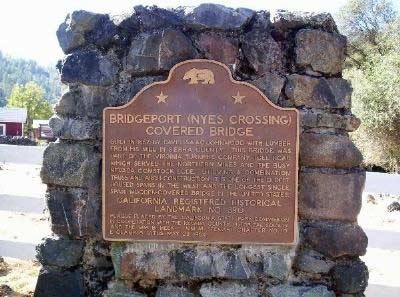
bridgeport-plaque

The historical plague dedicated to the bridge which reads:

Bridgeport (NYE’s Crossing) Covered Bridge

Built in 1862 by David Issac Johnwood with lumber from his mill in Sierra County, This Bridge was part of the Virginia Turnpike Company Toll Road which served the Northern Mines and the busy Nevada Comstock Lode.  Utilizing a combination truss and arch construction, it is one of the oldest housed spans in the west and the longest single span, wood covered bridge in the United States.

California Registered Historical Landmark No. 390

Plaque placed by the California State Park Commission in cooperation with the Nevada County Historical Society and the Wm. B. Meek-Wm. M. Stewart Chapter No. 10, E Clampus Vitus, May 23, 1964

To contact the Bridgeport State Park call (530) 432-2546


View Larger Map

It Could Happen Here

forest-fire

Contributed By Paul August

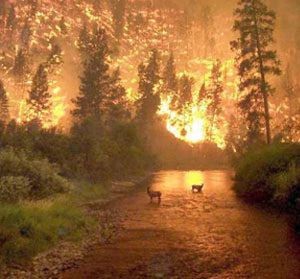
The Auburn 49er Fire could have been much worse. 60 homes burned. It was headed for Lake of the Pines. In 1991, the Oakland hills fire destroyed 3,354 homes, 25 people died and hundreds were injured.

What happened in Oakland and Auburn could happen here in Grass Valley and Nevada City. At the start of the Yuba Fire last month, I stood on my deck in North San Juan and watched a tidal wave of billowing black smoke explode miles into the sky. It was scary.

This North San Juan area gets hit with a catastrophic fire every thirty years. My wife Muriel left this home for a day trip to Tahoe back in 1960. “When I left it was green and beautiful. When I came back it was ash and charred wood.” The home survived. The trees didn’t.

The wind decides the fire. Fortunately, the Yuba Fire wind blew gently, and not in our direction. In the Auburn fire, however, gusts of wind pushed the fire forward and it surged beyond all fire defenses.

In Oakland, Santa Ana winds blew in from the south, swirling, gusting and fanning flames that engulfed house after house. No air tankers were available that first day to fight a city fire.

The home owner’s best fire defense is to clear 100 feet around your house. But even that’s no guarantee against a tidal wave of flame and their falling embers. I’ve seen homes with stucco walls and tile roofs burn as fire licked under the eaves and through the wooden front door.

The only house to survive in one Oakland hills neighborhood was a cement home built by a Vietnam refugee who vowed never to lose his home to fire again. He didn’t. But ash, dust and reconstruction noise surrounded his home for years. There’s no escaping the after effects.

Home owners need to prepare for the consequences of a fire. For those with well water, if the electrical wires burn down and there’s no electricity, the pump in the well won’t work – no water. If the driveway is blocked by fire, be sure to have a secondary plan of escape.

And get to know your local fire department, especially if you’re in a rural area with volunteer firefighters. In one Oakland neighborhood, the fire department saved one home owned by a firefighter who fought flames in another part of town. They saved his home although others around it were destroyed.

We had big fires up here in 1960 and 1989. 30 years later is about 2020. Be prepared.

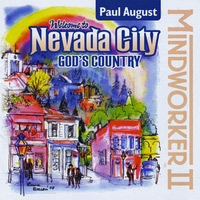
Paul August is a freelance writer and singer. His latest CD, “Welcome to Nevada City, God’s Country,” is available through cdbaby.com

Image is copyrighted and may not be reproduced

Ex-Cowboy Linebacker Eugene Lockhart Arrested in Mortgage Scam

eugene-lockhart

Former Dallas Cowboys linebacker Eugene “The Hitting Machine” Lockhart was arrested by FBI agents at his Carrollton home Thursday morning after being indicted on mortgage fraud charges, the U.S. Attorney’s office said.

Lockhart, 48, and eight others were indicted by a federal grand jury on various charges, including conspiracy, bank fraud and wire fraud. The alleged scheme involved approximately 54 fraudulent residential property loan closings resulting in the funding of $20.5 million in fraudulent loans.

Lockhart, who played for the Cowboys from 1984-90, and co-conspirator Lendell Beacham, 50, of DeSoto, were scheduled to appear before a federal magistrate at 1 p.m. If convicted, they could face up to 30 years in prison and a $1 million fine.

The indictment alleges that Lockhart and the others ran a scheme in which they located single-family residences for sale in the Dallas area, including distressed and pre-foreclosure properties, and negotiated a sales price with the seller. They allegedly created surplus loan proceeds by inflating the sales price to an arbitrary amount substantially more than the fair market value of the residence.

The statement from the U.S. Attorney’s office added that the group recruited individuals to submit false financial information and act as “straw purchasers” or “straw borrowers,” promising to pay them a bonus or commission for their participation.

Source: The Dallas Morning News

Enter Your Exhibits in The Harvest Fair at The Draft Horse Classic

draft horse

It’s free and all exhibitors will receive free tickets to a Draft Horse Classic performance

Entries are now being accepted for the Harvest Fair, September 24 – 27, at the Nevada County Fairgrounds. The deadline for Nevada County residents to turn in entry forms to enter exhibits is 5 pm on Friday, September 18. It’s free to enter, and all exhibitors will receive free tickets to the Thursday evening performance of the Draft Horse Classic.

Entry forms are now being accepted at the Fair Office and on-line for more than 100 different categories, including fruits and vegetables, cobblers, harvest pies, scarecrows, dried flowers, jams, honey, cut flowers, produce characters, and birdhouses. There’s even a garden photo contest. So many fun categories to choose from!

There’s also a special division for youth and teens, which includes categories like decoupage, Halloween masks, painted pumpkins, poetry, table settings, and wreaths.
Exhibitors must either submit paper entry forms at the Fair office or enter online at www.NevadaCountyFair.com. There is no entry fee for those who enter an exhibit in the Harvest Fair, and exhibitors have the opportunity to win a ribbon and a little bit of cash.

Complete descriptions of all Harvest Fair divisions and categories are available online at Nevada County Fair Website, at the Fair’s Office on McCourtney Road, or by calling the Fairgrounds Office at (530) 273-6217.

The Draft Horse Classic and Harvest Fair runs September 24 – 27 at the Nevada County Fairgrounds. There are six performances featuring the magnificent Draft Horses – Thursday and Friday at 6:30 pm, Saturday at 10 am and 6:30 pm, and Sunday at 10 am and 4 pm.

In addition to the Draft Horse performances, the Harvest Fair is bustling with activities during the four-day event. Live entertainment, Art at the Classic, Treat Street goodies, a Dutch oven cook-off, a clogging jamboree, a lumberjack show, a live shoeing competition, special exhibits, and visits to the barns and breed pavilion make for a family fun day at the Harvest Fair.

For Draft Horse performance tickets or information about entering a Harvest Fair exhibit, call the Fair Office at (530) 273-6217.