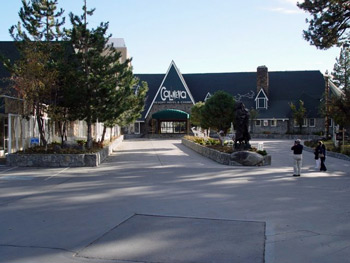
Frank Sinatra’s Resort in Foreclosure

Cal-Neva Lodge & Casino

Having gone a few times to the Cal-Neva Resort, owned by Frank Sinatra for three years in the 1960’s, it’s sad to see the historic resort in foreclosure. Unique in that part of the resort is in Nevada and part in California, you could jump in their swimming pool which has the state line bisecting the pool in two. You could swim from California to Nevada in just a few strokes!

The resort was up for auction and the result—zero bids. The recession is taking a big bite out of tourism around Lake Tahoe. Indian gaming in California is keeping day trippers closer to home. And Ezri Namvar, the hotel’s most recent ex-owner, was forced into bankruptcy amid several dozen lawsuits, many from the tight-knit Iranian Jewish community in Los Angeles, which alleges that he ran a $500 million real estate fraud.

Marcil’s company, National Hospitality Holdings, specializes in turning around hotels in trouble. It was hired by Canyon Capital Realty Advisors, the Los Angeles company that foreclosed on the Cal Neva.

Canyon officials said their April 8 auction flopped because of the resort’s unique location: The border between California and Nevada splits the property. “It’s the only place,” Sinatra joked, “where you walk across the lobby — and get locked up for violating the Mann Act” (which bans interstate transportation of women for immoral purposes).

The odd division required simultaneous auctions in Reno, Nev., and in Roseville. The complicated process “masked” the resort’s real value, a Canyon spokesman said.

The resort was once a watering hole for elite seekers of quickie Nevada divorces.

Over the years, it was raided by Prohibition agents and shuttered by the IRS. Today, the property once known as the “Lady of the Lake” is showing her age.

In 1983, Ron Cloud, a Fresno, Calif., plumbing contractor who had acquired the Cal Neva, lost his license for allegedly rigging the slot machines and strong-arming debtors


Source Steve Chawkins Los Angeles Times

What about Health Care for the Entrepreneur?

mountain-climber

There was a fascinating story on NPR the other day about entrepreneurs. The person being interviewed felt that entrepreneurs could be the way out of the recession, but because of a few factors most people who could or want to start a business don’t. One of the reasons stated why older people won’t start a business, which caught my attention is health care.

Paul Kedrosky, editor of the business blog ‘Infectious Greed,’ stated that start up costs really are not the main consideration when people of the older persuasion decide not to start a business…it’s health care.

I cannot agree more! I am happily self-employed at the young age of 40. I started my business when I was 35 and I went for a long time with major medical only. Thankfully my ex-husband covered our daughter under his work sponsored health care plan. What did “major medical” mean? It meant that I paid full price for my Doctor visits, my prescriptions and any tests or x-rays performed. Why? It was what I could afford. The only time I saw my Doctor was for my yearly girl exam. That’s it. I couldn’t afford to get sick and if I did my medical coverage wouldn’t kick in until I am on the hospital bed dying.

Thankfully my new husband has a job with great health care and I’m now covered under his plan. A few months ago his place of business went through a major restructuring and it looked like he was going to lose his job. We started brainstorming about what we can do if that happened.

My first reaction was to tell my husband to go freelance. He works with video and web and it would be an easy fit into my business. We were very excited at the prospect of creating this expanded business together and how having him work from home would help because he would be around more to help with the girls. We had no doubt that we would create enough income to continue our lifestyle and save for retirement….but then came the health care issue.  Could we afford the health care we need (I am older now…premiums tend to skyrocket at the age of 40 and DH is a few years older)?  That became the proverbial fly in my glass of wine.

Right now we have dental, vision, RX and health insurance. Last year alone I had $ 2000 worth of dental work done and my teeth are in good shape but they are not getting any younger. I have glasses and need yearly exams and occasionally new lenses (besides what is it with turning 40 and suddenly having to hold a book at arms length away while reading….?)  As I get older I find that I need more medical monitoring besides the yearly girl exam, there is now the mammogram and other yearly checkups.

The night before the layoffs my husband and I toyed with the idea of him going in and saying take me…lay me off. What stopped us? The idea that once he became self employed we would be one accident or one illness away from losing everything we worked for. We would be putting not only our financial health in jeopardy but we would also be gambling with our girls’ future.  We couldn’t do that.  Thankfully my husband’s job was spared. For how long?  We don’t know.

How sad is it that he is now working for the health insurance? He loves what he does, he likes where he works and the people he works with/for. But given the uncertain future at his place of work he would have more security going out on his own but he/we chose not to because of health care.  Where did it all go wrong?

I’m not a policy or political wonk. I keep abreast of the headlines but I’m too busy raising my family and running my business to get deep into the political wrangling. Normally I don’t talk publicly about politics. For the first time I wrote to my representative and implored them to do the right thing and create a health care system that is affordable for everyone…including us entrepreneurs. If the blogger is correct and I suspect he is (given that just about every major corporation is either in or on the verge of bankruptcy) we entrepreneurs just might end up being the saving grace of our economy


This article was written by Lisa Jacobson (My daughter)

California Imposes Statewide 90 Day Foreclosure Moratorium

really-you-got-to-stop-sign

California is imposing a 90-day moratorium on housing foreclosures under a new law that takes effect Monday, June 15, 2009.

The law is expected to make lenders try harder to keep borrowers in their homes. Loan companies must prove they tried to modify the delinquent loans before they can begin foreclosing.

But supporters acknowledge the California Foreclosure Prevention Act won’t stop thousands of foreclosures from eventually happening. There have been more than 365,000 foreclosures in California since early 2007, with many more already scheduled.

The law will largely press lenders to follow the Obama administration’s Making Home Affordable Program that began in March. That encourages lenders to cut interest rates or rewrite loans to 40-year terms to get payments below 38 percent of a borrower’s monthly income. Other options include reducing principal and tacking missed payments to the back of the loan. Under the law, California officials also can encourage short sales or deeds in lieu – options in which banks accept less than owed – for borrowers who want to leave or don’t qualify for modifications.

In summary, here’s what will happen starting Monday:

• Lenders will submit applications to the state outlining their loan modification programs. That gives them a 30-day exemption from a moratorium.

• If the state OKs a lender’s program, the firm is permanently exempt from the 90-day delay on foreclosures.

• If the state rejects the program as inadequate, a lender has 30 days to upgrade it and be reconsidered.

Leyes said consumers will be able to see a list of lenders that comply with the state’s requirements by mid-July.  

Source: The Sacramento Bee

Angel’s Doghouse Listings – Schmitty “Chief Doggie Officer”

I've worked so hard today, I need a nap.

My name is Schmitty. I’m a Boston Terrier and CDO at my mom’s business. CDO is “Chief Doggie Officer” and as you can see my job is quiet grueling.

My work functions are to look cute, bark at the wind, chase my girls, make sure my mom takes lots of breaks to pet me.

A usual work day schedule goes something like this:
Morning

6 am wake everyone up, eat breakfast and go outside
7 am chase the girls around the house, chew on shoes
8 am take the girls to school
8:30 – 9:00 am run around the house
9:00 am look cute for my mom
9:15 – 11:15 nap
11:15 wake up and go outside
11:30 get pets from mom

Afternoon

12:00 pm eat lunch
12:30 – 1:30 nap
1:30 go outside and stretch
1:50 come inside and chew on my bone
2:15 nap
2:30 pick up the girls.

I love what I do, but boy does it wear me out! This is my vacation home. This is a really nice doghouse, don’t you think? I really like the front deck.

Photo courtesy of melamarsh@Flicker.com

Have a dog? A dog house (you can make one up)? Angel would like to list your doghouse, send a picture of your dog and a doghouse, along with the square footage, how many bathrooms the doghouse has and we’ll post it on this site. Tell us what’s special about your dog and what breed it is. Angel would appreciate that. See the About Us page for details.

Can’t Sell Your Home, Offer a $1 Million Coupon

coupon
Can’t sell your home? Offer a coupon as one homeowner did in Florida in order to sell his home. Realtor Rusty Gulden came up with the idea rather than lower the price of the home $1 million, just make up a $1 million coupon.

In an effort to cut through the gloom in the luxury real estate market, Gulden has been running an ad in the Palm Beach Daily News. “FREE $1,000,000 with this coupon,” the ad reads. “Offer expires May 31, 2009.”

Gulden is trying to sell a 2,000-square-foot unit at the Sun & Surf condo at 100 Sunrise Blvd. in Palm Beach. The asking price was $3.7 million, but it’s a mere $2.7 million with the coupon.

Gulden says tough times call for attention-grabbing marketing gimmicks.
“The volume is significantly off — you don’t need a Ph.D. in finance to know that,” Gulden says.

Since the ad started running earlier this month, she says, “I’ve been busier than a one-armed paper hanger showing it.”

Seller John K. Kearney paid $1.65 million for the unit in 2004, according to property records.

The property Gulden advertised had been on the market for two years, she said. The owner, a Massachusetts resident who was selling because he “just wasn’t using the property,” agreed to shave a $1 million off the asking price if the house could sell in May.
Gulden created a black and white ad offering a “free $1 million” to anyone buying the property. An ad designer at the Palm Beach Post bordered the ad with dashes and a small scissor.

Gulden said she saw more calls on the property and even received an offer from a New York buyer within the month.

“It wasn’t just another ad,” Gulden said.

Million dollar coupons are yet another side effect of a high-end market that is over-saturated with homes and burdened by higher loan interest rates, said Walter Molony, a spokesman for the National Association of Realtors

Too Early to Call Housing Bottom

highway-sign-going-both-way 

Housing research organization IHS Global Insight estimates that the average U.S. home is undervalued by 12.2 percent, and many previously pricey communities are undervalued by considerably more.

A recent study released by IHS used home prices, interest rates, area incomes, population density, and historic premiums and discounts to analyze housing values. It examined 330 markets and found homes are underpriced in 248 of them.

Despite the high percentage of undervalued areas, IHS says “it is too early to call a bottoming,” as “job losses continue, housing inventories remain elevated, and consumers remain wary in light of economic uncertainty.”

Here are the 10 most undervalued areas:

1. Vero Beach, Fla., -42.5 percent
2. Houma, La., -41.4 percent
3. Las Vegas, -40.9 percent
4. Merced, Calif., -40.1 percent
5. Cape Coral, Fla., -39.1 percent
6. Houston, -36.9 percent
7. Midland, Tex., -34.8 percent
8. Lafayette, La., -34.4 percent
9. Vallejo, Calif., -34.3 percent
10. Stockton, Calif., -34.3 percent

Source: CNNMoney.com, Les Christie (06/04/2009)

Name The Nevada County Fair’s 2009 Mascot

Art work by Janene Powell

Sandy Woods, Chief Executive Officer, for the Nevada County Fairgrounds has announced a contest to name their mascot.

This year’s Nevada County Fair mascot is busy preparing for the annual Fair, “A Hare’s Magical A-Fair,” August 12 – 16. However, the rabbit mascot needs a name, and the Fairgrounds wants to know what you think her name should be.

Visit the Fair’s website at www.nevadacountyfair.com and submit a name for the rabbit. If the name you submit is selected, you win. It’s that easy!The contest runs now through July 15.For a complete list of contest rules or information about the contest, visit www.nevadacountyfair.com or call (530) 273-6217.

The lucky winner will receive a Nevada County Fair package that includes two free admission tickets for each day of the Fair, a 5-day parking pass for the Fair, and ride coupons.

For those without access to the Internet, entry forms are also available at the Nevada County Fairgrounds office on McCourtney Road.

Nevada County Fair                   August 12 – 16
2009 Draft Horse Classic          September 24 – 27
2009 Country Christmas Faire  November 27 – 29

Here’s a schedule of upcoming events at the Nevada County Fairgrounds.2009

Press release by Wendy Oaks

By the way if you have never attended or been to the fairgrounds, you are in for a treat. It is beautiful, with a covering of majestic pine trees and unlike any fairgrounds you have ever gone too!  John O’Dell

Want a Bank Loan, Just Sign Here!

chasebank-mortgage-ad-2002

Wonder why we have so many foreclosures now? Here’s an advertisement from “Home & Land” a Monmouth County, New Jersey real estate promotional magazine from the summer of 2005. Reading the ad, you can see how loose the lending standards were.

Chase’s “Simply Signature” mortgage program involved nothing more than your signature, a mirror placed under your nose to make sure you were breathing and wonders of wonders; you had a mortgage to buy your home!

Chase was not the only one’s making “Simply Signature” loans, Washington Mutual, (gone), Countrywide (gone), and since 2006 – 345 banks have “imploded” due to their loose lending practices.
So this is the reason we are in the mess we’re in.

Total deregulation of the banks, where they made loans, forgetting the safe practices they had used before, in which the requirements were; good credit, a reasonable amount for a down payment, and good appraisal practices. That was all thrown to the wind, in a mad dash to make as many mortgages as possible, then selling them off in bundles called derivatives to un-wary investors so they could make more unsafe loans.

You can thank the politicians, along with the banks, with their strong lobbyists paying off both sides of the aisle for the deregulations that have led to the present recession. Some blame the Fed for loose money standards, but no one made the banks drop all their safe lending practices. If you think of what you would do if you had 500 thousand dollars to loan out as an investment… would you just give it out to anyone? I wouldn’t if I really wanted a safe return on my money!

For a list of the failed banks go to Implote O Meter. This site keeps track of failed banks

Failures of Savings & Loans Crisis due to de-regulation Wikipedia

And, of course the banks are STILL fighting deregulation, see New York Times article: Crisis, Banks Dig In for Fight Against Rules

Cap’n Crunch’s Crunch Berries Not a Fruit!

 capn-crunch-cereal-box1

Harold Hewell, representing a California woman who filed a lawsuit on her behalf claiming that she was deceived into buying Cap’n Crunch cereal during a four-year period. Why, because she thought the “Crunch Berries” in the cereal, were get this, real fruit. Hummm, have you heard of a crunch berry bush? Or maybe she thought it grew on trees or in a bog?

According to Sacramento’s Channel 10:

“Janine Sugawara filed a class-action suit last June against Quaker’s parent company PepsiCo, seeking full restitution of all money gained through misleading labeling and a court order forcing Quaker to provide public notice of the true composition of Crunch Berries.

In his order dismissing the lawsuit, Judge Morrison England, Jr. said “a reasonable consumer would have understood the product packaging to expressly warrant only that the product contained sweetened corn and oat cereal, which it did.”

“As far as this court has been made aware, there is no such fruit (Crunch Berries) growing in the wild or occurring naturally in any part of the world,” England wrote.

In his dismissal order dated May 20, England pointed out San Diego lawyer Harold Hewell, who represents Sugawara, filed a similar suit against Fruit Loops cereal, which was also thrown out of court.”

Of course, the good attorney Hewell filed a new motion this week seeking an August hearing for the judge to reconsider the dismissal. We all know if he wins, in most cases like this, we will probably get on free box of Cap’n Crunch and he will get a cool million or two. (In the lawsuit, he asked for $5,000,000)

The last question, if Janine Sugawara is so concerned about eating fruit, why is she buying heavily sugared cereal anyway? If it did contain real berries in the cereal, the amount of sugar in the cereal would kill off any benefits she might derive from the berries! Three-quarters of a cup of Cap’t Crunch cereal contains 12g of sugar (3 teaspoons), not exactly a health food.

See the Crunch Berries lawsuit here  

Residential Home Sales, May 2009, Nevada County

picture-sales-going-up

In general, I track daily sales on from the Nevada County Multiple Listing Service (MLS) and there is a definite increase in sales lately. This is a good sign that people are buying, both investors and first time home buyers. Interest rates are very attractive now, and along with the bargains, the market seems to be shifting upwards. The market dynamics of Nevada County home sales from Terradatum are as follows:

Median prices of homes in Nevada County in May 2009 were $300,000 compared to the median price in May 2008 of $365,000 or a further decline in price of 18 percent.   

May 2009 sales decreased somewhat from April of 2009, with 59 closed sales in May versus 79 closed sales in April. However, sales from January 2009 to May 2009 were 272 closings compared to sales from January 2008 to May 2008 of 219 closings or a 24 percent increase in sales.

At the present time, there are 1,200 residential properties for sale or a 17.6 months inventory of homes.  If you have any questions, please e-mail me and I will glad to help you.

By the way, look on the left side of this page and you will see the daily postings of MLS stats under “What I’m Doing”. These stats include all sales, land, commercial, residential and multi-family for Western Nevada County.  They may include some sales from out of the area.