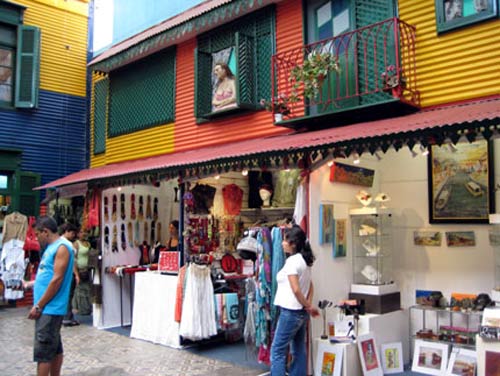
La Boca, meaning in Spanish, the mouth, is the area of Buenos Aires that Italians migrating to Buenos Aires in the 19th and 20th century settled into. The area was named La Boca because of the natural shape of the harbor formed by the River Rio Riachuelo bending and flowing into the Rio de la Plata creating what appears to be a mouth.
The area is difficult to get to using the Subte, so John and I bought a guide to the collective; the huge city bus system that criss-crosses the city. (Getting there was easy, getting back a little more difficult as we were standing on the wrong street for the return buses to our area. But here are almost no bus signs (let alone street signs), you just have to go stand where other people are standing; if they look like they are waiting for a bus!!)
Street Scene
The vendors have painted the area to recreate the early days of the area.
The first thing you see is the huge stadium for the Boca Juniors. And the people in the area have a fervent; most would say fanatical; identification with the team. Soccer memorabilia and T-shirts are everywhere.
Soccer stadium in background
Anyway, the first Italian and French immigrants built boarding houses haphazardly with metal sheeting called “conventillos”. These were decorated with whatever paint was left over on the docks, creating a mish-mash of colors on each building. The colors can be inviting, but the poorly insulated buildings can be unbearably hot in the summer and frigid in the winter. It was fine the day we were there, even though it is summer here, maybe mid-80’s.
On of many beautiful doors in Buenos Aires
On a Saturday (when we went) it is very busy and touristy. We saw a lot of interesting things, and spent a couple of hours in an on street cafe, enjoying the dancing and singing of a local tango troupe. Lots of little stores, artists, and street vendors we did a good bit of shopping there.
A train ride to the outer reaches of Buenos Aires (made a little longer than necessary because John and I didn’t know we had to switch trains in the middle until we had reached some other end destination). Then a switch to the new, obviously touristy “Tren de La Costa” Stopping at 7 or 8 little beach towns along the edge of the delta, north of Buenos Aires. Very nice real estate.
Tigre is one of the most popular weekend destinations from BA, on the banks of the lush jungly banks of the Delta of a lot of different rivers. Arriving, and avoiding the El Parque del la Costa (sort of an Argentine Disneyland/county fair combo) and the big Casino at the end of the line we walked in a discovered a very cute little town. We located a B & B to stay at (an OLD family home where the Grandmother rents 4 rooms a night to tourists) for 150 pesos (less than $50 US)
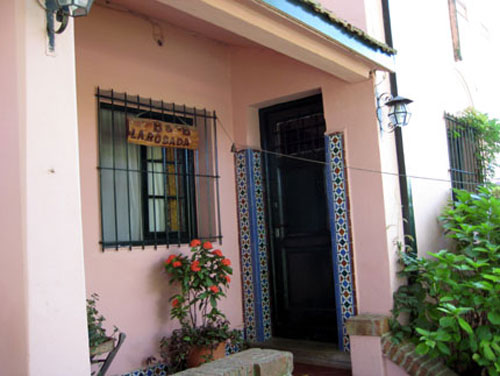
Bed and breakfest Inn Tigre
Typical treatment of many houses in area, with ornate treatment of front entries.
Walking, seeing the sites, visiting cafes and of course eating the great food. The next day we did some museum visits (the fantastically detailed Museo Naval, covering the origins of boat, Argentine navy merchant museum, lots of model ships, and relics from many old ships The outside display included relics of the Falklands Islands (Here called Malvinas Island) conflict with the British.
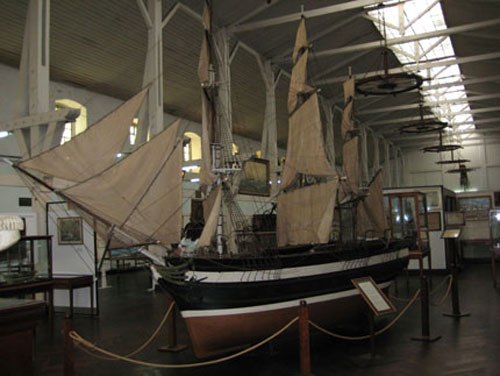
Model ship in Museo Naval
Then we were of on a 2 hour luxury cruse of a small portion of the huge delta, thousands of islands, waterways, summer homes, resorts, camping, restaurants and natural reserves. Really fantastic and relaxing. Next trip we are spending at least a week in one of these isolated resorts (I have the map, web sites and the phone numbers now!)View delta Tigre
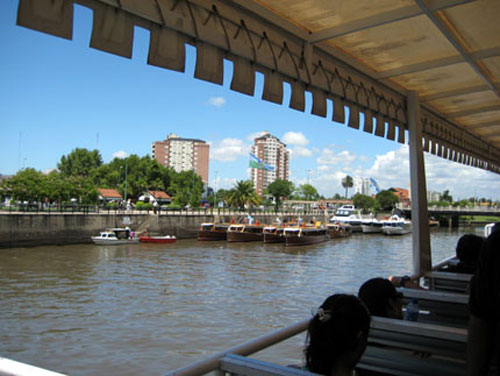
Looking out from the dining section of the catamaran. Great food by the way!
We passed (rapidly) through the smoky Casino and had a nice visit to the HUGE artisan and. fresh fruit fair, Puerto de Frutas. Handcraft wicker furniture and basketry (with river reeds and trees) are the specialty, and unique to the area.
A great way to get around Buenos Aires is on the subway or as they call it here the Subte. There are five lines A, B, C, D and E. You can get a map of the lines at the airport showing the routes. It’s cheap, thirty two cents per ticket when you buy ten at a time.
They were built at different times, by different regimes, and each has its own personality. Even the tiles in the halls and stairwells on the way down show the differences.
The Linea A is the oldest, and least decorated, although the wooden carts are works of art in their own right.
Linea B is the newest and most comfortable cars; it is also short on decoration.
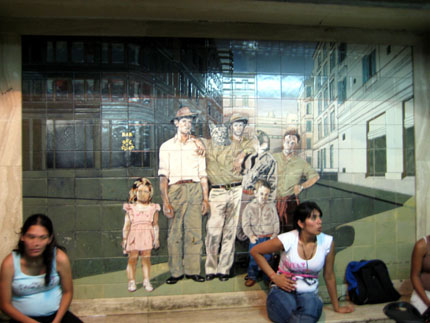
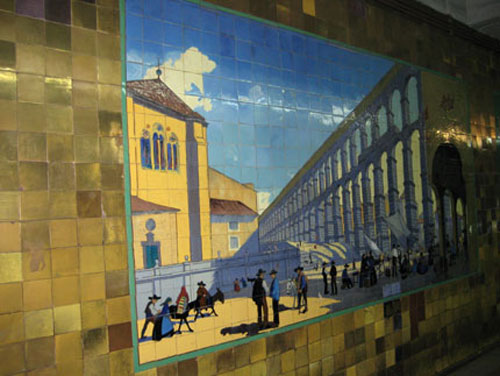
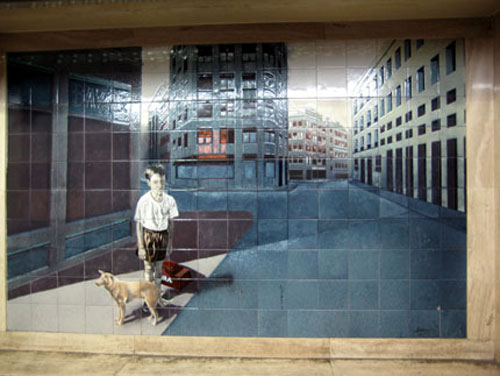
Linea C is the Linea de los Espanola, with ceramic depictions of landscapes from Spain. In the Retiro station there are three murals by Fernando Allievi: Saturday Story, the outing of a family, First Light, a bedraggeled shoeshine boy, and La Mascara (the Masks), unfortunately, the picture I took of Saturday Story came out blurred. One problem with the Cannon SD750 camera that I use, there is no anti-shake control.
The Sunshine BoyLa Mascara (The Masks) Notice the faces in the pictures
Linea D has more nationalistic depictions, the line opened in 1937, there are more depictions of the Spanish civil war and the Military regime then ruling Argentina.
Linea E opened in 1944, the time of the rise of Juan and Eva Peron, even more nationalistic times. Estacion San Jose has depictions of national treasures like Iguazu Falls.
Spanish Village Segovia
A depiction of life in a small Spanish Village Segovia, with Roman influence (Line C)
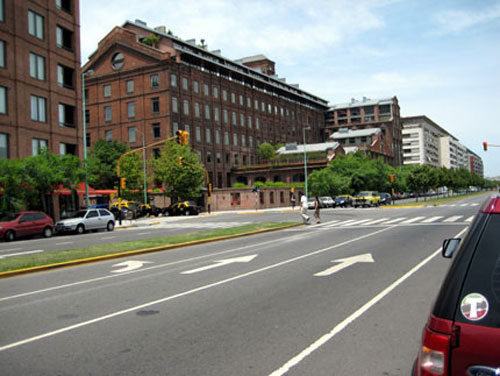
One night this week we went for a tour of Puerto Madero with Julio Iannetta and his daughter. Julio is a brother of Albert Iannetta, one of my real estate agents. It is a beautiful, clean, new area of the city down where the old docks of Buenos Aires use to be. When the city outgrew the area the old warehouse and granaries were abandoned for a while. But recently the shells of the old buildings have been turned into apartments, lofts, offices and of course restaurants and shops. Very High Scale.
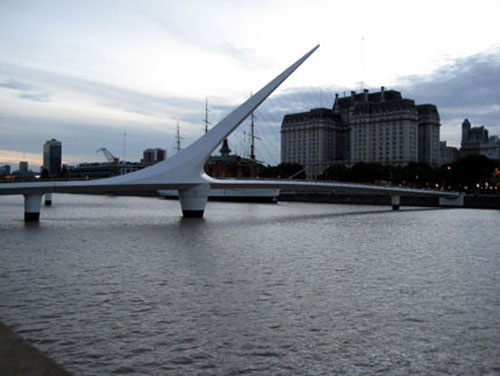
We toured the streets that are all named after famous Argentine women. There are great places to stroll, along the riverfront and around the four large diques (basins) of the former port, with many moving bridges, including this one:
Ladies Bridge Pureto Madero
This bridge which opens to let ships through, is a work of art.
In the area there are also two of the most exclusive hotels, the Faena Hotel and the Universe and the Hilton Buenos Aires. On the outside the Faena is all old brick, it used to be the Edificio El Portino (the main port building) but inside…an exclusive 83 room hotel costing from 300 to $1200 US per night. Each of the rooms has a home theatre and large totally mirrored bathrooms with a spa. When you check in, you are assigned and experience manager who takes care of all your needs while in the city. There are many treatment rooms, a huge health club area, and experiences such as polo with the pros and painting classes with a famous artist. On Friday John and I walked through the public area of the Faena – a very impressive swimming pool area with a swim-up bar, beautiful dining rooms and nightclubs, the lighting was truly an art in itself.
The Faena Hotel, an architectural master piece
We also walked through the Reserva Ecological Costanera Sur, once a landfill that nature has taken back over and is now a protected area for migratory waterfowl, swans, coots, flamingos, and other little animals and reptiles.
Some of the fauna found in the reserve
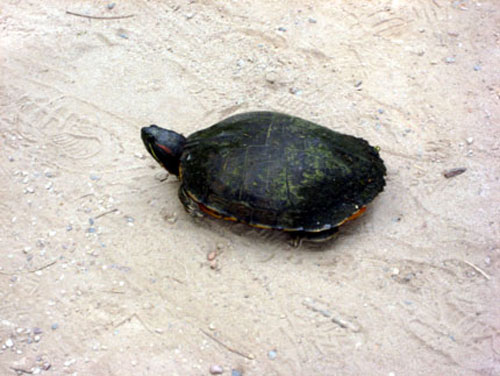
We found a relative of Skippy (Judy’s turtle at home in California) just strolling across the path, and redirected (him/her) back toward the water.
A wondering soul in the form of a turtle
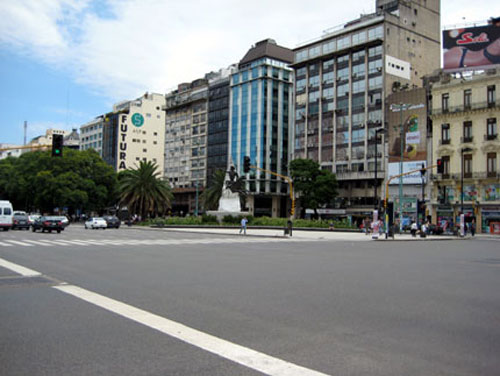
Our apartment is very centrally located within 1 1/2 blocks of one of the main Subtre (subway) lines. These are our main method of transportation around the city, although taxies are cheap and extremely readily available. It is the black glass front building you can see in this picture, just past the statue of Man of La Mancha – Don Quixote and his house.
Avenue 9 de Juilo
A view towards our apartment from the Av. 9 de Juilo, the widest street in the world
We left Bariloche Friday the 19th on a bus at three in the afternoon and arrived the next day at ten thirty. The ride is very comfortable and the seats fold down to make a bed. A hot meal is served at night and a very light breakfast in the morning.
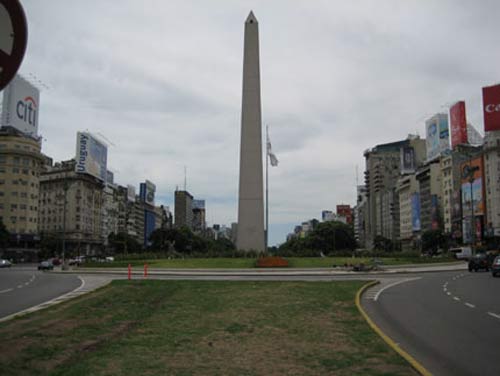
We checked into our apartment which is right downtown and about five blocks from the Obelisco. The Obelisco is a monument to Buenos Aires and was built in 1936 in just thirty one days. It was built to celebrate the 400th anniversary of the first, but unsuccessful founding of the city in. It was later founded in 1580.
Under the Obelisco is a shopping center and underground pedestrian causeway around the center of the subtre (an underground subway) The shops are old, dating back to the 1960’s. It’s called the Paseo Obelisco, with not much for shopping, a few barber shops, cheap clothing, cafes and other little shops. Three subways or metros meet at the Paseo Obelisco.
The Oblisco on the Avenida 9 de Julio micro central Buenos Aires
Later in the night we went to a restaurant that had a tango show. Dinner, the show and a small bottle of wine was only 70 pesos or so, about 22 bucks, we could almost touch the dancers. The dancing and singing was wonderful and full of great energy. The last time I was here I had my camera pick pocketed. This time, I bought a Cannon SD750 for our trip. I really like this camera, it’s small, you can put in your pocket, out of sight, and in crowded areas, I put both hands in my pocket. I put a four gigabyte card in the camera and was able to take movies of the dancers with plenty of memory to spare.
Tango dancers
Tango dancers at their best
Another tip, if you have a laptop, download your pictures every night, then if your camera is stolen, you still have the pictures you took. That’s what I did last time, and only lost that one days’ worth of pictures.
Then on Sunday we went to San Telmo, one of the oldest neighborhoods in Buenos Aires, it was the home of the very wealthy until the 1877 outbreak of Yellow Fever. It is the barrio most identified with the tango, also lots of shops selling antiques. On Sundays there is a huge market inside of Plaza Dorado (an entire block of stalls) and all the way up and down Calle (street) Defensa is a huge open air market. It is at least 13 blocks long, with no cars allowed, only side to side artesans selling their wares. And many of the side streets add another block or two of people selling there wares. It took us all day to complete the circuit. So that was the good part of the day, what comes next wasn’t so funny.
Judy and I were walking on down town street broad daylight, returning to the apartment when we both felt a sudden splash on our backs. It was a slightly smelly goop sort of the texture of weak concrete. Immediately, a women walking beside us came over to help clean it off. Then a man comes from the other direction, pointing up to a window he says he saw some one throw the stuff at us. While “helping” they took my wallet out, took two hundred pesos and my ATM card. Then they returned the wallet with 2 pesos left. I had been warned about more than one person coming to your aide yet missed it when it was happening. How naive we were when it was actually happening. Oh well, I hope this helps you in your travels. The card is cancelled and we are only about 60 bucks short for the lesson.
Pick pocketed!
Pick pocketed!
On Monday we spent a disappointing day going from government office to government office, waiting in line, trying to get John’s official Argentine identification number and passport. After three places and much waiting, we have a fourth place to go to tomorrow morning as everything governmental closes down by 3 PM! What a life! (Of course I don’t know when they start but I really don’t think it is earlier than 8AM. They told us to be at the next office between 9 and 3 tomorrow.
Winter is finally here. I live in Cascade Shores and I’m guessing that I’ve had about two to three of snow at my house. To go to town from the Shores you have a choice of either going on Banner Quaker Hill Cross Road with a thirty one percent grade or going on Pasquale Road. Banner Quaker Hill is a nerve racking experience if it’s icy. I’ve gone up the grade only to start sliding backwards in my four wheel drive, picking up speed and finally hitting a snow bank. This turned my truck 180 degrees and headed us down the hill at a nice clip. (Didn’t hurt the truck, it’s a Chevy!) I’ve also gone downhill on the grade only to start sliding and skiing down hill with little control of where the truck actually goes.
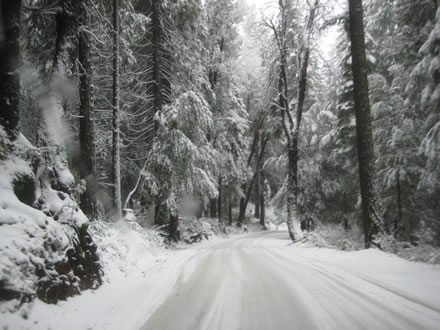
Pasquale Road Winter of 2007
Pasquale Road is icy and a little narrow in some areas, but it’s a beautiful drive. The County does a great job of snow removal to make it easy to get to town. The picture above shows some of the natural beauty of our area. I enjoy our area so much because we are lucky to have the four seasons here, with a little snow, not too hot a summer and beautiful spring and fall.
By the way, real estate in Nevada County is not too bad. In 2006, 983 homes were sold in Nevada County. In 2007, 862 homes were sold. That’s 121 fewer homes, but real estate has not died. The hardest hit areas, such as Fresno and Lincoln are areas in which developers over built large tracts of homes.
In our area, we do not have that problem. We live in a very desirable County, with no excess of inventory. We have very restrictive land use ordinances limiting new growth to almost no growth at all.
On the 11th of January I’m off to Buenos Aires for a month. I was born there and have duel citizenship. Buenos Aires is known as the Paris of South America and is a beautiful city. The first week I will be in a Spanish immersion class, living with a family so that I can regain my native language. I came to the United States when I was six and quickly learned English and lost my Spanish. My mother always said I would be sorry for not keeping up on my Spanish and of course like all mothers she was right. I’ll be posting pictures of my travels, so stay tuned.
John O’Dell is a licensed civil engineer, land surveyor, general contractor and real estate broker
Our county is green and wildflowers are springing up everywhere. Here are a few places you can go to enjoy the beauty.
The trails at Bridgeport, in the South Yuba River State Park. There are wildflower tours Saturdays and Sundays at 11am, but you can go there anytime.
Penn Valley’s Gateway Park. This is a great place to get together with friends and family with sports fields, playgrounds, picnic areas, an awesome disc golf course, and lovely little creek running through.
Driving Tours (from Grass Valley at the 49/20 intersection. Consider Dramamin or Bonine if you get carsick, these are winding roads.):
Take Highway 20 west to Pleasant Valley Road. Pleasant Valley Road north to Bridgeport. Get out, walk around, have a picnic, then get back in the car and continue north up the winding road to French Corral. Stop at French Corral to read the historic marker, then continue up Pleasant Valley Road to Hwy 49. Take 49 South through the canyon. Consider stopping at the South Yuba River for more hiking, or just a nice view of the river. Halfway up the south side of the canyon is the awesome Independence Trail, if you’re still up for a hike. Otherwise, continue back to Nevada City where you can get back on the Freeway.
Other options: Bitney Springs Road runs from just west of Grass Valley on the Rough & Ready Hwy to Pleasant Valley Rd. Whether you drive up from Pleasant Valley or down from Grass Valley this way, it shortens the loop described above, and is full of great scenery. Ready for a rough road? When you leave Bridgeport, there is a left turn onto a gravel road just a short distance up the hill—this leads to Rice’s Crossing. At the top of the hill, turn right and take the old Rice’s Crossing road up the hill. It comes out just below French Corral on Pleasant Valley Road. This is a great hike, too. Or take Mooney Flat Road west from Pleasant Valley Road (right after the Lake Wildwood Dam) down past Englebright Lake. Mooney Flat takes you right back to Hwy 20. This is a short loop.
Take McCourtney Road past the Fairgrounds and continue all the way down to Wolf Road. Take Wolf Road back to Hwy 49. Along the way you’ll see lots of beautiful scenery. Once you’re back at 49, you can return to Grass Valley, or continue across 49 and follow Combie Road to Magnolia Rd. Keep on Magnolia to Dog Bar. A left on Dog Bar will take you all the way back to Grass Valley. If you turn right, you can take Dog Bar to Placer Hills Road. A left on Placer Hills will take you up to Colfax, or a right will take you down towards Auburn, through Meadow Vista, to the Freeway at Clipper Gap.
Longer Drives:
Take Hwy 20 west to Marysville Road. Turn right and drive north. From here there a number of great routes:
Take Marysville Road past Collins Lake. There is a right turn to Dobbins and Oregon House that is still Marysville Road. If you miss the turn you will suddenly be on Willow Glen until that merges with LaPorte road, but that’s another story (below). Consider making an appointment to tour the Renaissance Winery before you head this way. It is out Rice Crossing Road east of Oregon House, and worth a visit for its great wine and beautiful gardens. (Yes, this is the same Rice Crossing Road we mentioned above, but NO you can’t get there from here. There’s private property, and a missing bridge across the Yuba.) Continue northeast on Marysville Road past Bullards Bar Reservoir (a great place for boating, camping, picnicing and mountain biking). Continue up Marysville Road to Hwy 49. Turn right (south) and return to Nevada City by way of North San Juan. (Also consider taking Moonshine Road just east of Bullards Bar. It will return you to Hwy 49 at the middle fork of the Yuba River. There’s a little picnic area and a covered bridge just across 49 from this intersection, too.)
After Browns Valley there is a left turn onto Loma Rica Road (Don’t take Fruitland Rd, which has a sign saying ‘Loma Rica’, wait until you see Loma Rica Road—actually, Fruitland Rd is pretty too, but I’m taking you through Bangor). Follow Loma Rica Road to Los Verjeles Rd and turn right. Follow Los Verjeles to Bangor and continue west on the Oroville-Bangor Hwy to Miners Ranch Road. Turn right on Miners Ranch and follow it to Hwy 162.
From here, there are two great options:
Turn right and go east to Forbestown Rd and follow that to old Forbestown. From Forbestown take the Challenge Cutoff to Brownsville (NOT Browns Valley). From Brownsville you can return via Willow Glenn Road to Marysville Road to Hwy 20 and return to Grass Valley.
Visit the famous Table Mountain wildflowers: turn left and drive toward Oroville on the Olive Hwy (162). Instead of turning when 162 does, continue on across the river on Washington Avenue. When you cross Montgomery, you’ll be on Table Mountain Blvd. Look for a right turn called Cherokee Rd. Follow Cherokee Rd. This will take you up over Table Mountain. From here you can either return, or continue via Derrick Rd. to historic Oregon City to see the little covered bridge and historic marker. There are two possible routes to follow from here: either return to Cherokee Rd, which will take you to Hwy 70 near Pence, if you turn right, or a left will take you back to Oroville the way you came. You can return to Grass Valley by taking 70 south (left) back to Marysville and pick up Hwy 20 there. You can also continue through Oregon City and loop back on Oregon Gulch Rd. to Cherokee and then return the way you came through Oroville or take 162 West to Hwy 70, and back by way of Marysville.
Take a map, some snacks, a camera, and an open mind. With the maps, trace your route and pick out alternatives to visit later. I’ve driven all these routes many times over the years, and I always find something new and wonderful by taking wrong turns (intentionally or not).
Residential sales in Western Nevada County in July 2007 vs. July 2006 fell about 6 percent. In July 2006, 98 homes were sold at an average sale price of $479,969, which was at 96.96 percent of the asking list price of $495,078.
In July 2007, 92 homes were sold at an average sale price of $406,267 which was at 96.37 percent of the asking list price of $421,556. Sales have not really dropped very much, but the average sales price dropped $73,702.
Of course one month does not reflect the true market conditions. Lawrence Yun, NAR senior economist, said “he isn’t looking for any notable changes in sales activity. A modest upturn is projected for existing-home sales toward the end of the year, with broader improvement to include the new-home market by the middle of 2008.”
With increased population growth in California, demand for housing is not going away. New construction has dropped considerably, land is scarce and interest rates are still low. Buyers will have to come into the market place sooner then later. Various reports that I have read expect a yo-yo effect, with nation wide prices dropping 2.3 percent and then rising 2.3 percent next year. Interest rates are expected to be 6.7 percent at the end of the year and ease off to 6.5 percent the beginning of next year. (Source, National Association of Realtors® NAR)
Real estate advertising will become less prevalent in newspapers as it shifts to the Web, where online home buyers are actively searching for properties, analysts say.
Currently about 15 to 20 percent of real estate advertising is online, but Mike Simonton, media industry analyst for Fitch Ratings credit analysis service, says it is poised to go higher for a number of reasons.
Suzy Antal, director of marketing for Prudential Real Estate Affiliates, a unit of Prudential Financial Inc., said many Prudential practitioners have been pulling back on advertising during the current downturn, but as they return, they’re shifting ad budgets to their own Web sites, creating blogs, and taking different approaches beyond newspapers.
“Is newspaper a high priority? No,” Antal says. “I don’t believe my buyers and sellers are going to be in that market.”
Tim Fagan, president the real estate portion of Classified Ventures, which manages website for 125 newspapers, says it plans to “significantly increase’ its investment in Homescape, a real estate-related Web site that provides home listings, but he declined to provide specific numbers.
It’s wrong to assume that online advertising is cheaper than buying space in the paper, says Blanche Evans, editor of Realty Times, a online real estate news service. After all, online users expect extensive color photographs, lengthy descriptions, and even video tours —and all of those features can add up for a real estate practitioner.
Malcom Gladwell is one of the funnier and more interesting writers of our time. His book “The Tipping Point” is one of my favorites. His recent article from the New Yorker, “Big and Bad” is a fascinating look at the history and marketing of SUVs, why people like them, and what the auto manufacturers have learned about how to make and sell them, to satisfy our craving for them.
When John wrote the article below, Gas Prices Too High? it brought home that, in a roomy and comfortable Prius, a 3,500 mile drive he took on his recent vacation cost him all of $249 in gas (at an average $3.35 gallon).
In an area where many people (my wife included) commute to Roseville or Sacramento, or beyond to get those perpetually necessary paychecks, the result is quite a financial squeeze if you don’t own efficient vehicles. What’s the point of getting a higher paycheck if it is eaten up by the commute to work?
There are plenty of reasons for big powerful vehicles. Towing and hauling is a real requirement for many people. But you should really read Gladwell’s article to see why people REALLY buy SUVs.