All posts by jd

Real estate broker, civil engineer and general contractor.

Frank Lloyd Wright House May Relocate to Japan

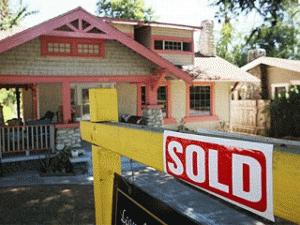
Frank Lloyd Wright house may relocate to Japan An experimental textile block house designed by architect Frank Lloyd Wright could be moved from California to Japan.

La Miniatura in Pasadena was built in the 1920s and is one of four similar houses in South California, reports the Los Angeles Times.

However, it has remained on the market unsold for two years and its asking price has now dropped from $7.7 million to less than $5 million.

Real estate agent Crosby Doe believes that he may now have found a potential buyer via an art dealer based in Japan.

“With my position in the preservation community, I will probably be crucified for saying this,” explained Mr Doe to the newspaper.

He added: “But we have to consider all options. We moved the London Bridge to the Colorado River. Why couldn’t we move this house to Japan?”

The Financial Times recently reported that there has been a surge in the number of Chinese investors purchasing property in Japan as real estate prices continue to fall across the country.

Written by Graham McPherson.

Home Prices Increase and Sales Stabilize

National home prices jumped a substantial 3.6% in the past year, according to the S&P/Case-Shiller Home Price Index released on Tuesday. Prices also climbed 4.4% in the second quarter compared with a 2.8% plunge in the first quarter.

Home prices rose in August for the third straight month, a rapid pace of recovery that surprised economists and raised questions about how long the trend can last.

U.S. home prices rose for the fourth straight month in August and shoppers spent more last week, providing evidence consumer demand could be stabilizing.

After a steep three-year descent, home prices rebounded this summer at an annualized pace of almost 7 percent, the Standard & Poor’s/Case-Shiller home price index showed Tuesday. Against a backdrop of rising unemployment and falling consumer confidence, the speed of the recovery stumped Robert Shiller, economist and co-creator of the index.

“It’s a time of exceptional uncertainty,” Shiller said. “It doesn’t seem like a time to see home prices booming, but that’s what’s happening.”

He expects prices will continue to rise for the next few months, but can’t forecast beyond that, explaining, “There’s no way to be a statistician about this.”

John O’Dell is a licensed real estate broker
Call him at 530-263-1091

Missed Mortgage Payments Rate Falling

The number of U.S. households that missed consecutive mortgage payments or were in foreclosure fell more in the second quarter than any time since the mortgage crisis began four years ago, a survey found.

But the data, released Thursday by the Mortgage Bankers Association, showed the crisis is far from ending. One worrisome sign: The number of newly distressed borrowers increased, raising the prospect that foreclosures and delinquencies could resume their rise.

Overall, some 14.4% of borrowers had missed at least one payment or were in foreclosure at the end of June. That was down from 14.7% at the end of March, but up from 13.5% a year ago. The improvement came because fewer borrowers fell 60 days or more delinquent on their mortgages. The number of households that had missed just one payment increased.

Read more Wall Street Journal

New Online Help From Fannie Mae


Since the start of the housing downturn, the number of Web sites and foreclosure-prevention companies claiming to offer help to struggling borrowers has greatly increased.  While some of the businesses are legitimate, others are fraudulent and offer services that consumers may be eligible to receive free of charge.

  • This month, Fannie Mae – the government-sponsored entity that helps set lending standards for most mortgages—started a Web site, KnowYourOptions.com. The site contains elements distinguishing it from those aiming to prevent foreclosure.  All of the information on the site is available in Spanish or English.
  • KnowYourOptions.com provides video explanations of what users might accomplish in each of the tabbed section of the site.  In the “Take Action” section, for example,” struggling homeowners are advised that the first step to take in seeking help with their mortgage is to contact their mortgage company.
  • Other features of the site include contact information for mortgage companies and loan counselors, calculators to determine if the borrower is eligible for assistance, and information on commencing short sales or deeds-in-lieu of foreclosure.
  • Another helpful Web site for consumers is Hope LoanPort, which allows struggling homeowners and housing counselors to submit financial documents to mortgage companies and track the status of their efforts to avoid foreclosure. Hope LoanPort was created by Hope Now, a consortium of 12 mortgage companies and 250 counseling agencies.

To read the full story, please click here.

Inside a Russian Billionaire’s $300 Million Yacht

Known as the “A” — the mega-yacht features luxuries most of us can hardly dream up, like a glass-bottomed pool built atop a disco or a plush room with walls covered in stingray hides.

The boat, designed to be longer than a football field by the legendary French designer Phillipe Starck, cost $300 million to build.

“The design is unique, it’s not beautiful but it’s interesting,” observed Norm Ronnenberg, a maritime lawyer in the Bay Area. ( I don’t know if he is jealous, but I think it’s beautiful )

Among other extravagances, the ship has a $60,000 bannister, a master bedroom that opens only to a fingerprint and a secret room designated specifically for “nookie.”

The yacht’s owner is Andrey Melinchenko, a 38-year-old Russian businessman who made his money in banking, fertilizer and coal. Forbes magazine currently puts Melinchenko’s net worth at $4.4 billion.

Wall Street Journal’s ‘s Robert Frank takes an exclusive tour of Andrey Melnichenko’s 394-foot mega-yacht.

Buying Land, be Careful

By John J. O’Dell

I recently met a couple at one of my favorite coffee shops, the Flour Garden. We started talking and they were looking for some cheap land to buy, figuring that there was a lot of good deals out there because of the economy.

Since I always carry my laptop with me, I did a search for land under $50,000.  I found a parcel that was a little over an acre in a great part of Nevada County.  The parcel was listed at around $30,000.  I thought to myself this seems too good to be true because of the price and location.

The clients and I drove out to look at the parcel.  The first thing I noticed was that there was evidence of at least three attempts to drill for water. Talking to the neighbors, they stated that there had been at least six attempts to drill for water! So here was a great parcel of land, no treated water nearby to tap into, and no apparent possibility of finding water by drilling a well. In other words, right now, you can’t build a house on the parcel.

I hate to tell you what the owners paid for that property, but it was well over $150,000, now listed at around $30,000.

The moral of the story is, never buy land that does not have either water available or if it doesn’t,  without drilling a well prior to closing.   Make sure you have an agreement with the seller as to how much money you are going to spend in case you don’t find water. That way, when you reach your budget you can cancel the purchase contract. Determine if the seller will work with you and share some of the expense of drilling a well.

John J.  O’Dell
Is a licensed real estate broker
You can reach him at 530-263-1091

A Hike to Grouse Ridge, Land of a 100 Lakes

Jeff Toff, a local Grass Valley attorney  took a hike around Grouse Ridge with his dog Logan a few weeks ago. Logan is an Irish Wolfhound, and when Logan puts his front feet on Jeff, he’s a lot taller than Jeff. Jeff took many pictures while he was there and I’ve combined them into a video showing how beautiful Grouse Ridge really is.

A beautiful area, it has a geologic display of the 100 million year old birth of the Sierra Nevada Mountains. Just a few thousand years ago, the Rigde was further sculptured by volcanoes and glaciers, leaving over 100 lakes.

Today the story reveals the gentle and slow aging of the region: lakes reverting to meadows and gradual invasion of forests. Within its heart, scattered stands of mature trees offer stark contrast to polished and sculpted granite. Flowers are abundant and beautiful against the massive display of rock.

Grouse Ridge Campground is located approximately 24 miles east of Nevada City at an elevation of 5,600 feet. This campground has 9 walk-in campsites. There is no potable water but toilets are available. There is no trash removal service. Hiking, fishing and swimming are available from this campground.

Information on hiking trails can be found at the Tahoe National Forest website. There are four hiking trails listed. Scroll down towards the bottom of the page to find the information.


View Larger Map

New Federal Reserve Rules to Protect Consumers From Abusive Lending Practices

Getting a mortgage in the hay day of the housing bubble was sometimes a very costly adventure.  Some mortgage brokers would try to steer the borrower into  loans that gave the  broker the most points (a point is one percent of the loan) to them. In other words, they would pick a lender that gave them the most money for originating a loan with them. Some mortgage companies and banks would add un-necessary fees to increase their profit margin when originating a loan.

The Federal Reserve Board has  issued new rules to protect consumers from abusive mortgage lending practices.

The new regulations, which take effect April 1, 2011, will ban lenders from paying mortgage originators more for putting borrowers in more expensive loans. Consumer advocates have long decried the incentive, known as “yield spread premium,” saying it steers homebuyers into loans with higher interest rates.

Under the new rules, lenders will also have to disclose how borrowers’ payments could change over time, including the maximum amount that could be owed under an adjustable rate loan. Homebuyers will also have to be told about any balloon payments due at the end of the loan’s term.

The Federal Reserve has been tightening mortgage lending regulations in the wake of the housing bust. The Wall Street reform act recently passed by Congress includes similar provisions, but also addresses practices not covered by the board’s new regulations. The Fed plans to implement the act’s provisions in the future

By the way, the regulations are not in effect yet, so shop around when you are getting a mortgage. Ask how many points the lender is going to charge you and what other costs are they going to tack on to get your loan. Question each cost item that they are going to charge you to originate your loan. Compare closing costs among several companies to see which one is the cheapest and gives you the best interest rate. Compare what they told you verbally to what they put in writing.

Home Appraisal Sites on Net Fail to Pin Down Accurate Prices


Over the last five years, one of the newest developments in real estate is the ability for home buyers and sellers to search online for a home’s value.  Popular Web sites such a Zillow.com, Cyberhomes.com, and Eppraisal.com offer free home estimates, but some consumers and real estate industry professionals say the values calculated often are inaccurate and misleading.

  • Online home appraisal Web sites assign home values without knowing the features or upgrades of a home or the neighborhood in which it is located.  Some Web sites offer a price range of $20,000 – $40,000 more or less than the actual value of the home.
  • Since housing markets are local and not every home of a certain size is the same value, consumers can be misled into believing a home is worth more or less than the actual value.  Working with a local REALTOR® can help minimize inaccuracies in home values.  REALTORS® can provide local housing market data and show homeowners and buyers recent sales of comparable homes in the area, to help determine an accurate list or offer price.
  • While some agents report that Web estimates can educate clients and provide a reasonable assessment of market conditions and the home-buying process, working with a local REALTOR® is the best option.

To read the full story, please click here.

Do You Know the Red Flags of Mortgage Fraud?

By Howell Haunson

RISMEDIA, August 18, 2010–Mortgage fraud is not going away any time soon. The FBI has been working with bureaus of investigation in states that recently passed residential mortgage fraud acts to stay abreast of the latest fraud tactics.

The FBI has found that fraudsters are evolving new ways to take advantage of others and hide their intent. For this reason, anyone involved in the mortgage industry needs to be educated on the red flags of possible mortgage fraud, such as those outlined below:

Flipping vs. Serial Flipping:
A fraudulent flip is one that erroneously increases the value of the property by using an inflated appraised value. If a property was purchased for $175,000 and soon thereafter was sold for $500,000, most professionals would notice. However, serial flipping is trickier. Say a house sold for $175,000, soon after sold for $250,000, then $325,000, then $400,000 and then $500,000. Fewer professionals would even raise an eyebrow. This scheme takes more time, but the end result is the same: fraud.

Multiple Contracts & HUD-1 Settlement Statements
In this scheme, unbeknownst to the seller, the contract and settlement statement that is sent to lender shows inflated sales price. This enables the buyer to obtain a higher mortgage. In the end, the seller believes the property was sold for $300,000, but lender, agent and buyer believe the sales price was $500,000 (the amount on which the agent’s commission is calculated).

Fraudulent Qualification Documents
In this scenario, the borrower’s ability to qualify for a loan is misrepresented by fabricated employment history, income, credit records, and bank statement balances. FBI calls this is an “emerging issue” and a result of sophisticated Photoshop and editing software.

Bogus Assignment Fees
Buyer #1 enters into an assignable contract with the seller at an inflated price. Buyer #1 locates Buyer #2 who may be a co-conspirator or a naïve investor. Buyer #2 takes an assignment of the contract at the inflated price and agrees to pay Buyer #1 an assignment fee. Inflated appraisal is used and Buyer #2’s application may contain misrepresentations.

Continue reading Do You Know the Red Flags of Mortgage Fraud?