Putting Mortgages into ‘Plain Language’

house-on-hands

Bank of America has created a new website called Bank of America Home Loans for borrowers that includes a calculator that determines not just what size loan people can qualify for, but how much they can spend without being stretched too thin. “We wanted to change the conversation to ‘How much house can I comfortably afford?’ rather than ‘What’s the maximum I can buy?’ ” said Aditya Bhasin, the product, pricing and strategy executive for Bank of America Home Loans.

The site is designed to be easy to read, spelling out a variety of contingencies, including the maximum payment that an adjustable rate mortgage could potentially cost.

The new site also offers what BofA calls Flat Fee Mortgage Plus, which has no application fee and a single closing fee that includes processing costs and fees for third-party services like appraisals.

Not included are other standard costs like property taxes, homeowners’ insurance and prepaid interest.

Craig Focardi, a senior research director at the Tower Group, a financial consulting firm, said the idea for the plan is nothing new – it’s been tried by others. But the prominence of the programs could persuade competitors to adopt the features.”

If you recall, Bank of America took over Countrywide Lending and renamed it Bank of America Home Loans. I’m not sure that their new website is not a rehash of Countrywide’s old website. But with B of A’s great customer service (tongue in cheek) they need some kind of P.R. to make them look helpful. Some related information on Countrywide Financial Corporation:

According to the LA Times 04/27/2009

“Linked more recently with high-risk loans, co-founder Angelo R. Mozilo’s huge paydays and FBI investigations, the Countrywide name became “too toxic to resuscitate,” as another expert puts it — and a liability for Bank of America Corp., which snatched it up last year as it neared collapse.

And so over the weekend, nearly 10 months after the Bank of America deal closed, Countrywide Home Loans signs came down and Bank of America Home Loans signs appeared at the lender’s 215 storefront offices in California. It was the start of a rebranding of nearly 1,300 Countrywide mortgage offices nationwide.”

Yep, Countrywide and Bank of America, great combination.
Fun Tuesday-Slow Loris

Slow Loris are  primates 10 to 15 long and weigh about 610 to 1000 grams. Although very cute with their large eyes, they can give you a very painful bite, since their teeth are full of toxins. Because of their cuteness they are sold on the open markets as pets in Asia and with destruction of the rain forest, they may become an endangered species. They are really cute and maybe we can bring awareness to help save these beautiful animals.

After watching these videos, for more information go to Slow Loris Research 

httpv://www.youtube.com/watch?v=rLdQ3UhLoD4
Tickle me some more!

httpv://www.youtube.com/watch?v=nb12bAaKzvA
Time for lunch.

Lenny Dykstra’s $25 Million Home Faces Foreclosure

lenny-dykstra

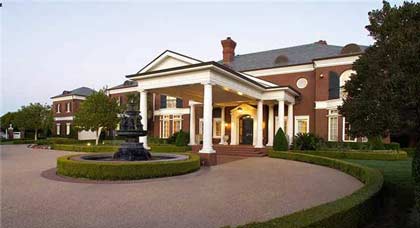
It seems that Lenny Dykstra, former major baseball player for the New York Mets and Philadelphia Phillies, may be facing foreclosure on his 12,723 square foot Georgian estate, originally built for hockey legend Wayne Gretzky. Dykstra’s lender, Index Investors LLC, filed a default notice on March 11 at which time he was behind in his payments in the amount of $422,436. The private investment group gave Dykstra an $850,000 bridge loan in November of last year which was secured by the home.

Dykstra bought the home from hockey Wayne Gretzky for $18.5 million in 2007 and put it on the market last year for $24.95 million. The six-bedroom home didn’t sell and in February it showed a price reduction down to $16.5 million. All of a sudden, the list price has been pushed back up to $25 million. It is still however listed at the same rental price it was in February, $55,000 a month.
lenny-dykstra-fireplace2

Now, the NY Post is reporting that “Lenny Dykstra” is flat-out broke and facing foreclosure. According to the article, “The private-equity firm Index Investors filed foreclosure papers March 11 on Dykstra’s sprawling Thousand Oaks estate…” Also, Washington Mutual filed its own notice of default on his $12 million mortgage on March 18. To top it off, his jet has been impounded.

If that isn’t bad enough, his wife, Terrie Dykstra of Thousand Oaks filed for divorce in Ventura County Court on April 16, listing irreconcilable differences. Terri is requesting joint custody of the couple’s 13-year-old son, according to court documents. Two houses in Thousand Oaks owned by the couple are listed as community property.

The couple were married more than 23 years and were separated on April 3, court documents show.

Stories about Dykstra’s personal acquisitions after baseball, his financial woes and legal battles have aired on HBO, ESPN and been published in sports magazines.

In addition, lawsuits filed in Ventura County Superior Court claim he owes: $4,850 for pilots and maintenance fees for a two-day trip he took over Christmas; $12,000 for chartered aviation services in connection with his magazine, The Players Club (the complaint states Dykstra’s Visa card was declined); and more than $290,000 to Las Vegas printing company Creel Printing and Publishing Co. for printing services for The Players Club. The magazine folded in April 2008, shortly after it was launched.

Dealbreaker also says that Dykstra’s Gulfstream II was impounded on February 12. It’s a dramatic turn from a year ago when the New Yorker did a profile of Dykstra and his magazine, The Players Club which was going to show professional athletes how to keep their wealth and not join the ranks of players who earn millions and wind up in financial trouble just a few years later. Since then, Dykstra has been the subject of multiple lawsuits and creditors in relation to the magazine. As investments, magazines are like restaurants, glamorous, but highly profitable only for the lucky few.

Dykstra’s major league career spanned from 1985 to 1996 with the New York Mets and Philadelphia Phillies.

Lenders Chase Short Sale Sellers

This is a reverse view, your neighbors are there to watch out for you.

This is Listing… with panoramic views in Seattle, Washington. But, on with the story.

An increasing number of lenders are going after borrowers who sell their homes for less than they owe – known as a short sale – in order to recover more of the difference between the amount owed and the sale price.Lenders say the factors that they consider when they decide to seek more money are: 

  • How large was the unpaid debt?
  • Was the property an investment or a personal residence?
  • How much money does the borrower make and what other assets does he have?
  • What is the policy of the mortgage insurer or the holder of the second lien? 

A PMI Group Inc. spokesman says the mortgage insurer “primarily target[s] borrowers who are not experiencing hardship – but those who simply elected to walk away from the property due to its decline in value

Source: The Wall Street Journal, Ruth Simon (04/30/2009)

In real estate, a short sale is when a bank or mortgage lender agrees to discount a loan balance due to an economic hardship on the part of the mortgagor. The home owner/debtor sells the mortgaged property for less than the outstanding balance of the loan, and turns over the proceeds of the sale to the lender, usually in full satisfaction of the debt. In such instances, the lender would have the right to approve or disapprove of a proposed sale. 

In some cases as mentioned above, the banks are not willing to just let go of the mortgage without further compensation.  In many cases, this has led to foreclosure in lieu of a short sale. 

Hard Money Lending & Tom Hastert

Tom Hastert
Tom Hastert

The term “hard-money” lending can be traced to the Great Depression when private individuals started lending money because of the banking crisis, said Leonard Rosen, whose La Jolla-based company, Pitbull Mortgage School, teaches mortgage brokers about hard-money loans.

“No one really knows the reason they used ‘hard money’ as a term. It could be that it was hard to get, hard to find or because it was hard cash,” Rosen said. “I’m not an advocate for hard-money lending. But it’s something that has its place as long as it’s done responsibly. There are some people who should not be in the lending business at all.”

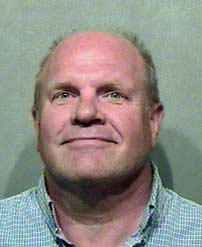
Thomas Hastert, now a former attorney and real estate broker, certainly was one of those people that should not have been in the lending business at all.  Hastert had the mortgage company Loan Sense, which was located in Grass Valley off of Brunswick Road.

As you may know by now, Hastert is in jail, having pleaded guilty to 59 felony counts of embezzlement, securities fraud and selling unregistered securities. However, Attorney General Brown had filed 73 criminal charges against Hastert, so by plea bargaining, it was dropped to 59 felony counts with a possible five year jail term instead of eleven years. Hastert is to be sentenced in June.

By the way, Hastert did not make $20 million; most of the money he received from customers he used to make loans with extreme poor judgment, ignoring the law and some obvious intent to commit fraud. Most of the investors’ monies were lost by loaning money with improper loan to value of property. This, along with improper funding of construction loans led to horrific losses to the customers who gave Hastert money to make hard money loans. 

This man brazenly deceived investors and borrowers, promising high returns and easy loans, ripping off his customers for his own personal enrichment,” Attorney General Brown said. “Ultimately, this criminal scheme collapsed when many of these loans failed, costing hundreds of people more than $20 million.”

  • Hastert brokered over 270 hard-money loans in Nevada, Sacramento, Sutter, Butte, Placer, and Yolo Counties between September 2004 and September 2007 for real estate development projects. Hard-money loans typically provide high returns for private investors and are secured through collateral such as real estate.

    In this case, Hastert secured $20 million from numerous investors, using the funds to broker hard-money loans to borrowers seeking to develop homes on real estate.

    In the criminal complaint, Hastert is alleged to have:

    “Misled investors. Hastert told investors that borrowers had excellent credit scores and were capable of repaying the loans. This proved to be untrue. Many borrowers had poor credit scores, did not make regular payments on the loans, and held properties that were in foreclosure.

    The loans that Hastert brokered were required by law to be placed into a special trust account overseen by a third-party escrow firm. The firm had to verify whether funds being withdrawn by borrowers were being used for construction projects. Despite telling investors he had established such a trust account, Hastert never did, and the money was regularly withdrawn and misused by borrowers with no oversight.

    Hastert told investors he would personally oversee the development of the land. In one instance, he was asked by investors to drive them to a particular property that was supposedly under development. Hastert could not locate the property.

    Set up fake investors, known as “straw men,” to keep concerned investors at bay. Hastert filed documents with a county recorder’s office saying that his secretary owned a majority interest in the investment, despite the fact that she had never invested a single dollar. If a legitimate investor tried to initiate foreclosure proceedings, Hastert would contend that the supposed majority owner opposed the action.

    Embezzled fees. Hastert was entitled to collect a 3% fee on loans he brokered. However, he took all his fees up-front as if the loan were fully funded. In fact, some loans never fully funded, and others took more than a year to fully fund.”

“Those who invest their money with hard-money lenders are taking on significant risk. That’s why they would expect a significant return relative to other investments,” said Stuart Gabriel, a UCLA finance professor and director of the university’s Ziman Center for Real Estate. “If they need to take the property back, there’s legal risk and marketing risk. There can be very significant losses.”

So if you are going to invest in hard money loans, with a promise of high returns, be careful. Give me a call or write if you want some guide lines prior to investing.

Fun Friday, Salmon Fishing, Only the Best for You

These are some of the funnist fish commericals I’ve seen. By the way, if the recession is getting you down remember: “Life is a shipwreck,” wrote Voltaire, the 18th-century French philosopher, “but we must not forget to sing in the lifeboats.” So cheer up, laugh a little, and have a great weekend!

httpv://www.youtube.com/watch?v=8vaiQyVhXm4

httpv://www.youtube.com/watch?v=5n4xXc25wPE

A Journey to Downieville, California

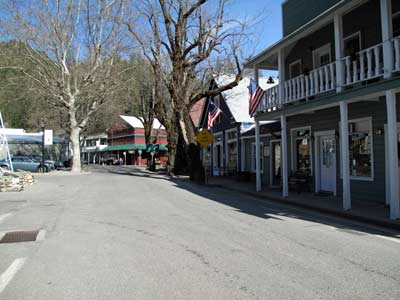
Downtown Downieville

 If you want a nice place to visit and a relatively short drive from Nevada City and Grass Valley then take a journey to Downieville. About forty five miles from Nevada City along scenic Highway 49, it’s a great drive, with a large portion of the trip along the North Fork of the Yuba River. Beautiful views of the river and forest, unsullied by human habitation! A group of us went up there last weekend to get away from it all. And we did!

We stayed at the Downieville River Inn a very nice Bed and Breakfast inn which is run by James & Diane Barnhard. Do not confuse this inn with the one right on Highway 49. I think this one is much quieter, definitely has more grounds and things to do (sauna, swimming pool, BBQ and lawn areas). Diane is a great cook if you come to the morning breakfast. You can even rent houses of various sizes for families who want to cook (or the whole place – there are 12 “units” but the place sleeps 40 people comfortably) for a group gathering or family vacation. Even many or the rooms have a small kitchenette, or refrigerator unit. 

After arriving at the inn, we took a one mile hike through town to the twin falls clear on the other side of the town. There are many other hiking trails, and the next day we took another mile hike along the river. Any time you are walking along and come across neighbors or people in the street, you can stop and talk to them. A visit to a restaurant is a time to start meeting the people next to you, where they are from, hobbies, and plans for the day. It is the friendliest town I have been to a long time.

Things to do while you are there includes, fishing, hiking, bicycle riding, there is museum and a couple of nice restaurants. There are numerous bike trails and many sponsored bike rides in the summer. Of course, there is also the natural beauty of the Sierras, with a confluence of the Downie River and the North Yuba River right in the heart of Downieville. When exploring the town, there is no need to drive your car, and the river is easily reachable to sit and just contemplate, or splash your feet.

Convergence of Downie River on the left & Yuba River on the right.

 It’s a great little place to visit and it hasn’t changed much from the time I was County Engineer and County Surveyor for Sierra County. When I was up there in the 70’s the population of Sierra County was a little over 3,500 people and now, it’s still a little over 3,500 people! The town has a great gold mining history, stores sell the local gold and jewelry made from it. The town also has a unique history, when in July 1851,  lynched a woman, Junita, from the bridge across the North Yuba River for killing a miner.  It remains the only lynching of a female in California history.


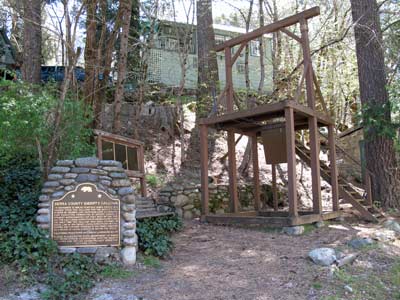
Sheriffs Gallows Downieville

There is also an original gallows, built in the town and used only, and still there for visitors to see. The gallows, called Sheriff’s Gallows, was constructed in 1885 for the specific execution of nineteen year old James O’Neill, a native of Ireland, who shot and killed his former employer, John Woodward, at Webber Lake, on the afternoon of August 7th.

The northern mines area was populated by a number of gold rush camps with colorful names, places like Brandy City, Whiskey Diggins, Poverty Hill, and Poker Flat. While many of these camps entirely disappeared after the gold rush, Downieville survived due both to its geographical location and status as the seat of Sierra County government

For information on camping, visit Downieville Ranger Station’s Campground Web Site. Also their telephone number is (530) 288-3231 


View Larger Map

The Bargains in Real Estate are Going to be Gone

inside-of-church

This is an interior picture of a  listing for a three bedroom, two bath home which will save you travel time and gas for Sunday services.

Here in Nevada County, while there were almost the same amount of sales in April of this year compared to last year, the pending sales are way up. Potential buyers in areas that were hard hit by the housing downturn have read about bargains; only find it disappointing when they go shopping.

But in Southern California, housing is hopping:

According to an article in the Los Angeles Times:

“House hunters are trying to pounce on deals from sellers they expected to be frantic — if not curled in the fetal position. What they’re finding instead are bidding wars as low interest rates and pent-up demand in traditionally stable or chic areas have kept prices up — not as high as the market’s peak, but not nearly as low as they had hoped.

Bank-owned or not, the cheaper properties are dominating the sellers’ block in the notoriously expensive L.A. County real estate market. In March, 2,871 homes under $300,000 were sold compared with only 734 a year earlier, according to real estate information firm MDA DataQuick.

When the real estate bubble burst, it didn’t affect the mid-priced market, said real estate information firm MDA DataQuick. Instead, it created opportunities in troubled neighborhoods and slowed sales in the market of homes priced above $1 million. But in areas where most of the homes sell for $400,000 to $800,000, there are few discounts to be found.

Even the foreclosure market has slowed, says University of Southern California Professor of Real Estate Tracey Seslen. Seslen said lenders with foreclosures are supporting market stabilization and releasing only a few homes at a time to avoid flooding the markets.”

Like I said, if you wait to buy at the bottom of the real estate market, you’ll find that the bottom pasted you by a long time ago.


Fun Tuesday?

land-listing

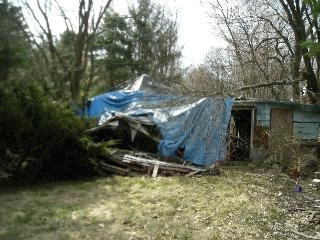
This lovely picture of a listing features a totally air conditioned home. Features include blue tarp, (may be used in a pinch to cover a pickup load to the dump) and some fire wood. Located in Hyde Park, NY.

A couple of things today. One, I talked to one of the major banks that I had listed yesterday about lifting the moratorium on foreclosures. He stated that the banks are loosing up their lending requirements. He stated that the TARP money was being used and they were working hard to stop foreclosures. In fact, he mentioned that they would soon be going back to making loans based on stated income for business people who had a good credit history. That sounds like we have hit bottom!

Now I know, I said fun Fridays, but I need some input from you, the reader.

Do you have stories of Nevada County that you would like to share? Some history of Nevada County? How about some pictures of something funny that you’ve seen or a funny picture of some one’s listing? Something going on that you would like to comment on? (No politics or grips please)

Anything else you would like to know about or like to see on this site?

Contact me and let me know. Please use this contact form. I know, you hate forms, but if I don’t use the form and just use my e-mail, there is software out there that grabs e-mail addresses and then I get a ton of junk mail.

Thanks, I look forward to hearing from you.

Error: Contact form not found.

Nevada County Residential & Land Sales, April 2009

"Alternative Housing" Location, Oregon


What the figures show for April of this year is that residential sales are about the same number as it was for April of last year.  However, we’ve had a further decline in medium residential home prices of minus 23 percent. Here are the stats for sales in Nevada County.

There were 67 residential properties sold in April 2009 compared to 62 residential sales in April 2008.  Total residential sales from January to the end of April 2009 were 191 sales compared to the same period last year of 203 sales.

The medium price for April 2009 was $299,000 compared to April 2008 of $387,500 a decline in market price of 23 percent.  There were 1,165 residential properties listed for sale at the end of April, which based on the number of sales from January to April 2009 equals about 1.6 years supply of residential property for sale, assuming sales continue at the same rate.

There were 20 land sales from January to April in 2009 with a 45 month supply of land at the end of April. Last year there were 45 land sales with a 49 month supply of land.

I’ve noticed a pickup in pending sales, which I post on this website daily for those that are interested, and it seems that the pending sales are up. They have been hovering in the 200 pending sales starting within the last month. However, this is for all sales, not just residential sales.

Where are we with future sales? It’s anyone’s guess, Fannie Mae and Freddie Mac asked lenders to forestall any more foreclosures until March 6, 2009.  What they are doing now that the agreement date has expired? Some circles say we are in for a tsunami of foreclosures. The following banks had agreed to the government’s request and their expiration dates of the agreement. 

JP Morgan Chase – New Owner-Occupied residential loans that are owned and serviced by JPMorgan Chase.  As with Fannie Mae, the moratorium of foreclosures end date, March 6th.

Citigroup – All Citi-owned first mortgage loans that are principal residence and on loans for which understandings with investors have been reached.  Moratorium end date – March 12th.

Bank of America (also Countrywide now renamed Bank of America Home Loans) – Delay foreclosures sales on owner occupied properties whose mortgage loans are owned and serviced by B of A or Countrywide  – Through March 6th.

Wells Fargo (also Wachovia) – For Loans it holds.  The moratorium is expected to remain in place until the government’s foreclosure prevention plan is announced.  The majority of Wells Fargo’s mortgage loans are serviced by it and owned by other investors.