New Appraisal Rules for Fannie Mae & Freddie Mac

appraisal-of-house

There is a new “Home Value Code of Conduct” that went into effect on May 1, 2009.  All Fannie Mae and Freddie Mac mortgages have major changes in ordering and processing home appraisals.

Under the new rules, mortgage brokers will no longer be able to order appraisals directly for loans sold to Freddie and Fannie. This will force mortgage brokers to be “hands off” in choosing appraisers and potentially influencing the outcome of the appraisal.

Fans of the new code say appraisals will be more accurate, and there will be less fraud and lower costs. But others say the new rules will result in less reliable appraisals by some who may not be thoroughly familiar with an area, delays in getting loans processed and steeper costs.

In his latest blog post, Mortgage Broker Dennis Smith of Stratis Financial Services in Huntington Beach writes about how he sees the new code affecting home buying.

Smith writes about the process:

“First, the HVCC is a requirement for all loans that are being funded by Fannie Mae and Freddie Mac, no exceptions.  Under the rules of the HVCC any person or company that collects a commission as part of the mortgage transaction may not have any contact with the appraiser, including ordering the service. 
 
“Starting with all transactions with applications dated [on or] after May 1, 2009 the originating entity, me, must order any appraisals through the funding entity (lender) who must use an “adverse selection” process to select a national appraisal company. 

“When the appraisal is ordered the fee for the appraisal must be paid in full through credit card transaction; the borrower will need to provide this information for the transaction to move forward.  The national appraisal company upon receiving the order will then contact an appraiser in the area or region of the subject property and place an order for the appraisal.
 
“The appraiser will contact the appropriate person for access to the property and complete the appraisal.  He will then send the appraisal electronically to the national appraisal company who will review the appraisal and send it electronically to the underwriting unit of the lender.  The underwriter will review the appraisal and if acceptable will post it on the company website and notify the borrower.
 
“Attention! It gets interesting here.  Under the HVCC policy the borrower must receive a copy of the appraisal at least three days before ‘closing’.  I put closing in quotes because in some states closing and loan documents are the same time-this occurs in non-escrow states.  In states such as California where we order loan documents and then close after they are signed an reviewed most lenders are requiring that the borrower receive the appraisal at least 3 days prior to drawing loan documents.  In short, loan documents will not be drawn until 3 days after the borrower has received a copy of the appraisal.  And that copy must come directly from the lender. 
 
“This process will take several weeks to flush out but in California the most obvious problem is the appraisal contingency that is part of all CAR contracts — expect a revision in the near future as the HVCC becomes better understood by the CAR attorneys — since no one intimately involved in the transaction has any contact or control over the process from selecting the national appraisal company to selecting the appraiser, no one involved in the process can say for certain when an appraisal will be delivered so all aspects are known.” 

I left out the rest of his comments, since as a mortgage broker; he does not like the new rules. Mortgage brokers like to work with appraisers who they are familiar with and who know the area that they are working in. My own personal opinion is the more hands off the process is, the better it is for all of us.

What do you think?
 

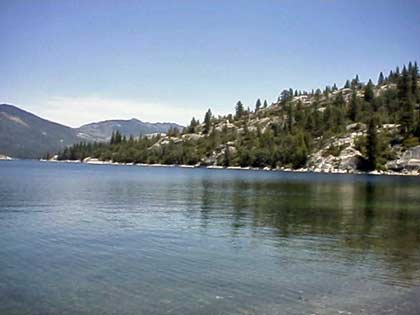
Collins Lake, Oregon House, California

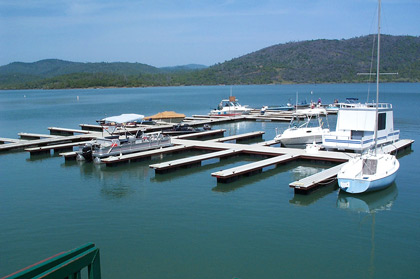
Collins Lake Marina
Collins Lake Marina

Although Collins Lake Recreational Area is not in Nevada County, it is close enough to our area to be considered a great place to go fishing, boating or camping. Collins Lakes sits at an elevation of 1,200 with a surface area of over 1,000 acres with 12 miles of shoreline.

There are many activities at Collins Lake; which include:

Water skiing, tube or wakeboard are allowed. The water ski season begins May 1st and ends October 15th of each year. However, small, personal watercraft such as jet-skis and small personal watercraft are not permitted to operate on Collins Lake. Boat rentals are available. Of course, swimming is allowed, with the surface temperature of the clear water hovering around 75F to 78F degrees in the summer.

Camping facilities are available, along with cabins in addition to 150 campsites with hookups and 30 campsites without hookups.

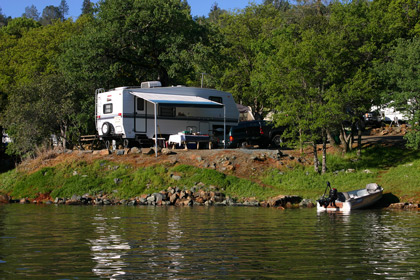
Collins Lake Camp Site

The most noted feature of Collins Lake is its fishing. They are raising trophy rainbow trout in underwater net pens during the winter and releasing them in late spring. There are a total of 12 pens, each about the size of a bedroom (12’x 10’x 12′) which is located at the marina. These same trout are expected to triple in size to become 3 to 4 pound trophy-sized fish when released in spring time.

Not only that, they already have California’s largest trout stocking program north of Sacramento and have constructed net pens that will further increase this successful program. For every plant of rainbow trout normally received from Fish and Game, Collins Lake purchases 3 plants of larger trophy sized trout from private hatcheries. In 2007, there were a total of 28,000 pounds of trout planted. The average size of trophy trout planted each week during the spring was 2 to 6 pounds, with some whoppers topping 10 pounds! They are also famous for trophy trout and bass fishing.

For contact information and reservations call 800-286-0576 and locally 530-692-1600

Their website is at Collins Lake


View Larger Map

Fun Friday- Dog Dreams & Rabbit Chases Snake

I’ve decided that the blogs on Friday’s would be a “fun” Friday. (I got this idea from my daughter Lisa)  This is one of the funniest videos of a dog dreaming that I’ve seen. I hope you enjoy it.

httpv://www.youtube.com/watch?v=YJYqMhIYw58

Then there’s a rabbit chasing a snake. I could not believe this! Although when I was on the ranch I caught a jack rabbit and it just about tore my hands apart with its back claws.

httpv://www.youtube.com/watch?v=_Ez5QPW-ku4

Be Careful of Real Estate Scams & Fraud

house-fraud

Real estate fraud is a serious problem now and always has been something to watch out for. Here are some examples of danger signals.

Property Flipping – A type of real estate investment strategy in which an investor purchases properties with the goal of reselling them for a profit. However, not all property flips are fraud, it is just a red flag and illegal flipping is another story.

From one end to the other these are deals that routinely involve valuations from appraisers who get money under the table, falsified loan applications, mortgage fraud, bait-and-switch financing, predatory loans with unconscionable terms and repairs which are not up to code and thus result in a house which may be neither safe nor habitable.

Chunking – Another common scam, where basically, there is a get-rich quick seminar to convince attendees to become investors. This is a scheme in which a fraudster sells an investor an overpriced property and pockets the difference. This is usually done in get-rich quick seminars.

As an example, Mr. Borrower attends a “seminar” or program that shows how to get rich by investing in real estate with no money down. A third party, Mr. Fraudster, possibly a presenter at the seminar/program, encourages Mr. Borrower to invest in three RE properties and acts as Mr. Borrower’s counsel/agent.

Under Mr. Fraudster’s guidance, Mr. Borrower completes the required application documentation for the transactions. Unbeknown to Mr. Borrower, Mr. Fraudster takes the applications and submits the information to 15 different lenders for 15 different properties. This scheme requires the assistance of an appraiser, broker, and/or a representative of a title company to ensure that Mr. Borrower does not have to bring money to the multiple closings.

Mr. Fraudster acts as an agent for Mr. Borrower at the 15 different closings. The net effect is that Mr. Borrower receives loan proceeds from three of the closings and Mr. Fraudster pockets loan proceeds from 12 of the 15 closings. The lenders are stuck with loans to a borrower who does not have the ability to repay the debt and are often forced to foreclose on the properties..

Nominee Loans/Straw Buyers – This involves a person who agrees to lend their name and credit but does not intend to actually be responsible for the property.

As an example, person A wants to buy a property, but convinces person B to step in as a “straw buyer” to obtain terms that person A could not. Alternatively, person A steals person B’s identity, and forges all of their information on the purchase and loan papers. In both cases, person B is not the person really purchasing the property, but their name is on the mortgage. In the first case, person B is fully responsible for the loan and everything else that goes on, as well as having committed fraud.

Fictitious/Stolen Identity – Same problem as straw buyers, but in this instance the identity is stolen or created out of thin air.

Just be careful of the get rich quick schemes. But regardless of this, it is a great time to buy real estate; in fact, I think it’s a buying opportunity of a life time..

Banks Banking Their Money

Banks and their money

So the major banks have been given billions of dollars from TARP so we could start borrowing money to buy cars and homes to get the economy going again. But now that the banks are awash in cash they’re keeping it in the bank. It seems that the banks are hoarding their cash so they can pay back TARP funds and of course, so they can raise the pay of their CEO’s. After all, they claim if they can’t pay millions to the top help, they won’t be able to hire good managers?

According to Fortune Magazine, writing about the large amounts of cash that lending institutions have on hand:

“The rise was even more dramatic at Bank of America, where cash on hand soared to $173 billion at the end of the first quarter from $33 billion at year-end. CEO Ken Lewis, whose Charlotte-based bank recently acquired the troubled broker-dealer Merrill Lynch, called the shift “very expensive in the short term but well worth the cost in the long term.”

Other institutions holding cash are Goldman, $164 billion, Morgan Stanley $150 billion, AmEX, $25 billion in the third quarter from $13 billion in the forth quarter.

Here’s another quote from Fortune Magazine:

“Liquidity allows the banks to lend if they can find borrowers who can pay them back,” said Gary Townsend, a former bank analyst who now runs Hill-Townsend Capital in Chevy Chase, Md. “That’s the big challenge right now, because the risk-adjusted returns are as big as we’ve seen in a couple of decades.”

Interpret that statement to mean if you want to borrow money from a bank, you must have enough money and assets that you really don’t need to borrow money.

The Flu, the Real Danger to You and the World Economy

flu-virus

What’s the big concern about this flu that’s going around now? According to Daniel J. DeNoon and reviewed by Louise Chang, MD is that this is an unusual strain of virus.

According to Mr. DeNoon, “there are four different types of swine flu strains that commonly circulate among pigs. Most recent swine flu viruses have belonged to the H1N1 and H3N2 subtypes. Pigs typically get sick but usually don’t die from swine flu.”

“What is alarming about the current flu that has started is that it’s acquired genes from swine, bird and human flu bugs. It also has genes from Eurasian swine flu viruses that aren’t supposed to be in North America.”

So we have a “cocktail” of virus that could mutate into something more dangerous. I’m not a scientist, but I believe that is the real concern of the government.

Just how concerned:

“We are declaring today a public health emergency,” Secretary of Homeland Security Janet Napolitano said today at a White House news briefing. That declaration is “standard operating procedure,” Napolitano said. “It is similar to what we do when we see a hurricane approaching a site. The hurricane might not actually hit but allows you to take a number of preparatory steps. We really don’t know ultimately what the size or seriousness of this outbreak is going to be.”

For more information on the flu and how to protect yourself, go to WebMD Health News

We’ve covered what the current flu worries are. Now here are some of the ramifications that are already happening to the economy because of the flu outbreak. According to CNN An article about how the could derail the fragile global economy:

“Already, Russia has banned imports from Mexico, California and Texas. As the flu progresses, the fear is an overreaction and the banning of exports, perhaps worldwide.

But if the outbreak does grow into a large-scale pandemic, Auger said global trade could be disrupted through export restrictions.

“It could lead to travel restrictions for goods and people through major control over ports and airports,” he said.”

My wishes and prayers are with all of you, be safe and stay healthy.

Jumbo Loan Limits Raised by Fannie Mae and Freddie Mac

mansion-picture

Fannie Mae and Freddie Mac will once more begin buying “super-conforming” mortgage loans of up to $729,750, which will bring rates down for borrowers with good credit seeking loans previously classified as jumbo.
Currently, loans greater than the $417,000 conforming limit in “normal” housing markets — or the super-conforming limit of up to $625,500 in high-cost markets — are considered jumbo loans.

Jumbo loans carry higher rates than conforming loans because they aren’t eligible for purchase or guarantee by Fannie Mae and Freddie Mac. Rates on jumbo loans are running at least 1 percent to 1.5 percent higher than conforming loans of less than $417,000.

In between conforming and jumbo loans are so-called super-conforming loans that exceed the $417,000 conforming loan limit, but are still eligible for purchase or guarantee by Fannie and Freddie.

Super-conforming loans carry slightly higher interest rates than conforming loans — about 25 to 30 basis points — but are less costly than jumbo loans that Fannie and Freddie can’t buy or guarantee. A basis point is one hundredth of a percent.

On Jan. 1, the upper limit for super-conforming loans was rolled back from $729,750 to $625,500. But the economic stimulus bill signed into law Feb. 17 restored the higher limit for single-family homes in high-cost markets that was in place for much of 2008.

The following week, the Federal Housing Finance Agency published lookup tables for the new Fannie and Freddie limits in high-cost markets — 250 counties nationwide.

But Fannie Mae did not issue its eligibility requirements for the new limits until March 30. Freddie Mac published its guidelines on April 16. Both companies will begin buying super conforming loans of up to $729,750 from lenders on May 4.

Wells Fargo will begin making super-conforming loans of up to $729,750 in high-cost markets on Monday, and Bank of America will start in mid-May, the San Francisco Chronicle reported.

Craigslist Classified for Rent Scams

sceme-picture

Although millions of transactions spawned by Craigslist are completed without a problem, there is always someone out there using it to steal someone’s money. So goes the tale of a West African scammer who took the address of a home in Lexington that was listed for sale and advertised it on Craigslist as one of his rentals. Saying that he was in West Africa on a land deal, he gave instructions the prospective renter to send a deposit and first month’s rent to a specified address and the keys for the house would be sent by mail.

People who wanted to rent the property, saw a for sale sign and called the listing agent telling her that they had seen the house for rent on Craigslist. The listing agent became aware of the scam and contacted Craigslist. She discovered that that the con artist had used her listing photographs and details of the property from her listing information and had used his contact number instead of her. The listing agent contacted Craigslist and told them of the scam and she hopes it is gone. The twist in this story – the property had been sold even before she got any calls for renting the property.

Here’s another one, how about a Nigerian “pastor” who was trying to collect rent on a Delta Township home to which he had no connection?

The homeowner’s were not amused when all of a sudden, their house which had no activity all of a sudden had tons of people driving by and looking at their home. They were picking up flyers and people were getting out of their cars and looking around their home.

One of the browsers approached the homeowners and wanted to confirm that the house was for rent. Available for WHAT? Was the astonished reply by the homeowners. It seems the home was listed for rent by the good pastor for $1,300 a month, including utilities, dogs and cats were welcomed. Now for a 2,000 square foot home in a good neighborhood this is really a good deal. And we all know if it’s too good to be true, well, it’s not true. The bogus ad had gone up the previous night on Craigslist and the next day the home was bombarded by lookers. The ad on the Internet classified ad site: $1,300 per month plus a $500 deposit.

The agent acknowledged that Craigslist was among the many places he listed the house, but never as a rental. Somebody simply lifted the text of the ad and created a new ad in the hope of collecting as much money as possible before being exposed.

The man who posted the ad called himself “Pastor Heller,” and he tells a story about having to abandon the Delta Township home for an emergency trip to Africa. He asks for $1,300 – one month’s rent, plus a $500 deposit, to be sent through Western Union. He promises to Fed-Ex the keys after receiving the money. I wonder why he picked the name Pastor HELLer?

You know that most of the ads on Craigslist are valid, but if you see one where the ad states that you are to send money by wire or mail, beware, it might be Past HELLer.

The Willo

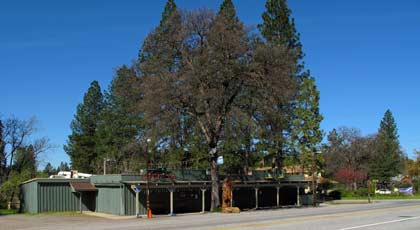
The Willo at Highway 49 and Newtown Road

Driving out two and one half miles north on Highway 49 from Nevada City you might notice a non-descriptive building with a sign “The Willo” along with a small florescent martini glass. You may wonder why there are so many cars and trucks parked outside.  Your first thoughts might be, this must be a really great watering hole!  So unless you live in Nevada County or  a good friend has told you about this restaurant there is no hint that this has been voted the best steak house in Nevada County.   

Once you park and start to walk inside, you will notice a sign near the left hand door that finally tells you that this is a steak house. Walking in, you are in a different world, with dark paneling, cedar walls, pictures hanging in some kind of random order and a picture of the Bay Bridge with lights flashing on the wall. Once your senses have gotten acclimated to the scene, you are in for a treat with excellent service and good food. You have a choice of three portions of New York Steak, small, medium and large (16 ounces). You also have a choice of pork, chicken and three kinds of fish, or even a garden burger. You can cook the steaks yourself, but for an extra fifty cents, they’ll do it for you. By the way, the prices are excellent and won’t break your budget. 

The Willo is owned by a very friendly, very nice couple, Mike Byrne and Nancy Wilson. They have kept up the tradition of the Willo which started its history at its present location as follows: 

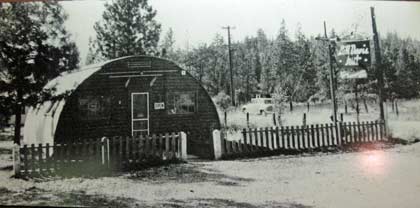
Beginnings of the Willo 1947

In 1947 Bill Davis purchased a surplus WW II Quonset hut from the U.S. Army.  The hut was located at Camp Parks in Sacramento and was disassembled and transported to the site of the Willo at the corner of Highway 49 and Newtown Road. It was re-assembled and opened as Bill Davis Hut, a popular watering hole for the lumber and mining work force. It was later sold to a local couple and it became The Hut. 

In 1963 Bob and Peggy Tucker purchased the Hut and renamed it Tuck’s Hut. With a truck load of lumber from a local mill they enlarged the bar and added a covered structure on the east side where they built a grill pit and served hamburgers through the window to the bar patrons. A “Gold Miners Special” (burger and beer) cost sixty cents. In 1969, the Tuckers leased the property to a local tavern owner, Frank Williams, who was forced to move from Grass Valley to make room for construction of the new “Golden Freeway”.

Together with Veda Folden who with the help of her husband and brothers, converted the covered structure into the main dining room and the Willo Steakhouse was born. The banquet room was added in 1973. How did the Willo get its name instead of the Willow?  What happened to the W on the end? Well, it’s a combination of one of the prior owners names, Frank Williams last name and his wife’s first name Lola.  I advise you to call ahead for reservations, for they are always packed. Their telephone number is  (530) 265-9902

Google shows two locations for the Willo. Don’t know why, but location B is almost the true location. You have to drive a little farther from Nevada City then point B, it’s at the corner of Newtown Road and Highway 49.


View Larger Map

Lake Spaulding & High Sierra Lakes

Lake Spaulding
Lake Spaulding

Nevada County has numerous lakes. Most of them are located in the high country between Nevada City and the City of Truckee. Some of these lakes are; Toll house Lake, French Lake, Lake Spaulding, Webber Lake, White Rock Lake and there are more! Many of the lakes were formed by ancient glaciers that are now long gone.

A few of the lakes provide hydroelectric power and is managed by Pacific Gas & Electric. Those owned by P.G.&E are used for hydroelectric power and the company provides camping grounds and picnic facilities. One of these is Lake Spaulding which sits at an elevation of 5,014 feet. It has a surface area of 698 acres surrounded by a high alpine forest. (Google Maps shows Lake Spaulding as Fordyce Creek)

The history of the lake is that it was built for hydraulic mining in 1912. Hydraulic mining generated millions of dollars in tax revenues but was an environmental disaster. Millions of tons of earth and water were delivered to mountain streams that fed rivers flowing into the Sacramento Valley. Once the rivers reached the relatively flat valley, the water slowed, the rivers widened, and the sediment was deposited in the floodplains and river beds causing them to rise, shift to new channels, and overflow their banks, causing major flooding, especially during the spring melt. The end came on January 7, 1884, Judge Lorenzo Sawyer ruled on the matter. – no more dumping of mining debris where it could reach farmlands or navigable rivers.

Lake Spaulding has 25 developed camp sites for tents and RV’s. Boating is allowed, including power, row boats, jet ski, windsurf, canoe, sail, water-ski and inflatable’s. However, check with P.G. & E. before you go up there, since rules and regulations change from time to time. This is also an area for fishing which include brown and rainbow trout. There is also swimming, picnicking, hiking and backpacking.

For reservations and further information, contact P.G.& E. Regional Land Department (916) 386-5164

Let me know if you can add to the above information, use the contact form and I’ll contact you.


View Larger Map