Patty and Jody Farmer were hooked when a Rancho Cordova-based company offered to help refinance their adjustable-rate mortgage, which was about to become unaffordable.
But after paying the company nearly $8,000 — and following its advice to stop making mortgage payments — the Farmers didn’t get a new mortgage. Instead, their lender foreclosed on their Fresno home of 11 years, and they were forced to move out.
Now the state is suing the company that authorities say scammed the Farmers.
“I do know that there are people out there that do take advantage of homeowners, but you never think it’s going to happen to you,” said Patty Farmer. “It was terrible. It just made me feel like it was hard to trust anybody again.”
The Farmers are among thousands of California residents who have fallen victim to the mortgage scams that have proliferated during the economic downturn. Some are committed by real companies, and some are the work of criminals.
Warning signs
You may be dealing with a mortgage scam if:
— You’re advised not to contact your lender.
— There’s a fee up front.
— You’re advised to stop paying your mortgage.
— The company guarantees to stop a foreclosure or get a loan modified. Sources: Aspera Housing Inc., ClearPoint Credit Counseling Solutions, Loan Modification Scam Prevention Network
Mortgage fraud has exploded over the last 10 years amid the housing boom and bust. When the real estate market was rising, unscrupulous loan agents often would falsify mortgage applications so borrowers could qualify — and they could reap big commissions.
When the bubble burst and home values plummeted, the fraud continued, with perpetrators simply changing their tactics to prey on those who needed help keeping their homes.
Soaring fraud reports suggest the bad economy is even more profitable for criminals.
“Mortgage fraud keeps reinventing itself,” said Randall Guerra, director of housing and counseling services at Aspera Housing Inc., a housing counseling agency in Fresno. “The profiteers are jumping on everything.”
The Empire Mine is the site of the oldest, largest, and richest gold mine in California. From 1850 to its closing in 1956, it produced 5.8 million ounces of gold.This 5.8 million ounces of gold would fill a box 7 feet on each side. It is estimated that this represented only 20% of the available gold…80% remains. The Park contains many of the original mine buildings, the owners cottage and the restored gardens and grounds as well as the entrance to 367 miles (the equivalent of a round trip from Grass Valley to San Jose) of abandoned and flooded shafts and tunnels. The park consists of 845 acres of forested back country and 12 miles of trails for hikers, bikers and horseback riders.
New York law firm Harwood Feffer filed a class action lawsuit against a Wells Fargo servicer America’s Servicing Company alleging it induced distressed borrowers to default on their mortgage in order to get a modification, meanwhile accruing late fees and penalties.
According to the suit, ASC allegedly told the borrowers now represented by Harwood Feffer that they would not be able to modify the mortgage as long as they were current. The firm said by making a loan default a pre-requisite for modification — even if the borrower qualified because of financial hardship — credit scores were harmed and fees, penalties and additional interest were charged.
The firm is suing ASC for compensation on those fees, totaling more than $5 million for the 12 plaintiff households. The suit was filed in U.S. District Court for the Northern District of California.
According to the Treasury Department‘s Home Affordable Modification Program guidelines, a participating servicer can offer a modification to a borrower facing imminent default. Wells Fargo participates in the voluntary program, but ASC does not.
Mortgage servicers have come under fire from Congress, regulators, state attorneys general and the public for mishandling foreclosure affidavits. Class action attorneys have used the issue to raise questions over the entire mortgage documentation process, from foreclosures and secularization to now modifications.
Wells Fargo and ASC did not immediately reply to requests for comment.
For all your real estate needs:
John J. O’Dell
Real Estate Broker
Call today (530) 263-1091
The Nevada County Fairgrounds is sponsoring a contest to find the best artwork to illustrate the 2011 Nevada County Fair theme – “Gold! Rush to the Fair.” If you’re a talented artist, and you’d like $250, then this is the contest to enter!
The contest, which is open to Nevada County residents only, takes place now through Friday, January 14. If you submit the winning artwork, you will win $250 and a 2011 Nevada County Fair package that includes admission tickets, parking and carnival coupons. Additionally, the winning artwork will be used on various Fair promotional pieces, print ads, buttons, t-shirts, banners, posters, and fliers.
Interested artists may use any medium and can submit up to three entries, which must be on 8-1/2 by 11-inch paper. Entries can be delivered to the Fairgrounds Office at 11228 McCourtney Road or mailed to the Fair Office at PO Box 2687, Grass Valley, CA 95945. A complete set of rules can be found on the Fair’s website at www.NevadaCountyFair.com, or by calling the Fair Office at (530) 273-6217.
Lucy Galbraith of Nevada City submitted the winning slogan, “Gold! Rush to the Fair,” for the five day Fair, August 10 – 14, 2011
Wendy Oaks
Publicist, Nevada County Fairgrounds
(530) 273-6217 wsoaks@gmail.com
As Americans downsize in the aftermath of a colossal real estate bust, at least one tiny corner of the housing market appears to be thriving. To save money or simplify their lives, a small but growing number of Americans are buying or building homes that could fit inside many people’s living rooms, according to entrepreneurs in the small house industry.
Some put these wheeled homes in their backyards to use as offices, studios or extra bedrooms. Others use them as mobile vacation homes they can park in the woods. But the most intrepid of the tiny house owners live in them full-time, paring down their possessions and often living off the grid.
“It’s very un-American in the sense that living small means consuming less,” said Jay Shafer, 46, co-founder of the Small House Society, sitting on the porch of his wooden cabin in California wine country. “Living in a small like this really entails knowing what you need to be happy and getting rid of everything else.”
Imagine a time when horse draw carriages and covered wagons carried hopeful pioneers to the gold country and dreams of striking gold became a reality for many. The vision of that Victorian Era was for a life of rustic elegance and ease surrounded by majestic pine trees, raging rivers, wide open spaces and picturesque ponds.
The path to such a life wasn’t always paved with the gold they dreamed of, but rather with the vision and leadership of many hard working pioneers. Stephen and Clara Smith were among the first to invest in this boom town known today as Grass Valley. They built the Adams Express Office and the Golden Gate Saloon which sadly, were destroyed by fire in 1855 along with most of Grass Valley. The Smiths rebuilt the popular saloon as a one story field stone building with a brick facade, making it safer from the threat of another fire. The Golden Gate Saloon is oldest, continuously operated saloon west of the Mississippi River. In 1862 a relative, Charles Smith, built the current structure and named it the Exchange Hotel.
It was noted for it’s convenience to the local Gold Exchange. When the Gold Exchange closed, 18 ounces of pure gold were found in the carpeting. Like other local buildings that were constructed, the hotel was fortified against fire damage with heavy iron doors and the roof was covered with a 12 inch layer of dirt and brick.
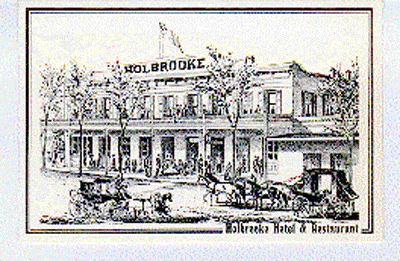
In 1879 the hotel was purchase by Ellen and Daniel Holbrooke and was given its current name. Daniel Holbrooke passed away 1884, but Ellen Holbrooke continued to manage and operate the hotel until 1908.
The CALIFORNIA ASSOCIATION OF REALTORS® (C.A.R.) recently launched a new program that allows home sellers to purchase mortgage protection coverage and offer it as an additional incentive to home buyers who purchase their home.
The “Home Payment Protection Program” (HPPP) is available through California REALTORS® who offer it to sellers at the time the property is listed. HPPP is optional, is paid for by the seller, and costs either $200 or $275, depending on the amount of coverage the seller elects to purchase.
The program covers both first-time and repeat buyers for 12 months from escrow closing. If the home buyer loses his or her job as a result of a layoff during the qualified time period, HPPP will pay the buyer up to six monthly payments of up to either $1,000 or $1,500, depending upon the level of coverage the seller chose at the time of the listing.
The payment for HPPP is made at the time of closing, per the seller’s escrow instructions. HPPP remains on the property for as long as it is listed with the REALTOR® under the original listing contract. The buyer cannot renew, extend, or enhance the coverage under the HPPP, nor purchase it independently.
Sellers who would like to offer the Home Payment Protection Program should ask for an application from their REALTOR®. REALTORS® can find information about the program and an application at www.cynosurefinancial.com/car.
They are all parts of marketing “clichés” that could skyrocket your sales.
“It takes ‘seven touches’ to turn a prospect into a client.”
“Know me, like me, trust me, buy from me.”
“The money is in the list.”
What do these sayings have in common, and what do they have to do with your business? The answer to both questions is that they’re all true, and that understanding how to make them work for you could boost your bottom line exponentially.
In my previous post about marketing (before the one about rescuing cats from trees), I talked about simple, inexpensive marketing tools. Now I’m going to expand on one of my points—the opt-in box. The opt-in box, remember, is where people enter their name and e-mail address and click “submit,” or words to that effect. This little box could literally bring in 90% of your sales; if you have one, you’re in a good position to capture the lion’s share of your market niche.
It’s what happens after they click “submit” that really matters. Using an automated messaging system, you’ll send them a series of messages called “auto responders.” This accomplishes several things.
First, it keeps you top-of-mind. If one of the people who opt in (known as your “list members”) suddenly has a need for your product or service, and you’ve been sending him or her interesting information for weeks or months, you’ll be the obvious choice over your competitors.
Second, it establishes you as an expert. You see, you’re not sending them constant sales messages—although sales messages certainly can be part of the plan. You’ll mainly be sending them useful, valuable information that they’ll feel indebted to you for—and possibly forward to friends.
Third, it’s an inoffensive way to stay in people’s faces. The automated system includes an “unsubscribe” link at the bottom of every message, so if people get tired of hearing from you, they just click and you’re gone. No angry phone calls, no returned mail, no enemies.
Autoresponders are particularly useful if your product is a one-time or occasional type of purchase or a seasonal item. People don’t buy a washing machine, a computer, or a Christmas tree, or get their windows washed or their gutters cleaned, every week. You don’t want your prospects to forget about you between that first visit and when they actually need what you offer.
The messages can be created around any of a variety of themes. They can reflect current trends or news themes; they can be based on case studies or testimonials; they can each focus on a particular product or service you offer, or announce sales or specials; they can be “seven tips for…” or “ten ways to…” types of messages.
Let me give you a first-hand example of a missed marketing opportunity by a local business owner.
I’d won a free session with a particular type of service provider. It was a new experience for me; I found it enjoyable, and my curiosity about this service was piqued. I told the service provider that I was a marketing writer, yet strangely, I never heard from her again! Apparently she didn’t have a website, so she certainly didn’t have an opt-in box or an autoresponder series. So she missed two great opportunities—to sell additional services to me (far easier and cheaper than finding new customers), and to take advantage of my ability to market her services to others.
Now, there are a few keys to making your opt-in box a success. First of all, your website has to be good enough that people will stay long enough to even notice you have an opt-in box. Second, the words on the box need to be compelling. (Hint: “submit” isn’t: no one likes to submit.) Third, offering an enticement, or “ethical bribe,” increases your opt-in rate dramatically. Enticements include a free e-book, report, white paper, informational message they can listen to or download, or free sample or consultation. How often you mail to your list depends on several factors, including the nature of your product or service.
Let me emphasize that you don’t want to try to keep your own list and send the messages manually. Yes, the automated system costs money (contact me for the name of the one that 95% of Internet marketers use); however, not only is doing it yourself a lot of work, you’ll eventually get labeled a spammer and blocked from most people’s e-mail systems.
Lisa J. Lehr is a writer and copywriter living in Grass Valley. She can help you promote your business with a full range of online and offline marketing pieces. A member of Empire Toastmasters, she’s available to speak to your business or professional group. Visit her website www.justrightcopy.com for more information, opt in for a message series, and receive a free Marketing Guide.
—
Lisa J. Lehr
I write words that make you money–just ask me how. www.justrightcopy.com
Visit my website and sign up for my fr~ee marketing tips.
New! No~cost Marketing Guide now available at my website.
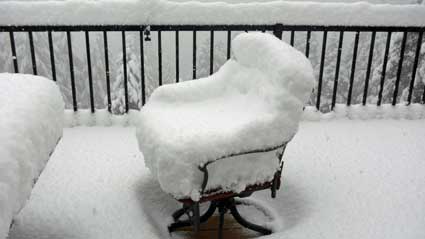
Snow storm came during the night and decided to have a seat.
Friday night, November 19 2010, it started snowing and by Saturday morning I had about six to eight inches of snow. Just as I started to go to work on my computer, the power went out. With no power, I have no heat so I figured… I’d better leave for the weekend. On the way out, there was a pretty good size tree branch in the road. I managed to drive around it but I could tell this was going to be a bad storm.
The leaves are still on the trees and the snow is very wet, resulting in trees and tree limbs coming down all over the forest.
Looking up the road away from my house Saturday morning
Checking on my house Monday, November 22, 2010, there still was no power. The road I live on loops, and I came up the first turn to my road and went up to my house. Everything was fine until I decided to continue out the other end of my road. Guess what? There is a tree lying across the road. One wire has fallen off the power pole and is lying across the road also. If you look closely at the picture I took, looking up the hill, you will notice the wire on the right hand side of the pole is not there.
Look at the right upper side of pole, wire has fallen offNotice the tree and power line across the road - Monday evening
PG & E called me on my cell last night and informed me that there would be no power until Tuesday. At this point there are about 7,000 homes without power. Tonight, I received another friendly call from PG & E and they said there would be no power until Wednesday. (my house is at 3,700 foot elevation)

 Patty and Jody Farmer were hooked when a Rancho Cordova-based company offered to help refinance their adjustable-rate mortgage, which was about to become unaffordable.